
CES 2026 LiDAR: How Hesai, RoboSense & Others Redefine Robotic Vision
How Are LiDAR Innovations at CES 2026 Changing Robotic Navigation and Perception?
Publication Date: January 8, 2026
CES 2026, LiDAR technology, Hesai Technology, RoboSense, Seyond, autonomous vehicle sensors, robotic LiDAR, robotic lawn mower, FMCW LiDAR, solid-state LiDAR
The Consumer Electronics Show 2026 (CES 2026) officially opened, highlighting breakthroughs in physical AI and embodied intelligence. While Chinese exhibitor numbers slightly adjusted, the 'hard tech' showcase reached new heights, with LiDAR technology emerging as a core bridge between digital and physical worlds.
Unlike previous years focused mainly on automotive applications, CES 2026 demonstrates LiDAR’s rapid expansion into general robotics, including autonomous mobile robots (AMRs), robotic lawn mowers, delivery vehicles, and humanoid robots. This article provides a detailed review of leading manufacturers, robotics LiDAR innovations, and emerging technologies shaping the LiDAR industry at CES 2026.
I. Domestic LiDAR Leaders: From Automotive to Robotics Applications
1. Hesai Technology: The 'Eye' of Intelligent Robots
Hesai Technology, a global LiDAR leader, demonstrated its technological superiority at CES 2026.
-
Key Products: Refreshed ATX (Fermi C500 chip) and JT Series (robotics-focused)
-
Robotics Applications: JT Series miniaturized 3D LiDAR serves as the visual core for robots due to its compact size and high precision
-
Demonstrations: V-Dragon companion robots, Dreame robotic lawn mowers, Ruishi 3D scanners
-
Market Impact: Over 200,000 JT Series units shipped in one year, with annual production capacity doubling to 4 million units in 2026, strengthening Hesai’s dominance in robotic perception
2. RoboSense & Weilanda: Digital Perception Upgrade for Consumer Robotics
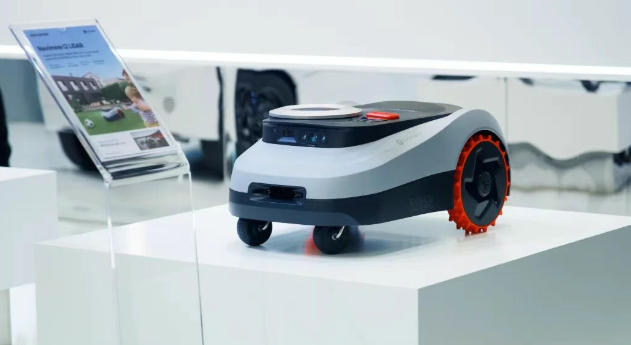
RoboSense and Weilanda introduced Navimow i2 LiDAR at CES 2026, marking deep LiDAR adoption in household robotics.
-
Technical Breakthrough: First fully solid-state digital LiDAR for consumer robots (E1R)
-
Specifications: 120°×90° FOV, 144 lines, scanning ~200,000 points/sec
-
AI Integration: Recognizes 200+ obstacle types, builds full-color Geo-Sketch™ maps
-
Advantages: Solid-state design ensures high impact resistance, solving complex garden perception challenges for robotic lawn mowers
3. Seyond: Full-Scenario Perception Matrix
Seyond continues to lead automotive LiDAR while expanding into robotics perception.
-
Flagship Products: Falcon series (automotive), Hummingbird D1 (CES 2026 Best-in-Show)
-
Robotics Application: Jiuzhi Z5 unmanned delivery vehicle, equipped with Wren W LiDAR, achieves all-weather autonomous logistics
-
Impact: Accelerates commercialization of autonomous freight and last-mile delivery robots
4. LightIC: Pocket-Sized 4D FMCW Radar
LightIC’s FR60 is the world’s smallest 4D FMCW LiDAR, enabling:
-
Real-time point cloud velocity sensing
-
Deployment in space-constrained robotic platforms (AMRs, AGVs, smart factories)
-
Cost-performance balance, ideal for flexible autonomous navigation
5. VanJee: Solid-State LiDAR for Blind-Spot Robotics
VanJee showcased:
-
WLR-750: Fully solid-state FLASH LiDAR, 128°×96° FOV, solves metal glare & reflection interference
-
WLR-722: Lightweight 16-line LiDAR for robotic dogs, two-wheeled robots, lawn mowers, emphasizing low noise, low power, and compact integration

II. International LiDAR Innovators: Cross-Industry Integration
1. Innoviz: Ultra-Thin Robotics LiDAR
InnovizThree reduces cost by 35% and weighs only 600g, offering:
-
Compact, cost-effective solution for humanoid robots, drones, and micro-robots
-
High performance in robotic perception and obstacle avoidance
2. Aeva: 4D LiDAR with Windshield Integration
Atlas Ultra 4D LiDAR uses FMCW technology to measure distance and velocity, crucial for:
-
Autonomous vehicles
-
Dynamic obstacle detection in robotics
3. Voyant Photonics & Lumos: Silicon Photonics LiDAR
-
Trend: Optical functions on chips enable miniaturization and cost reduction
-
Applications: Industrial automation, smart city infrastructure, compact robotic perception
III. Key LiDAR Trends at CES 2026
-
The Rise of Physical AI: LiDAR is now the core sensor enabling robots to perceive the real world, from lawn mowers to unmanned delivery robots.
-
Diversified Technology Roadmaps: Manufacturers explore mechanical LiDAR, FMCW, SPAD, and Silicon Photonics, improving performance and cost-efficiency, with some LiDAR directly capturing velocity information.
-
From Hardware to Ecosystem Solutions: Companies increasingly provide end-to-end LiDAR platforms, combining sensors, AI algorithms, mapping, and autonomous navigation software, e.g., Vueron VueX.
Conclusion
CES 2026 demonstrates that LiDAR is no longer just for cars. From autonomous delivery robots to household robotics, robotic perception and embodied intelligence are driving the next era of physical AI.
With solid-state, FMCW, and Silicon Photonics innovations, and integration of AI, mapping, and real-time 3D perception, LiDAR is redefining robotic navigation, obstacle avoidance, and autonomous operations, making robots smarter, safer, and more capable across industries.
OS1 32/64 /128 lines for autonomous delivery Autonomous driving 3D lidar Ouster Mid-Range High-Resolution Imaging Lidar

After-sales Support:
Our professional technical team specializing in 3D camera ranging is ready to assist you at any time. Whether you encounter any issues with your TOF camera after purchase or need clarification on TOF technology, feel free to contact us anytime. We are committed to providing high-quality technical after-sales service and user experience, ensuring your peace of mind in both shopping and using our products.




Please upload banner from store admin blog pages