905nm Laser Speed Sensor Explained: Traffic Speed Measurement Guide
How Does a 905nm Laser Speed Sensor Work in Traffic Speed Measurement Systems?
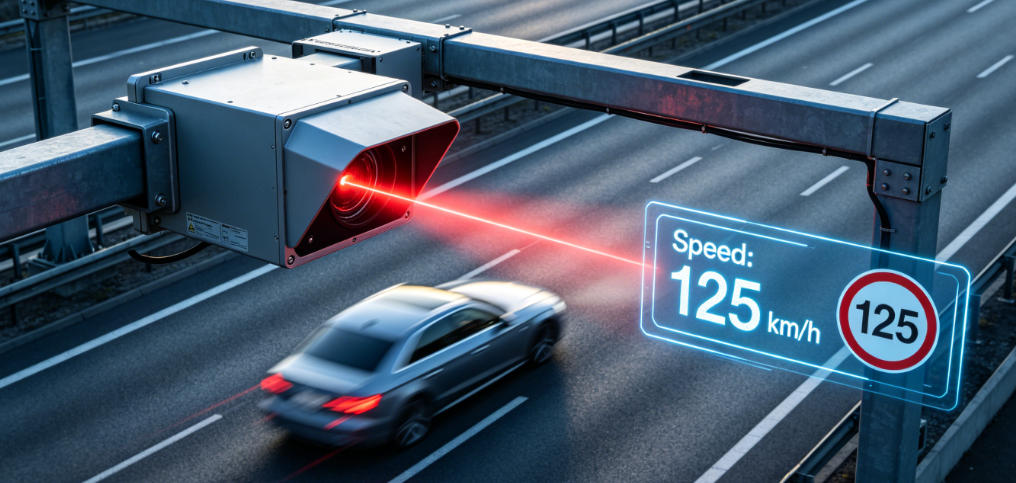
With the continuous upgrading of smart traffic systems, urban road safety management, and highway enforcement systems, the laser speed sensor has gradually become an important alternative to traditional radar and video-based speed detection technologies. Among them, systems based on 905nm laser technology are widely used in traffic monitoring and vehicle speed detection due to their balanced cost, fast response, and industrial-grade stability.
This article provides a comprehensive overview of laser speed measurement technology, including principles, system architecture, application scenarios, and future trends.
1. What is a Laser Speed Sensor?
A laser speed sensor is a high-precision, non-contact sensor used to measure the speed of moving objects. It is widely applied in traffic monitoring, industrial inspection, and intelligent automation systems.
It works by emitting a laser beam (commonly a 905nm near-infrared laser) toward a target and receiving the reflected signal. The system calculates speed by analyzing optical signal changes.
Technically, laser speed sensors rely mainly on two principles:
- Laser Doppler Effect
- Time-based / displacement measurement
When a laser hits a moving object (such as a vehicle), the frequency of the reflected light changes slightly. By analyzing this frequency shift, the system can calculate real-time speed. Alternatively, speed can be derived by tracking position changes over time.
Compared with traditional methods (radar or video analysis), laser speed sensors offer several advantages:
- Extremely high accuracy (often up to ±0.1 km/h)
- Real-time measurement with millisecond-level response
- Non-contact operation with no mechanical wear
- Strong anti-interference capability in rain, fog, or low-light conditions
In practice, these sensors are integrated into Intelligent Transportation Systems (ITS) for:
- Highway speed enforcement
- Urban traffic light speed monitoring
- Tunnel vehicle tracking
- Traffic flow analysis
They are also widely used in industrial applications such as conveyor belt speed monitoring and robotic motion feedback systems.

2. Principles of Laser Speed Measurement
Laser speed measurement is based on converting optical interactions between a laser beam and a moving object into measurable speed data. Depending on the application, there are two main approaches:
1. Laser Doppler Effect Method
When a laser beam hits a moving target, the reflected signal experiences a Doppler frequency shift, which is proportional to the target’s speed. A high-precision photodetector analyzes this shift to calculate velocity.
Typical system components include:
- Stable 905nm near-infrared laser source
- High-sensitivity optical receiver
- Digital signal processing (DSP) unit
Workflow:
- Laser emitter generates a stable beam
- Beam hits the moving target
- Reflected signal shows frequency shift
- Receiver captures signal changes
- DSP analyzes Doppler shift
- Output real-time speed
Key features:
- Extremely high accuracy (sub-km/h error range)
- Suitable for high-speed targets (e.g., highway vehicles)
- Real-time response (millisecond level)
- Strong resistance to lighting interference
This method is widely used in high-end traffic enforcement systems.
2. Time-Based Measurement Method
This method calculates speed using the basic physics formula:
v=ΔtΔx
In laser speed measurement systems, the sensor continuously tracks object position over time and computes speed from successive position changes.
Workflow:
- Continuous laser scanning
- Distance data collected at multiple time points
- Position sequence generated
- Displacement over time calculated
- Speed output produced
Key features:
- Simple structure and easy integration
- Lower cost, suitable for city deployment
- Effective for low to medium speed monitoring
- Requires signal filtering and calibration
This method is commonly used in urban traffic monitoring, parking systems, and smart road infrastructure.
3. Key Differences Between the Two Methods
Although both approaches belong to laser speed measurement, they differ fundamentally:
- Doppler method: based on physical wave frequency shift, higher accuracy
- Time-based method: based on computational modeling, easier deployment
In advanced systems, both methods may be combined into a hybrid sensing approach for improved stability.
4. Industrial and Traffic Applications
Laser speed measurement plays a critical role in modern ITS and industrial automation:
- Highway speed enforcement systems
- Urban traffic flow analysis
- Conveyor belt speed monitoring in factories
- Robotic motion feedback control
- ADAS (Advanced Driver Assistance Systems)
Compared to radar or camera-based systems, laser solutions provide superior precision, stability, and anti-interference performance.
5. Advantages of 905nm Laser Speed Sensors
1. Stable Laser Output
905nm lasers are based on mature semiconductor technology, enabling stable long-term operation.
2. Strong Environmental Adaptability
Reliable performance in rain, fog, and nighttime conditions.
3. High Response Speed
Millisecond or even microsecond-level data updates enable real-time measurement.
4. Cost Efficiency
Compared to higher-end wavelengths like 1535nm, 905nm systems provide a strong balance between cost and performance, making them suitable for large-scale deployment.

6. System Components of a Laser Speed Sensor
A typical 905nm laser speed sensor system includes:
- Laser emitter module
- Optical receiver module
- Signal processing unit
- Speed calculation algorithm module
- Communication interface (RS485 / UART / Ethernet)
Industrial systems often support RS485 for integration into traffic monitoring networks.
7. Applications in Traffic Systems
1. Highway Speed Enforcement
Real-time vehicle speed detection and violation enforcement.
2. Urban Road Monitoring
Speed detection at intersections, red-light enforcement, and traffic flow analysis.
3. Tunnel and Bridge Monitoring
Stable measurement in enclosed or structurally complex environments.
4. Intelligent Transportation Systems (ITS)
Integration with AI cameras and radar for multi-sensor fusion.
5. Parking and Low-Speed Zones
Vehicle movement detection and safety control.
8. Laser Speed Sensor vs Traditional Technologies
| Technology | Accuracy | Response Speed | Anti-Interference | Applications |
|---|---|---|---|---|
| Radar | High | High | Medium | Highway enforcement |
| Video | Medium | Medium | Low | Urban monitoring |
| Ultrasonic | Low | Low | Low | Simple detection |
| Laser speed sensor | Very high | Very high | High | Smart traffic systems |
9. Future Trends of Laser Speed Measurement
1. AI + Laser Fusion
Combining computer vision and laser sensing for improved multi-object detection.
2. Multi-Lane Detection
Enabling tracking across multiple traffic lanes simultaneously.
3. Higher Precision Systems
Achieving accuracy levels of ±0.1 km/h or better.
4. Cloud-Based Traffic Management
Real-time data upload to cloud traffic platforms.
5. Miniaturized Sensors
Smaller embedded devices for edge computing and smart infrastructure.
IHawk Structured Light Camera 072 1.5M

10. Conclusion
The laser speed sensor has become a core component of modern intelligent transportation systems.
Based on 905nm laser technology, these systems offer an optimal balance of performance, cost, and stability, making them one of the most widely adopted solutions for traffic speed measurement.
With the advancement of AI and smart city infrastructure, laser speed measurement technology will continue to play a critical role in traffic enforcement, road safety, and urban management, driving the evolution of next-generation intelligent transportation systems.





Please upload banner from store admin blog pages
Please select collection from store admin blog pages