Laser Wavelength Comparison: 905nm vs 1535nm vs 532nm Guide
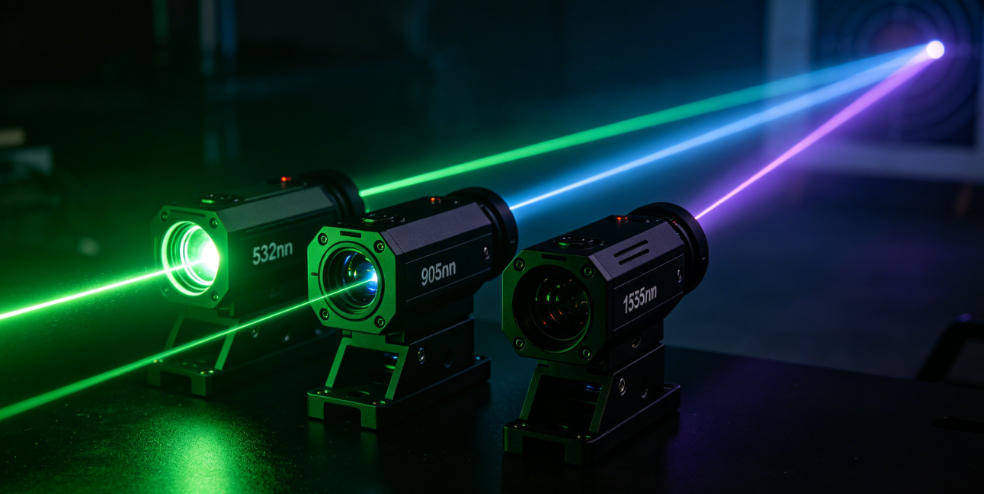
What is the difference between 905nm, 1535nm, and 532nm laser wavelengths, and which one should you choose for a laser distance module or sensor?
In laser distance measurement, LiDAR systems, and industrial sensing applications, laser wavelength is one of the most critical parameters that determines system performance, safety, and application scenarios. Different wavelengths such as 905nm, 1535nm, and 532nm vary significantly in measurement range, eye safety level, environmental adaptability, and cost. Therefore, when selecting a laser distance module or a measurement laser sensor, wavelength selection is a key design consideration.
This article provides a systematic comparison of the three mainstream laser wavelengths and focuses on the performance and application boundaries of 532nm wavelength distance in industrial and scientific use cases.
1. What is laser wavelength?
laser wavelength refers to the spatial period of a laser wave as it propagates through space, defined as the distance between two consecutive wave peaks. It is typically measured in nanometers (nm), such as 905nm, 1535nm, or 532nm.
From a physics perspective, laser wavelength is part of the electromagnetic spectrum. Different wavelengths carry different energy characteristics and interact differently with air, materials, water mist, and even the human eye.
In laser measurement systems, wavelength is a fundamental parameter because it directly affects system performance. In devices such as a laser distance module or measurement laser sensor, wavelength differences can significantly influence measurement range, accuracy, and signal stability.
Generally:
- Shorter wavelengths (e.g., 532nm) offer better beam focus and smaller spot size, making them suitable for high-precision measurement.
- Mid-range wavelengths (e.g., 905nm) balance performance and cost and are widely used in industrial and automotive systems.
- Longer wavelengths (e.g., 1535nm) provide better eye safety and longer measurement range, making them ideal for long-distance applications.
In practical use, laser wavelength affects several key performance factors:
- Distance range: atmospheric attenuation varies by wavelength
- Accuracy: beam quality affects return signal precision
- Penetration ability: performance in fog, smoke, or haze
- Environmental resistance: sensitivity to sunlight and background light
- Eye safety class: longer wavelengths generally allow higher safety levels
Therefore, when selecting a high precision laser distance sensor, wavelength is as important as range, accuracy, and cost.

2. 905nm laser wavelength: mainstream industrial and automotive standard
905nm is currently the most widely used wavelength in laser ranging systems, especially in ToF (Time-of-Flight) sensors and cost-effective LiDAR systems.
Features:
- Low cost and mature mass production
- Suitable for short-to-medium range measurement
- High refresh rate (kHz-level possible)
- Compatible with CMOS/Si detectors
Advantages:
- Widely used in automotive LiDAR systems
- Common in AGV/AMR navigation
- Used in industrial automation sensors
Limitations:
- Lower eye safety margin
- Moderate performance under strong sunlight
- Limited long-distance capability
👉 Typical applications:
- laser distance module
- Obstacle avoidance systems
- Automotive driver assistance systems
3. 1535nm laser wavelength: long-range and eye-safe solution
1535nm is a high-end wavelength used for long-distance and high-safety applications.
Features:
- High eye safety level (easier to achieve Class 1)
- Ultra-long measurement range (kilometer-level possible)
- Less sensitive to sunlight interference
- Supports high-power laser output
Advantages:
- Preferred for long range laser sensor systems
- Ideal for military and surveying applications
- Stable performance in outdoor environments
Limitations:
- Higher cost
- More complex system design
- Expensive InGaAs detectors
👉 Typical applications:
- Terrain mapping
- Military rangefinding systems
- Long-distance industrial monitoring

4. 532nm laser wavelength: visible high-precision measurement solution (key focus)
532nm wavelength distance refers to the measurement capability of green visible laser light generated through frequency doubling technology. It is widely used in high-precision measurement and scientific applications.
Features:
- Visible green laser beam
- Excellent beam quality
- Small spot size and strong focusing ability
- High resolution suitable for precision measurement
Core advantages of 532nm wavelength distance:
In practical ranging applications, 532nm wavelength distance demonstrates the following characteristics:
- Higher target recognition accuracy
- Stronger reflected signal quality
- Extremely high precision in short-range measurement
- Excellent performance on complex surfaces (reflective or rough materials)
Limitations:
- Strong atmospheric scattering (especially in fog or haze)
- Higher power consumption
- Not suitable for ultra-long-distance measurement
- Higher cost compared to 905nm systems
Applications:
- Precision industrial inspection
- Laboratory laser ranging systems
- 3D scanning and modeling
- High-precision displacement measurement
- Optical experiments and scientific research
👉 Typical keywords:
- high precision laser distance sensor
- measurement laser sensor
- laser alignment system
5. Comparison of three laser wavelengths
| Wavelength | Range | Accuracy | Cost | Applications |
|---|---|---|---|---|
| 905nm | Medium | High | Low | Automotive LiDAR / industrial sensing |
| 1535nm | Ultra-long | Medium–High | High | Military / surveying |
| 532nm | Short-range high precision | Very high | Medium–High | Precision measurement / lab systems |
6. How to choose laser distance module wavelength?
When selecting a laser distance module or measurement laser sensor, the choice depends on the application scenario:
1. Industrial automation / AGV / AMR
👉 Recommended: 905nm
- Low cost
- Fast response
- Easy integration
2. Long-distance monitoring / outdoor surveying
👉 Recommended: 1535nm
- Ultra-long range
- High reliability
- Strong sunlight resistance
3. Precision measurement / scientific research
👉 Recommended: 532nm wavelength distance
- Extremely high accuracy
- Visible beam alignment
- High stability
7. Trends in laser wavelength technology
Future laser wavelength development will focus on:
- Higher eye-safe laser systems
- Multi-wavelength fusion LiDAR
- AI-enhanced sensing algorithms
- Smaller laser distance module designs
- Higher precision measurement laser sensor systems
AllSENSOR 20M Outdoor Fully Solid-State LiDAR S150

8. Conclusion
Different laser wavelengths define the core capability of measurement systems:
- 905nm: mainstream industrial and automotive solution
- 1535nm: long-range and high-safety professional solution
- 532nm wavelength distance: high-precision scientific and industrial measurement solution
When selecting a high precision laser distance sensor, factors such as range, accuracy, cost, and environment must all be considered rather than relying on a single parameter.
With the development of smart manufacturing and laser technology, multi-wavelength fusion systems are becoming the core direction of next-generation LiDAR and industrial sensing systems.





Please upload banner from store admin blog pages
Please select collection from store admin blog pages