Red vs Green Laser Sensor: Key Differences & Selection Guide
How Do I Choose Between a Red Laser and a Green Laser Sensor for My Application?
With the growing demand for industrial automation, smart detection, and precision measurement, laser sensors are increasingly used in manufacturing, robotics, logistics, and traffic monitoring. Among the most common options are red laser sensors and green laser sensors. Many users often wonder: 'diferencia entre laser rojo y verde (the difference between red and green lasers)'. This article provides a comprehensive comparison and selection guide to help you make the best choice based on performance, application scenarios, and cost.
What Is the Difference Between Red and Green Lasers?
1. Basic Differences Between Red and Green Laser Sensors
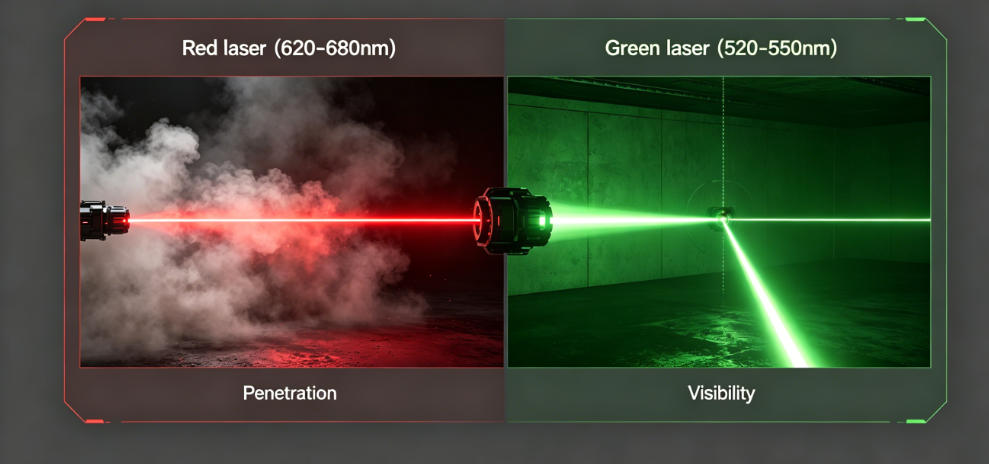
Laser sensors are mainly divided by wavelength into red lasers (620–680nm) and green lasers (520–550nm). The choice of wavelength affects sensor visibility, measurement accuracy, environmental adaptability, and cost. Understanding the diferencia entre laser rojo y verde is crucial in industrial automation, robotics, logistics detection, and precision measurement. Below, we analyze visibility, accuracy, environmental adaptability, and cost-effectiveness.
1. Visibility and Environmental Adaptability
-
Red Laser
Red lasers have a longer wavelength and are less visible to the human eye than green lasers. Their visibility under bright light or outdoor sunlight is moderate, but they have stronger penetration, allowing them to pass through dust, smoke, and light fog. This makes red lasers highly reliable in industrial production lines, robotic handling, or dusty warehouse environments. Additionally, red lasers perform well when detecting transparent materials such as glass or plastic, as they are less affected by light scattering. -
Green Laser
Green lasers have shorter wavelengths and are more easily perceived by the human eye, offering higher visibility, especially in indoor, laboratory, or brightly lit environments. This makes green lasers ideal for visual inspections, teaching demonstrations, laboratory calibration, and high-precision visual positioning. For applications requiring multi-point marking, laser projection, or demonstration operations, green lasers provide clear reference points, reducing operational errors.

2. Accuracy and Measurement Stability
-
Red Laser
Red lasers offer excellent measurement stability in industrial environments, with strong resistance to dust, smoke, and ambient light interference. They are suitable for high-speed production line inspection, conveyor belt monitoring, and robotic motion tracking, typically achieving sub-millimeter positioning accuracy to minimize long-term measurement errors. -
Green Laser
Green lasers are more intuitive for long-distance measurement and visual target tracking, ideal for remote positioning, automatic calibration, and high-precision scanning. Their high visibility allows operators to quickly adjust the laser position, reducing calibration time and human error. In precision distance measurement or optical alignment systems, green lasers improve overall efficiency and safety.
3. Cost and Value
-
Red Laser Sensors
Red lasers are more cost-effective, with mature technology, making them suitable for large-scale industrial applications and bulk purchases. Their high value-to-cost ratio makes them a preferred solution for production lines, robotic handling, and warehouse sorting. -
Green Laser Sensors
Green lasers are slightly more expensive but offer significant advantages in high-visibility applications, such as educational demonstrations, laboratory precision measurement, projection alignment, and field calibration. For systems requiring multi-point visualization and high-precision adjustments, investing in green lasers delivers higher long-term value.
4. Practical Selection Advice
- For industrial environments with dust or smoke: choose red lasers.
- For high-precision positioning, visualization, or educational/lab use: choose green lasers.
- For cost-sensitive, large-scale deployments: red lasers offer better value.
- For intuitive operation and high visibility: green lasers are more suitable.
By understanding the diferencia entre laser rojo y verde, organizations can select the optimal laser sensor for their environment, measurement distance, precision requirements, and budget, improving efficiency, accuracy, and usability.
2. Core Comparison Table of Red vs Green Lasers
| Feature | Red Laser | Green Laser |
|---|---|---|
| Wavelength | 620–680nm | 520–550nm |
| Visibility | Moderate | High, very visible |
| Cost | Low | Higher |
| Environmental Adaptability | Strong, penetrates dust/smoke | Best in bright indoor light |
| Applications | Industrial automation, robotic inspection, conveyor monitoring | Educational demonstrations, visual measurement, marking & positioning |
| Accuracy | High | High, more intuitive for long-distance observation |
Red lasers are best suited for stable industrial measurements, while green lasers are ideal for applications that require high visibility.

3. How to Choose the Right Laser Sensor
When selecting a red or green laser sensor, consider the working environment, measurement needs, ease of operation, and budget:
-
Working Environment
- Red lasers are ideal for dusty, smoky, or complex factory environments due to strong penetration and stable measurements.
- Green lasers are better for bright indoor labs or demonstration setups, providing clear visibility and easy adjustment.
-
Target Visibility
- Green lasers reduce human error and increase efficiency for visual measurement or multi-point calibration.
- Red lasers offer higher stability in challenging industrial conditions.
-
Budget
- Red lasers are cost-effective for large-scale production lines or warehouses.
- Green lasers are more expensive but provide better visibility and efficiency in labs or teaching environments.
-
Measurement Distance and Accuracy
- Green lasers are advantageous for long-distance and high-precision measurements.
- Red lasers excel in short-range industrial measurements with high stability and penetration.
By balancing these factors, organizations can determine the diferencia entre laser rojo y verde and select the laser sensor that best fits their project.
4. Application Cases of Red and Green Lasers
-
Industrial Automation
- Red lasers are widely used for conveyor monitoring, component positioning, robotic detection, and part measurement.
- They maintain high-precision stability even in dusty or high-speed production environments.
-
Logistics and Packaging
- Red lasers enable fast object positioning, barcode scanning, and package sorting, improving efficiency and reducing errors.
- They perform reliably in various lighting and warehouse conditions.
-
Education and Demonstrations
- Green lasers are ideal for classroom demonstrations, training, or lab experiments.
- Their high visibility allows students and operators to easily see beam paths for guidance and adjustments.
-
Precision Measurement and Positioning
- Green lasers excel in long-distance positioning, projection calibration, and high-precision measurements.
- They reduce manual adjustment errors and improve operational efficiency.
-
Robotics and Automation Equipment
- Red lasers are used for robotic path tracking and pick-and-place positioning in industrial environments.
- Green lasers provide visual guidance for service robots, assembly demonstrations, and educational robotics.
-
Construction and Surveying
- Green lasers are widely applied in construction surveying, laser alignment, and leveling tasks.
- Their clear visibility ensures accuracy even in bright sunlight, supporting precise field measurements.
These application cases help organizations understand the diferencia entre laser rojo y verde and select the right laser sensor to achieve higher efficiency, accuracy, and reliability.
IHawk Structured Light Camera 072 1.5M

5. Conclusion
Choosing between red and green laser sensors requires considering application environment, visibility, measurement precision, and budget:
- Red Laser: Ideal for industrial applications with strong penetration and high cost-effectiveness.
- Green Laser: Ideal for visual measurements in education, demonstrations, and high-precision long-distance applications.
By understanding the key differences in the diferencia entre laser rojo y verde, you can quickly select the laser sensor that best fits your project, improving measurement efficiency and operational experience.





Please upload banner from store admin blog pages
Please select collection from store admin blog pages