
ToF Depth Sensing for Safe and Accurate High-Speed Mobile Robots
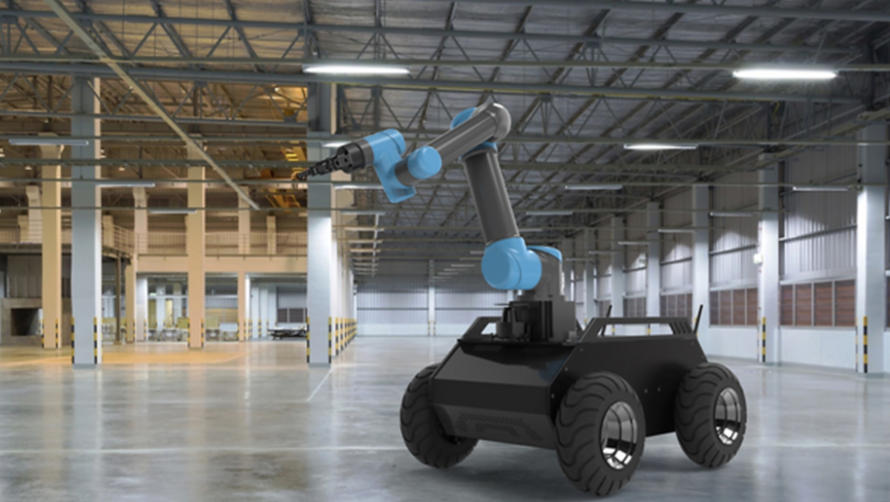
How Can ToF Depth Sensing Make High-Speed Mobile Robots Safer and Smarter?
— Empowering Next-Generation Autonomous Navigation and Intelligent Perception
With the rapid evolution of mobile robotics, robots are transitioning from low-speed, structured environments to high-speed autonomous operation in complex indoor and outdoor scenarios. This transformation dramatically increases requirements for real-time perception, high-precision localization, dynamic path planning, obstacle avoidance, and functional safety control.
Among various perception technologies, TOF (Time-of-Flight) depth sensing has emerged as a core enabling technology for high-speed mobile robots. By delivering low-latency, high-accuracy 3D spatial data, ToF depth cameras provide a robust perception foundation for intelligent navigation, environmental understanding, and safe human–robot interaction across diverse application domains.
What Is Time-of-Flight (ToF) Depth Sensing?
Time-of-Flight (ToF) is an active 3D depth measurement technology that determines distance by emitting modulated light and measuring the time required for the light to reflect back from an object.
Unlike passive vision systems, ToF depth cameras generate true per-pixel depth information in a single frame, producing dense real-time depth maps and point clouds. Because ToF sensing does not rely on ambient lighting or surface texture, it delivers stable depth perception in low-light, high-contrast, and texture-poor environments.
High-search keywords integrated:
ToF depth camera, 3D depth sensing, real-time depth perception, active depth technology, robotic vision sensor
Today, ToF technology is widely deployed in:
-
Autonomous mobile robots (AMRs)
-
Service and logistics robots
-
Autonomous driving and ADAS
-
Embodied intelligence systems
-
Human–machine interaction (HMI)
-
Industrial and outdoor robotics

1. High-Precision Localization and Navigation
How ToF Enhances SLAM and Multi-Sensor Fusion
For high-speed autonomous navigation, accurate localization is non-negotiable. By integrating ToF depth cameras with SLAM algorithms, robots gain reliable spatial awareness even in dynamic and challenging environments.
Visual SLAM and LiDAR SLAM Integration
ToF depth cameras generate high-resolution depth maps and dense point clouds that significantly enhance visual SLAM and LiDAR SLAM performance. When fused with RGB cameras and LiDAR:
-
Robots maintain localization accuracy in low-texture or low-light environments
-
Mapping robustness improves in indoor warehouses, factories, and underground spaces
-
Real-time 3D reconstruction supports fast path planning and re-localization
Long-tail keywords:
ToF SLAM, 3D SLAM with depth camera, indoor robot localization, warehouse robot navigation
GNSS and RTK-GPS for Outdoor High-Speed Robots
In outdoor applications, combining ToF depth data with GNSS and RTK-GPS enables centimeter-level positioning accuracy, even at high speeds. This hybrid approach ensures reliable navigation in:
-
Construction sites
-
Agricultural fields
-
Urban delivery routes
-
Large-scale inspection environments
IMU Fusion for High-Dynamic Motion
High-speed robots experience vibration, acceleration, and gyroscope drift. Fusing IMU data with ToF depth sensing enables real-time motion correction, improving:
-
Pose estimation accuracy
-
Stability on slopes and uneven terrain
-
Safety during rapid acceleration or deceleration
Multi-Sensor Redundancy and Reliability
By combining ToF, LiDAR, RGB-D, IMU, and GNSS, robots achieve perception redundancy. Even if one sensor degrades due to lighting, dust, or weather, others maintain operational continuity—critical for industrial-grade autonomous robots.
2. Efficient Path Planning and Intelligent Decision-Making
High-speed robots must react instantly to environmental changes. ToF-based depth perception provides the spatial foundation for intelligent decision-making:
-
Dynamic path planning: Real-time obstacle updates enable adaptive routing using A*, Dijkstra, and sampling-based algorithms
-
AI-powered optimization: Deep learning models analyze ToF depth data to evaluate free space, risk zones, and optimal trajectories
-
Multi-robot coordination: Shared depth-based maps support collaborative planning and task allocation
SEO keywords:
robot path planning, dynamic navigation algorithms, AI decision-making for robots

3. Dynamic Obstacle Avoidance and Functional Safety
Safety is paramount for robots operating at high speed or near humans.
Real-Time Obstacle Detection
ToF depth maps provide millisecond-level 3D perception, enabling robots to detect:
-
Pedestrians
-
Vehicles
-
Machinery
-
Unexpected obstacles
When combined with AI-based object recognition, robots dynamically adjust speed and trajectory.
Sensor Fusion for Safety Assurance
Fusing ToF with LiDAR, ultrasonic sensors, and radar improves detection reliability in crowded or fast-changing environments.
Collision Prevention and Safety Zones
-
Continuous ToF monitoring supports emergency braking
-
Virtual safety zones dynamically adapt to robot speed and payload
-
Ensures compliance with industrial safety standards
4. Real-Time Data Processing and High-Speed Communication
High-speed robots generate massive sensor data streams.
-
Edge computing: Local processing of ToF point clouds minimizes latency
-
5G and industrial wireless networks: Enable real-time data exchange with control centers and cloud platforms
-
Collaborative robotics: Multiple robots share spatial data to execute complex missions efficiently
Keywords:
edge computing robotics, real-time robot perception, 5G autonomous robots

5. All-Terrain Adaptability for Outdoor Mobile Robots
Outdoor robots face sand, mud, snow, wet ground, and rocky terrain. ToF depth sensing enables real-time terrain understanding, supporting adaptive motion strategies.
Intelligent Drive Systems
Using ToF-derived terrain data, robots dynamically adjust:
-
Torque distribution
-
Wheel speed
-
Traction control
Adaptive Suspension and Chassis Control
ToF scans detect height differences and slopes, allowing suspension systems to adjust damping and ride height—maintaining stability at speed.
Tire and Track Optimization
Depth-based terrain modeling enables intelligent adjustment of contact area and traction, improving obstacle crossing and energy efficiency.
Real-Time Terrain-Aware Path Planning
Robots detect depressions, obstacles, and slopes in advance, reducing rollover risk and improving mission success rates.
Application keywords:
agricultural robots, outdoor inspection robots, autonomous delivery robots, all-terrain mobile robots
6. Advanced Environmental Perception and Multimodal Intelligence
ToF as the 3D Cognitive Core of Robots
Modern robots require multimodal perception systems. In such architectures, ToF depth cameras act as the central hub for near- and mid-range 3D perception, working alongside:
-
LiDAR for long-range scanning
-
RGB cameras for texture and semantics
-
Radar and ultrasonic sensors for adverse weather robustness
From Geometry to Semantic Understanding
Using ToF-based 3D data, robots move beyond object detection to semantic scene understanding:
-
Distinguishing humans, vehicles, shelves, and vegetation
-
Identifying traversable, movable, or hazardous areas
-
Understanding functional zones such as walkways and restricted areas
This spatial-semantic fusion enables human-like reasoning in real-world environments.
All-Weather, All-Light Operation
As an active sensing technology, ToF maintains performance in:
-
Nighttime or low-light conditions
-
Strong backlighting
-
Fog, rain, and snow (with radar fusion)
Point Cloud Processing: From Perception to Action
ToF depth cameras generate dense point clouds that support:
-
Real-time 3D mapping and reconstruction
-
Dynamic obstacle tracking and trajectory prediction
-
Occupancy grid generation and safe path planning
This forms a closed-loop pipeline from perception → understanding → decision → action.
Conclusion
As mobile robots expand into high-speed, complex, and human-centric environments, ToF depth sensing has become a foundational technology. It delivers accurate, real-time 3D perception that powers:
-
High-precision localization and SLAM
-
Dynamic path planning and obstacle avoidance
-
Functional safety and human–robot collaboration
-
All-terrain adaptability and outdoor autonomy
-
Semantic environmental understanding
When combined with multi-sensor fusion, point cloud processing, and AI algorithms, ToF depth sensing is transforming robots from task executors into truly autonomous intelligent agents—driving safer, faster, and more efficient operations across industrial automation, smart logistics, service robotics, autonomous driving, and outdoor inspection.
SLAMTEC RPLIDAR S3 40M LiDAR Sensor for Robot Navigation & Avoidance

After-sales Support:
Our professional technical team specializing in 3D camera ranging is ready to assist you at any time. Whether you encounter any issues with your TOF camera after purchase or need clarification on TOF technology, feel free to contact us anytime. We are committed to providing high-quality technical after-sales service and user experience, ensuring your peace of mind in both shopping and using our products.




Please upload banner from store admin blog pages