What Is a ToF Sensor? How Time of Flight Technology Works

What Is a ToF Sensor and How Does It Measure Distance for 3D Vision?
With the rapid development of artificial intelligence, robotics, autonomous systems, and smart manufacturing, ToF Sensor (Time of Flight Sensor) technology has become an important solution for modern 3D vision and depth sensing applications. From smartphone facial recognition and consumer electronics to industrial robots, AGV, AMR, and automated warehouse systems, Time of Flight Sensor technology is helping machines achieve more accurate spatial perception and intelligent decision-making.
So, what is a ToF sensor and how does it work? A ToF Sensor is an optical measurement device that calculates distance by measuring the time required for light to travel from the sensor to an object and return to the receiver. Since the speed of light is constant, the system can calculate the distance between the sensor and the target based on the measured flight time.
Unlike traditional 2D cameras that only capture color and brightness information, a ToF sensor can directly obtain depth data. This allows machines to understand not only the appearance of an object but also its distance, position, and three-dimensional structure. As a result, ToF technology has become widely used in robot vision, industrial automation, smart logistics, autonomous navigation, and AI-powered 3D vision systems.
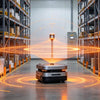
The basic principle of Time of Flight measurement is simple. The sensor emits infrared light toward a target object. When the light reaches the surface, part of the optical signal is reflected back to the receiver. The system then calculates the round-trip travel time of the light and converts this information into distance data.
The basic calculation formula is:
Distance = (Speed of Light × Time of Flight) / 2
The division by two is necessary because the light travels a complete round trip, moving from the transmitter to the object and then returning to the receiver.
Although the principle of ToF distance measurement is straightforward, achieving high performance in real-world applications requires advanced hardware design and software optimization. Factors such as target reflectivity, ambient light interference, temperature variation, optical alignment, and multipath reflection can influence measurement results.
Therefore, ToF sensor accuracy depends on more than just the sensor chip. A reliable high precision ToF sensor requires optimized optical components, sensitive receivers, accurate timing circuits, and advanced calibration algorithms to ensure stable performance under different conditions.
How Does a Time of Flight Sensor Measure Distance?
A typical Time of Flight Sensor consists of several key components, including an infrared light source, optical lens, receiver module, timing circuit, processor, and signal-processing algorithm.
During operation, the infrared emitter sends modulated light toward an object. After the light reflects from the target surface, the receiver captures the returning signal. The sensor then analyzes the difference between the transmitted and received signals to calculate the distance.
Modern ToF measurement systems often use VCSEL infrared lasers, advanced photodetectors, and digital processing technologies to improve measurement speed and accuracy. These technologies allow sensors to provide fast and reliable depth information for applications that require real-time perception.
However, real-world measurement environments are much more complex than laboratory conditions. Several factors can affect the performance of a ToF distance sensor:
-
Target surface reflectivity
-
Ambient infrared light interference
-
Sensor installation angle
-
Operating temperature
-
Optical noise
-
Multipath interference
For example, a white surface usually reflects more infrared light, making it easier for the receiver to collect enough signal. Dark, transparent, or highly reflective objects may create challenges because the returned signal can become weaker or distorted.
This is why industrial applications often require industrial ToF sensors with stronger environmental adaptability. In factories, warehouses, and outdoor environments, sensors must maintain stable performance despite changing lighting conditions and different object materials.

What Is a 3D ToF Camera and How Does It Work?
A 3D ToF Camera is an advanced form of ToF technology that uses a pixel array to capture multiple distance measurements simultaneously. Instead of measuring only one point, a ToF camera can generate a complete depth image containing spatial information across a wide field of view.
Each pixel in a 3D ToF camera represents the distance between the camera and the corresponding point in the environment. After processing, these measurements can create:
-
Depth Map
-
Point Cloud
-
3D coordinates
-
Infrared image data
A Depth Map shows the distance information of objects in the scene, while a Point Cloud converts this information into three-dimensional coordinates that can be analyzed by robots and AI systems.
Compared with traditional RGB cameras, a ToF Camera has the advantage of directly measuring depth. A normal camera can recognize the color and shape of an object, but it cannot accurately determine the distance without additional algorithms or sensors.
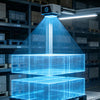
For example, in a warehouse environment, an RGB camera may identify a package visually, but a 3D ToF Camera can also determine:
-
How far the package is from the robot
-
The package height and dimensions
-
The exact position for robotic picking
This makes ToF cameras for robotics increasingly important in applications such as automated picking, obstacle avoidance, robot navigation, and intelligent inspection.
What Is the Difference Between a ToF Sensor and a ToF Camera?
Although ToF Sensor and ToF Camera are closely related, they are designed for different applications.
A standard ToF sensor usually focuses on single-point or short-range distance measurement. It is commonly used for:
-
Object detection
-
Distance monitoring
-
Presence detection
-
Industrial positioning
A ToF Camera, however, contains thousands or millions of sensing pixels and can capture complete three-dimensional information.
In simple terms:
A ToF Sensor measures distance.
A 3D ToF Camera creates a three-dimensional view of the environment.
Because of this difference, ToF cameras are widely used in advanced machine vision systems, where robots need to understand the position and structure of objects before performing tasks.
In smart manufacturing, for example, a robot equipped with a ToF camera for robotics can detect components on a production line, calculate their position, and adjust movement automatically.
In AGV and AMR navigation, a 3D depth camera can help autonomous mobile robots identify obstacles, measure distances, and improve navigation accuracy.
Why Is ToF Technology Important for Modern 3D Vision?
Traditional vision systems mainly depend on image information, but modern automation requires machines to understand the physical world in three dimensions.
This is where 3D vision technology becomes important.
A machine equipped with a ToF depth camera can obtain spatial information that traditional cameras cannot provide. This allows intelligent systems to perform tasks such as:
-
Object recognition
-
Human detection
-
Robot guidance
-
Volume measurement
-
Safety monitoring
-
Automated inspection
With the combination of AI vision and ToF technology, depth data can be analyzed in real time. Artificial intelligence algorithms can recognize objects, classify scenes, and make decisions based on three-dimensional information.
This combination of AI-powered 3D vision, edge computing, and depth sensing technology is accelerating the development of intelligent factories, autonomous robots, and next-generation automation systems.
What Is the Difference Between iToF and dToF Technology?
When researching ToF Sensor technology, many users compare iToF vs dToF because these two methods represent the main approaches used in modern Time of Flight sensors.
Although both technologies use the principle of measuring light travel time, their methods are different.
iToF (Indirect Time of Flight) calculates distance by analyzing the phase difference between emitted and reflected light signals. The sensor continuously emits modulated infrared light and measures the phase shift that occurs when the signal returns from the target.
Because iToF can capture multiple pixels simultaneously, it is widely used in 3D ToF Cameras, smartphones, consumer devices, and indoor robotic applications.
The advantages of iToF technology include:
- High-resolution depth imaging
- Fast frame rates
- Compact sensor design
- Lower system complexity
- Suitable for real-time depth sensing
Common applications of iToF cameras include:
- Facial recognition
- Gesture recognition
- AR/VR devices
- Indoor robots
- Smart home systems
- Industrial vision applications
On the other hand, dToF (Direct Time of Flight) directly measures the arrival time of individual photons. Instead of calculating phase differences, it records the exact time required for photons to travel from the transmitter to the target and back.
Because of its direct measurement method, dToF sensors are often used in applications requiring longer range and higher timing precision.
Typical applications include:
- Long-range distance measurement
- LiDAR systems
- Autonomous vehicles
- Outdoor sensing
- Advanced robotics
When selecting between iToF and dToF, engineers need to consider application requirements such as measurement range, resolution, accuracy, cost, power consumption, and environmental conditions.
There is no single technology suitable for every scenario. A short-range indoor robot may benefit from an iToF 3D camera, while a long-range autonomous sensing system may require dToF or LiDAR-based solutions.
How Accurate Is a ToF Sensor?
One of the most common questions about this technology is: how accurate is a ToF sensor?
The answer depends on many factors, including sensor design, measurement distance, target material, lighting conditions, and calibration quality.
A high-quality ToF sensor accuracy specification usually includes several performance indicators:
- Measurement accuracy
- Repeatability
- Resolution
- Noise level
- Response time
- Environmental stability
For example, a sensor may provide millimeter-level precision under controlled laboratory conditions, but the actual performance may change when used outdoors under strong sunlight or when measuring dark objects.
This is why professional industrial ToF sensors require advanced compensation technologies.
Common methods used to improve ToF measurement accuracy include:
- Temperature compensation
- Optical calibration
- Noise filtering
- Signal optimization
- Multi-frame processing
- AI-based correction algorithms
In industrial automation, accuracy alone is not enough. A robot working on a production line requires consistent measurements over thousands of repeated operations. Therefore, repeatability and long-term stability are equally important.
For example, an AMR robot navigating inside a warehouse may need to detect the same obstacle multiple times during operation. If the distance measurement changes significantly between readings, navigation performance may be affected.

What Is the Future of AI-Powered ToF Sensor Technology?
The future development of ToF Sensor technology is closely connected with artificial intelligence, edge computing, and advanced 3D vision systems. As robots, autonomous machines, and smart manufacturing equipment require more accurate environmental understanding, AI-powered ToF sensors are becoming an important technology for real-time spatial perception.
Traditional ToF cameras mainly provide depth information, such as distance values, Depth Maps, and Point Clouds. However, with the integration of AI algorithms, modern 3D ToF Cameras can do much more than simple distance measurement. AI can analyze depth data, recognize objects, understand scenes, and make intelligent decisions in real time.
The combination of AI vision and ToF technology enables machines to perform advanced tasks such as:
-
Real-time object recognition
-
Human pose detection
-
Intelligent obstacle avoidance
-
3D object tracking
-
Automated inspection
-
Spatial understanding
For example, in a smart factory, an AI-powered 3D vision system equipped with a ToF sensor can identify different components on a production line, measure their position, and guide robots to complete precise operations.
Edge AI is also becoming an important trend in ToF sensor applications. Instead of sending all depth data to a remote server, embedded processors can analyze information directly on the device. This reduces latency, improves privacy, and allows robots and industrial equipment to respond faster.
Future high precision ToF sensors are expected to achieve improvements in:
-
Higher depth resolution
-
Longer measurement range
-
Better performance under strong ambient light
-
Lower power consumption
-
Smaller sensor size
-
More intelligent data processing
As semiconductor technology continues to advance, ToF depth cameras will become easier to integrate into robots, autonomous devices, and industrial systems.
How Will ToF Sensors Transform Robotics and Smart Manufacturing?
The growth of robotics and smart manufacturing is creating increasing demand for reliable 3D perception technologies. Robots need accurate information about their surroundings to move safely, identify objects, and complete complex tasks.
Compared with traditional vision systems, ToF sensors for robotics provide direct depth measurement, allowing machines to understand the three-dimensional environment more effectively.
In industrial robotics, 3D ToF Cameras can support applications including:
-
Robotic picking
-
Object positioning
-
Automated assembly
-
Machine tending
-
Quality inspection
-
Safety monitoring
For example, a robotic arm equipped with a ToF camera for robotics can detect the exact position and distance of a component before picking it up. This improves accuracy and reduces errors in automated production processes.
In warehouse automation, AGV and AMR robots rely on advanced sensing technologies to navigate complex environments. A ToF sensor can help autonomous robots detect obstacles, identify humans, and maintain safe operating distances.
The combination of ToF technology, AI vision, and robotics software is also improving applications such as:
-
Smart logistics
-
Automated inventory management
-
3D warehouse scanning
-
Autonomous mobile robots
-
Intelligent transportation systems
In the future, robots will require not only the ability to see but also the ability to understand. By providing accurate depth information, ToF sensors serve as an important perception layer that helps machines interact with the physical world.
Why Will ToF Sensors Become More Important in 3D Vision Systems?
Modern automation is moving from simple machine operation toward intelligent decision-making. This transformation requires sensors that can provide reliable and detailed environmental information.
A traditional RGB camera can capture visual appearance, but it cannot directly measure distance. A ToF depth camera solves this limitation by providing real-time three-dimensional data.
This makes ToF sensors valuable in applications where accurate spatial information is essential, including:
-
Industrial automation
-
Autonomous robots
-
Smart factories
-
Healthcare devices
-
Consumer electronics
-
AI-powered machines
Through the combination of ToF sensor technology, machine vision, and artificial intelligence, future systems will achieve higher levels of automation and intelligence.
From factory robots that accurately handle components to autonomous machines that navigate complex environments, depth perception will continue to be a key foundation for intelligent systems.
Conclusion: Why Are ToF Sensors Important for the Future of Intelligent Machines?
From basic distance measurement to advanced 3D vision applications, ToF Sensor technology has evolved into an important sensing solution for modern intelligent systems.
By using the Time of Flight principle, a ToF sensor can accurately measure distance and generate depth information that helps machines understand the surrounding environment. Compared with traditional cameras, 3D ToF Cameras provide additional spatial information through Depth Maps and Point Clouds, making them highly suitable for robotics, automation, and smart manufacturing.
With continuous improvements in AI vision, semiconductor technology, and sensor fusion, future ToF sensors will deliver higher accuracy, faster processing, and stronger environmental adaptability.
Whether used in AGV and AMR navigation, industrial robots, automated inspection systems, smart warehouses, or consumer devices, ToF technology will continue to play an important role in enabling real-time 3D perception.
As industries move toward greater automation and intelligence, reliable depth sensing will become a fundamental capability for machines. The combination of AI and ToF sensors will help create smarter robots, more efficient factories, and more advanced intelligent systems in the future.
IHaw Structured Light Camera P050 0.50M



Please upload banner from store admin blog pages