What Is a Time-of-Flight Sensor? How ToF Technology Works
How Does a ToF 3D Sensor Improve Robot Vision and Industrial Automation?
Modern robots, smartphones, drones, autonomous machines, smart home devices, AR/VR systems, and industrial equipment need more than a conventional image to understand their surroundings. They also need accurate information about distance, position, and depth. While an RGB camera captures color and 2D visual information, a time of flight sensor measures how far an object is from the sensor and converts that information into depth data.
So, what is a time of flight sensor and how does it work? Time-of-Flight, commonly called ToF, is a depth-sensing technology that determines distance by measuring the time required for emitted light to travel to an object and return to the receiver. Because ToF directly measures distance using light, it can provide spatial information that is difficult to obtain from a conventional 2D camera alone.
Today, time of flight technology is used in applications ranging from smartphone autofocus and gesture recognition to robot navigation, 3D vision, autonomous systems, industrial measurement, and human-machine interaction. Modern time-of-flight sensors have also evolved from simple single-point distance sensors into multi-zone and 3D imaging systems.
STMicroelectronics' FlightSense technology is one example of this development, covering direct ToF, multi-zone sensing, and 3D ToF solutions while also supporting indirect Time-of-Flight approaches for different depth-sensing requirements.
What Is a Time of Flight Sensor?
If you search for what is time of flight sensor or what is a time of flight sensor, the basic definition is straightforward: it is a sensor that measures distance by determining how long light takes to travel between the sensor and a target.
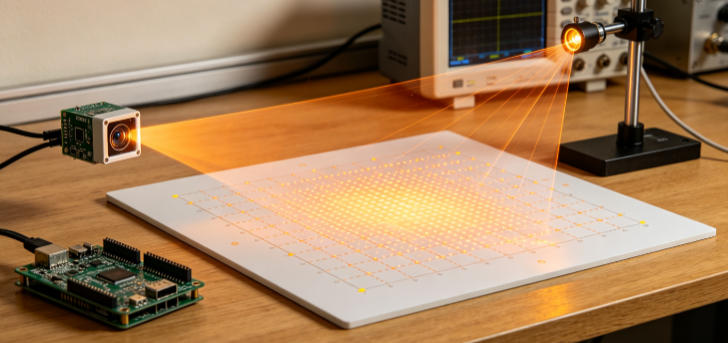
A typical tof sensor consists of a light emitter, optical components, a receiver, and signal-processing electronics. The sensor sends infrared light toward a target. When the light reaches the target surface, a portion of the optical signal is reflected back toward the receiver. The system then analyzes the measured flight time or phase information to determine the distance.
For a direct measurement, the basic relationship can be represented as:
Distance = Speed of Light × Time of Flight / 2
The factor of two is important because the emitted light travels from the sensor to the target and then travels back to the receiver.
This principle explains why time-of-flight technology is fundamentally a depth-sensing method rather than simply another type of camera. By converting the behavior of reflected light into distance information, ToF allows electronic systems to understand the three-dimensional position of objects.
For applications that require reliable object detection, proximity sensing, depth measurement, or spatial awareness, a ToF sensor can therefore provide information that complements conventional RGB vision.

How Does ToF Technology Work?
The operating principle behind tof technology is based on the propagation of light. Instead of estimating depth from visual cues such as shadows, perspective, texture, or binocular parallax, ToF systems actively emit light and measure information from the reflected signal.
Depending on how the distance information is obtained, ToF systems are commonly divided into Direct ToF (dToF) and Indirect ToF (iToF).
What Is a dToF Sensor?
A dtof sensor, or Direct Time-of-Flight Sensor, determines distance by measuring the actual time between light emission and the detection of the returning optical signal.
In a dToF system, a short optical pulse is emitted toward a target. The receiver detects the reflected photons, and the electronics calculate the time interval between transmission and reception. Since the speed of light is known, the measured time can be converted into distance.
One important development in direct ToF sensing is the use of SPAD, or Single-Photon Avalanche Diode, technology. SPAD-based receivers can detect individual photons with high sensitivity, which makes them useful for applications requiring fast and precise distance detection.
A dtof solution can therefore be useful for proximity detection, obstacle avoidance, robotics, ranging, and other applications where fast distance measurement is important.
For example, a mobile robot may use dToF to determine whether an obstacle is approaching. An industrial machine can use it to detect the position of a component, while a smart device can use compact ToF ranging for automatic interaction or object detection.
What Is an Indirect Time of Flight Sensor?
An indirect time of flight sensor uses a different measurement approach. Rather than directly measuring the flight time of individual photons, iToF systems generally determine distance from the phase relationship between the emitted and reflected modulated light.
This approach is especially useful when a system needs to generate a large amount of depth information at the same time. Multiple pixels can measure different areas of a scene, allowing the system to produce a depth image rather than a single distance value.
This makes iToF particularly relevant to tof image sensor, 3D vision, depth cameras, robotics, AR/VR, and human-machine interaction.
When the output contains depth information for many pixels or zones, the technology becomes part of a broader tof 3d sensing system capable of representing the shape and position of objects in three-dimensional space.
What Is a ToF Camera and How Is It Different From a Conventional Camera?
A tof camera combines ToF distance measurement with an imaging architecture to capture depth information across a scene. A conventional RGB camera mainly records color and brightness, whereas a time-of-flight camera can provide both visual information and distance data.
Consider a robot approaching a cardboard box. An RGB camera may identify the box based on its color, edges, and shape. However, a single 2D image does not directly reveal the exact distance between the robot and the box. A ToF camera can provide depth information for the same scene, allowing the robot to determine where the object is located in three-dimensional space.
This capability makes time of flight cameras useful in robot vision, object detection, autonomous navigation, 3D modeling, gesture recognition, and industrial automation.
A modern tof camera sensor or time of flight camera sensor generally combines an infrared emitter, ToF receiver, optics, processing electronics, and software. Depending on the product architecture, the output may be a single distance measurement, several distance zones, or a complete depth map.
How Does a ToF Camera Module Provide 3D Depth Sensing?
For many developers, using a complete tof camera module is more practical than designing a depth-sensing system around a bare sensor.
A typical ToF camera module may integrate:
-
Infrared emitter
-
ToF receiver
-
Optical filter and lens system
-
Driver electronics
-
Processing circuitry
-
Communication interface
-
Depth-processing software
Together, these components allow the module to transform reflected infrared light into usable depth information.
This is one reason 3d tof technology is becoming increasingly important in compact machine vision systems. Unlike a conventional scanning LiDAR architecture, a multi-zone or array-based ToF camera can measure multiple regions simultaneously and generate depth information within a relatively small form factor.
Depending on the application, the resulting data can be used for object detection, collision avoidance, robotic grasping, people detection, dimension measurement, and spatial mapping.
Why Are ToF 3D Sensors Useful for Smart Devices?
As smartphones, tablets, wearable devices, and smart home products become smaller and more intelligent, manufacturers need sensing technologies that combine compact size, low power consumption, fast response, and reliable depth measurement.
A tof 3d sensor can provide distance and depth information without requiring a large mechanical scanning system. This makes ToF attractive for smartphones, consumer electronics, smart appliances, human-machine interfaces, and other embedded products.
Depth information can support features such as autofocus, gesture recognition, presence detection, background separation, object measurement, and spatial interaction.
For example, a smartphone equipped with a ToF system can use depth information to improve focusing performance or distinguish nearby objects from the background. In a smart home, a ToF sensor can detect whether a person is present without necessarily relying on a conventional RGB video stream.
This combination of compact hardware and spatial information is one reason tof sensors continue to attract interest in consumer electronics and industrial applications.
What Is the Difference Between a ToF Image Sensor and an RGB Camera Sensor?
A conventional camera sensor primarily captures RGB or grayscale intensity, while a tof image sensor is designed to determine the distance between the sensor and objects in the scene.
Imagine photographing a person standing in front of a similarly colored wall. An RGB camera can identify differences in color, brightness, and texture, but separating the person from the background may require additional computer vision algorithms.
A ToF sensor adds another dimension: depth.
When RGB images are combined with depth data, the result is commonly called an RGB-D system. This combination can improve spatial understanding for applications such as:
-
3D human detection
-
Gesture and pose recognition
-
People counting
-
Robotic grasping
-
Object positioning
-
AR/VR applications
-
Smart home automation
-
Industrial inspection
For this reason, camera tof solutions are increasingly used to bridge the gap between conventional 2D imaging and three-dimensional machine perception.
What Is FlightSense and How Does It Relate to ToF?
flightsense is a family of ToF sensing technologies developed by STMicroelectronics. Its portfolio includes solutions designed for different ranging and depth-sensing applications, including direct ToF, single-zone sensing, multi-zone measurement, and 3D ToF.
The development of these technologies demonstrates how ToF has expanded beyond simple proximity detection. Modern ToF systems can support applications such as object detection, autofocus, gesture recognition, people detection, robotics, SLAM, and industrial automation.
In a robotic system, for example, ToF can provide close-range depth information that complements other sensors. In consumer electronics, it can provide compact distance measurement for interaction and imaging features.
As a result, the modern time of flight sensor can be considered an important component of spatial perception systems rather than simply a basic distance sensor.
What Is the Difference Between ToF and Ultrasonic Sensors?
Developers sometimes search for ultrasonic sensor time of flight because ultrasonic sensors also calculate distance using propagation time. However, the two technologies use fundamentally different types of waves.
Ultrasonic sensors transmit and receive sound waves, while optical ToF sensors transmit and detect light, usually infrared light.
Because the physical properties of sound and light are different, their sensing characteristics also differ. Ultrasonic sensors can be useful for relatively simple distance and proximity measurements, while optical ToF can provide fast measurements and, depending on the architecture, multi-zone or pixel-level depth information.
For compact robotics, smart devices, industrial automation, and applications requiring richer spatial information, ToF can provide an important alternative or complement to ultrasonic sensing.
The appropriate choice ultimately depends on factors such as sensing range, accuracy requirements, target characteristics, environmental conditions, cost, power consumption, and the amount of spatial information required.

What Is the Relationship Between a Time of Flight Camera and LiDAR?
A time of flight laser scanner and a ToF camera can both rely on the fundamental time-of-flight principle, but they are not necessarily the same type of sensing system.
LiDAR generally uses laser pulses or laser beams to measure distances and build information about the surrounding environment. Depending on the system, LiDAR may scan individual points, lines, or a wider field of view.
A ToF camera, by comparison, is typically designed to acquire depth information across multiple zones or pixels at the same time.
This difference makes the two technologies useful in different but sometimes complementary applications. In robotics, for example, LiDAR can support longer-range environmental mapping and navigation, while a ToF camera can provide close-range depth information for obstacle detection, object recognition, and robotic grasping.
A time of flight laser distance sensor can also be integrated into industrial equipment where accurate ranging or object detection is required.
For autonomous robots and AMR/AGV systems, combining ToF with LiDAR, RGB cameras, IMU sensors, and other perception technologies can create a more comprehensive sensor-fusion architecture.
What Factors Should You Consider When Choosing a ToF Sensor?
Choosing a tof sensor involves more than comparing the maximum measurement range. Engineers should consider the complete sensing environment and system requirements.
Important specifications may include:
Measurement range: Determines how close or far the sensor can reliably detect targets.
Accuracy and precision: Accuracy describes how close a measurement is to the actual distance, while precision describes the consistency of repeated measurements.
Field of view: A wider field of view can cover more of a scene, while a narrower field can provide more focused detection.
Resolution and zone count: A single-zone sensor provides basic distance information, while multi-zone or 3D ToF systems can provide richer spatial data.
Frame rate: Higher frame rates are useful for moving robots, people, and dynamic environments.
Power consumption: Particularly important for battery-powered robots, smartphones, and wearable devices.
Ambient-light performance: Outdoor and high-infrared environments may require careful sensor selection and optical filtering.
Interface and integration: Developers should consider communication protocols, SDK support, software compatibility, and mechanical integration.
These factors determine whether a particular tof camera sensor, dToF module, iToF system, or 3D depth camera is appropriate for a specific application.
Where Is Time-of-Flight Technology Heading?
The development of tof sensors is moving toward higher spatial resolution, better environmental performance, smaller modules, lower power consumption, and more intelligent depth processing.
The evolution from single-point ranging to multi-zone measurement and eventually to full 3d time of flight camera systems reflects a broader change in machine perception. Devices are no longer simply measuring whether an object is nearby; they are increasingly using depth information to understand the shape, position, movement, and spatial relationship of objects.
In robotics, ToF can support obstacle avoidance, object manipulation, and navigation. In industrial automation, it can assist positioning, inspection, and measurement. In smartphones and smart home products, it can enable autofocus, presence detection, gesture recognition, and spatial interaction.
So, when someone asks what is time of flight sensing, the answer extends far beyond a simple distance formula. ToF is a complete depth-sensing approach that combines optical emission, light detection, signal processing, calibration, and 3D spatial data.
As AI vision, robotics, autonomous systems, and smart automation continue to develop, ToF technology will play an increasingly important role in connecting traditional 2D imaging with three-dimensional machine perception. By providing fast and compact depth information, ToF sensors can help machines understand not only what they see, but also where objects are and how far away they are.
IHawk Structured Light Camera P100E 8M





Please upload banner from store admin blog pages