
What Is TOF Camera? Depth Module Explained for Robotics & AI Vision
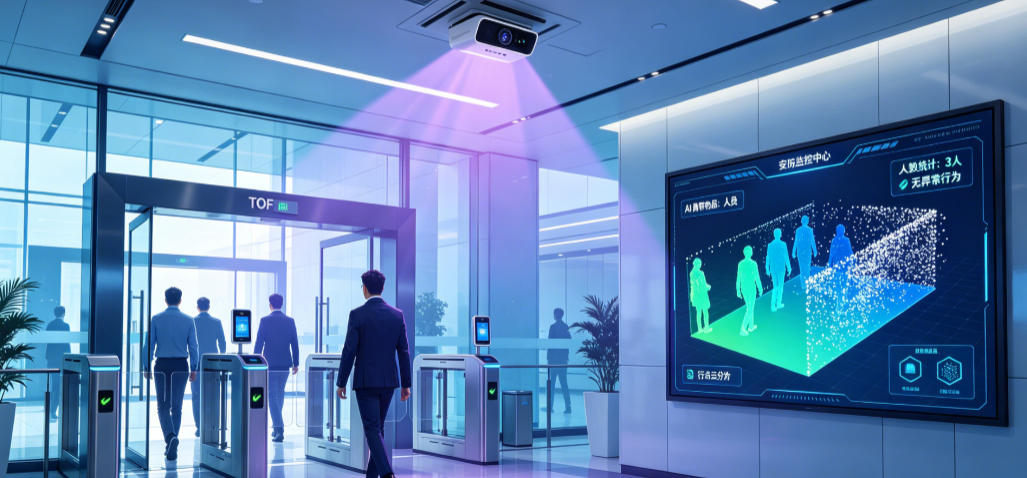
How Do TOF Cameras and Depth Camera Modules Enable 3D Vision and Spatial Understanding?
TOF Camera Product Overview
A TOF Camera (Time-of-Flight Camera) is a 3D depth vision sensor based on the principle of light time-of-flight measurement, designed to capture real-time distance information and spatial structure data of objects.
This type of TOF Camera emits modulated infrared light and receives reflected signals to calculate the round-trip travel time of photons, generating a high-precision depth map (Depth Map). Compared with traditional 2D cameras, it can directly output 3D spatial information, making it a core component of modern machine vision systems.
With the rapid development of artificial intelligence, robotics, and industrial automation, TOF Camera and depth camera module technologies are becoming key solutions in intelligent perception systems, widely used in robot navigation, industrial inspection, AR/VR, security monitoring, and smart devices.
What Is a TOF Camera?
A TOF Camera (Time-of-Flight Camera) is a 3D depth sensing device based on Time-of-Flight technology. It measures the time difference between emitted infrared light pulses (or modulated light signals) and their return after reflecting from a target object, thereby calculating precise distance and generating high-resolution depth information.
This technology relies on the constant speed of light, converting time differences into distance measurements, enabling fast, stable, and highly accurate spatial sensing.
Compared with traditional RGB cameras, the capabilities of a TOF Camera go beyond simply 'seeing images' — it can actually 'understand space':
- RGB Camera: only provides color, brightness, and texture information
- TOF Camera: provides RGB information + depth information + spatial structure data
Therefore, TOF Cameras can directly perceive object distances, spatial contours, and full 3D scene geometry, offering significantly stronger environmental understanding in complex scenarios.

Core Capabilities of TOF Cameras
- Real-time depth sensing
- 3D scene reconstruction
- Distance measurement
- Object segmentation
- Dynamic environment understanding
Why Is TOF Camera Important?
Because it directly outputs depth data, the TOF Camera has become a key “spatial perception interface” for modern intelligent systems and is widely used in:
- Robot navigation and obstacle avoidance (AMR/AGV)
- Industrial automation and inspection systems
- AR/VR and spatial computing devices
- Smart security and human detection
- UAV and autonomous flight systems
A TOF Camera is not just an imaging device — it is a depth perception sensor that enables machines to 'understand the 3D world.'
Working Principle
The core workflow of a TOF Camera is as follows:
- Infrared light source emits modulated optical signals
- Light illuminates the target object surface
- Reflected light returns to the sensor
- System calculates Time-of-Flight (ToF)
- Converts signals into distance and depth data
- Generates real-time 3D depth map (Depth Map)
Through this process, TOF Cameras can output:
- Depth data
- Distance measurements
- 3D spatial mapping
- Object contour information
TOF Camera vs Traditional RGB Camera
In intelligent vision systems, TOF Cameras and RGB cameras differ fundamentally in imaging principles, data output, and application capabilities.
1. Depth Sensing Capability
- RGB Camera: captures only 2D image information such as color, brightness, and texture
- TOF Camera: provides both RGB data and depth information, outputting per-pixel distance values
This allows TOF Cameras to not only 'see the image' but also 'understand spatial structure,' which is essential for robotics, 3D modeling, and automation systems.
2. Environmental Adaptability
- RGB Camera depends heavily on ambient light and performs poorly in low-light or overexposed environments
- TOF Camera uses active infrared illumination and can operate stably in darkness or low-light conditions
It also performs reliably in:
- Dark or no-light environments
- Rapid indoor/outdoor transitions
- Light dust or haze conditions
This makes TOF Cameras more reliable in industrial and outdoor robotics applications.
3. AI Spatial Understanding
TOF Cameras provide structured spatial data to AI systems, enabling higher-level perception capabilities.
They directly output:
- Depth information: real-world distance per pixel
- 3D spatial mapping: full scene reconstruction
- Object segmentation: foreground/background separation
- Human pose & motion analysis support
Thus, TOF Cameras act not just as vision inputs but as spatial understanding engines for AI.
Application Value Summary
Because of their depth sensing capability and environmental robustness, TOF Cameras are widely used in:
- Intelligent robotics and AMR/AGV navigation systems
- Industrial automation and quality inspection
- AR/VR spatial computing and interaction systems
- Smart security and human recognition systems
- UAV and autonomous flight control systems
Compared with TOF systems, traditional RGB cameras are mainly used for basic image capture and simple visual recognition tasks.
What Is a Depth Camera Module?
A depth camera module is an integrated 3D vision sensing component, typically based on TOF or structured light technology, used for real-time depth measurement and spatial modeling.
It is a miniaturized version of a TOF Camera system and can be directly embedded into devices to provide efficient 3D perception capability.
Key Features:
- Highly integrated design (sensor + processing unit)
- Real-time depth map output
- Low power consumption
- Easy integration into robots and smart devices
- AI vision system compatibility
Key Advantages of TOF Camera
1. High-Precision 3D Depth Sensing
TOF Cameras can achieve millimeter-level depth accuracy, suitable for demanding industrial applications:
- Industrial inspection and measurement
- Robot positioning
- Automation line control
- Precision dimension detection
2. Strong Environmental Adaptability
TOF Cameras operate reliably in complex environments:
- Strong ambient light
- Low-light or dark environments
- Indoor/outdoor mixed conditions
- Dust and haze environments (industrial-grade models)
3. Real-Time High-Speed Output
- High-frame-rate depth map generation
- Low-latency response
- Dynamic target tracking support
- Suitable for real-time control systems
4. AI-Friendly Architecture
TOF Cameras integrate well with AI algorithms for:
- Human detection and segmentation
- Gesture recognition
- Behavior analysis
- 3D scene reconstruction

TOF Camera Applications
With the development of AI vision and robotics technologies, TOF Camera and depth camera module technologies are playing an increasingly important role across multiple industries.
Robotics and Automation Systems
TOF Camera is a core vision sensor in robotics:
- AMR/AGV autonomous navigation
- Obstacle detection and avoidance
- SLAM mapping and localization
- Dynamic object recognition
Industrial Automation & Smart Manufacturing
Widely used in Industry 4.0 systems:
- Product dimension measurement
- Defect detection
- Automated sorting systems
- Robotic arm guidance
Smart Security Systems
Used in modern surveillance systems:
- People detection and counting
- Intrusion detection
- Zone occupancy analysis
- Intelligent alarm systems
AR/VR and Spatial Computing
TOF Camera is a key sensor in spatial computing:
- Space modeling
- Gesture interaction
- VR positioning
- Mixed reality interaction
TOF Camera Market Trends (2026)
Trend 1: AI Vision Integration Accelerates
TOF Camera + AI Vision becomes mainstream:
- Improved recognition capabilities
- Multi-sensor fusion trends
- Increased edge computing deployment
Trend 2: Robotics Market Growth
- Rapid growth of AMR/AGV systems
- Expansion of service robots
- Industrial robot upgrades
Trend 3: Consumer Electronics Upgrade
- Rising AR/VR demand
- Enhanced smartphone 3D sensing
- Spatial interaction becomes standard
Trend 4: Modularization Trend
depth camera module is becoming an industry standard:
- Miniaturization
- Integration
- Plug-and-play design
TOF Camera vs Depth Camera Module
| Item | TOF Camera | Depth Camera Module |
|---|---|---|
| Structure | Complete system | Modular component |
| Integration | Medium | High |
| Applications | Industrial/robotics | Embedded devices |
| Flexibility | Moderate | Higher |
Slamtec RPLIDAR A2 A3 S1 S2 S3 Lidar Front-End Ports Ethernet Adapter

Conclusion
TOF Camera has become a core technology in modern 3D vision systems. With the development of robotics, AI vision, industrial automation, and AR/VR, its application scope continues to expand.
At the same time, the rapid adoption of the depth camera module is making 3D vision sensing more lightweight and easier to integrate, providing stronger spatial perception capabilities for next-generation intelligent devices.





Please upload banner from store admin blog pages
Please select collection from store admin blog pages