
360° LiDAR: Enhance Low-Speed Robot Navigation & Obstacle Avoidance
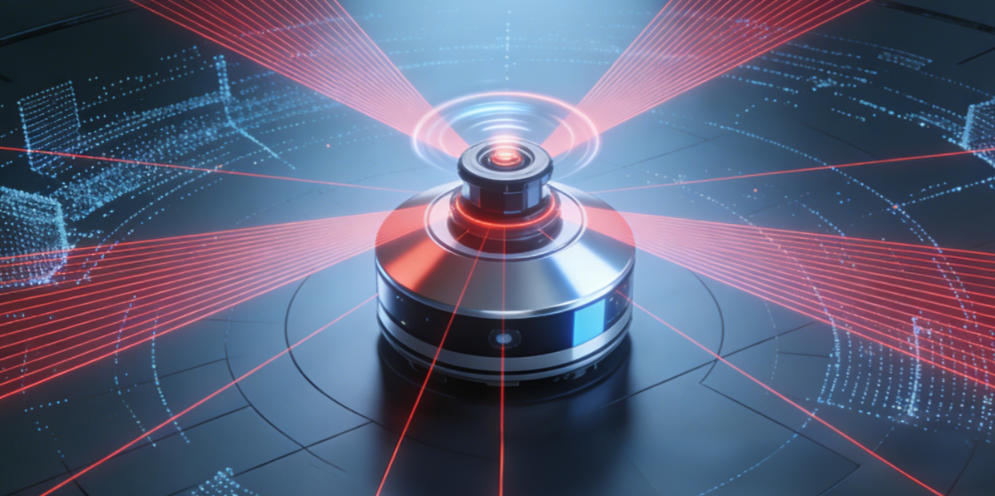
What is 360° LiDAR, and how does it help low-speed robots navigate and avoid obstacles?
In the fields of robot navigation, autonomous driving assistance, warehouse logistics, and intelligent service robots, 360 lidar (360° LiDAR) has become a key sensor technology. With its full-range environmental perception capabilities, 360° LiDAR is transforming how mobile robots understand their surroundings, providing more comprehensive and precise data for navigation, obstacle avoidance, localization, and 3D mapping.
This article explores 360° LiDAR sensors in depth, covering their principles, advantages, technical features, and application scenarios, helping you understand why 360 lidar is leading the next generation of intelligent robot perception.
What is 360 LiDAR?
360 lidar (360° LiDAR) is a type of LiDAR sensor with full horizontal field-of-view coverage, capable of real-time, full-direction 3D scanning of the environment. Unlike traditional limited-view LiDARs, 360° LiDAR continuously captures high-density point cloud data of the surroundings, allowing robots to have comprehensive spatial awareness regardless of orientation or movement. Whether navigating narrow indoor corridors, complex obstacle environments, or open yards and warehouse spaces, 360° LiDAR provides robots with unobstructed, all-around environmental information.
Next-generation 360° LiDAR typically uses rotating mirror designs, hybrid solid-state solutions, or multi-beam solid-state architectures to extend the horizontal field-of-view to a full 360°, while covering multiple vertical angles. This enables robots to detect not only front, back, and sides but also obstacles above and below, achieving true three-dimensional spatial perception.
Additionally, 360 lidar full-view sensing offers:
- High-precision point cloud output: Generates dense, detailed 3D point clouds, aiding precise localization, map construction, and obstacle detection.
- Real-time environment modeling: Supports dynamic scene perception and moving object tracking, allowing robots to respond to people, pets, or moving obstacles.
- Enhanced obstacle avoidance: Full-view scanning enables early detection of potential hazards and automatic path adjustment, improving navigation safety.
- Stable navigation performance: Regardless of lighting changes, spatial complexity, or terrain variations, 360° LiDAR provides reliable environmental data, ensuring smooth low-speed robot operation.
In short, 360 lidar is not only a core technology for autonomous navigation, intelligent obstacle avoidance, and 3D mapping but also a key enabler for upgrading low-speed robots, service robots, and automated inspection systems. It allows robots to “see” their surroundings, achieving full-view perception and high-precision autonomous operation.

Key Advantages of 360 LiDAR
1. Full-View Coverage (360° FOV)
The standout feature of 360° LiDAR is its complete horizontal field-of-view coverage. Unlike traditional LiDARs with limited scanning angles, 360 lidar achieves true full-view perception, enabling robots to acquire comprehensive environmental data without rotation or posture adjustment. This full coverage is particularly important for low-speed robots, service robots, and warehouse navigation robots:
- Zero blind spot scanning: Ensures robots detect all potential obstacles in complex environments.
- Improved safety: Reduces collisions and minimizes downtime or damage risks.
- Enhanced perception efficiency: Full-view scanning covers front, back, sides, and even vertical angles, reducing path-planning time.
For robots operating in narrow corridors, curved hallways, multi-obstacle zones, or dynamic environments, full-view perception is critical for efficient autonomous navigation.
2. Supports Real-Time SLAM and Autonomous Localization
By combining 360° full-view scanning with high-density point cloud data, 360 lidar enables mobile robots to perform real-time SLAM (Simultaneous Localization and Mapping):
- Dynamic mapping: Continuously updates 3D maps of the surroundings while moving, adapting to environmental changes.
- Accurate localization: High-density point clouds allow real-time position correction, maintaining precise navigation even in complex terrain or obstructed areas.
- Optimized path planning: Provides reliable environmental data so robots can select optimal routes and minimize repeated or missed coverage.
- Intelligent obstacle avoidance: Real-time point cloud data enables prediction of potential hazards and dynamic rerouting.
This makes 360 lidar not just a perception tool but a core sensor for autonomous decision-making and intelligent navigation in low-speed robots.
3. Eliminates Perception Blind Spots
Limited-view sensors often have blind spots, causing delayed reactions or collisions in complex environments. 360° LiDAR eliminates this problem with full-ring scanning:
- Full panoramic coverage: Detects obstacles in front, back, and sides instantly.
- Indoor and outdoor applicability: Maintains high-precision perception in dense indoor environments or multi-obstacle outdoor spaces.
- Enhanced navigation robustness: Quickly adapts to dynamic or occluded obstacles, improving safety and efficiency.
With full-view perception, real-time SLAM, and intelligent algorithms, 360 lidar provides low-speed robots with an environment understanding comparable to autonomous vehicles, ensuring reliable operation in complex scenarios.
360 LiDAR Technical Features
Wide Field-of-View and High-Density Point Clouds
Mainstream 360° LiDAR modules provide:
- 360° horizontal field-of-view: Robots perceive all directions simultaneously without rotation.
- Vertical coverage of multiple angles: Detects obstacles above and below, enabling true 3D perception.
- High-density point cloud output: Generates continuous, detailed 3D point clouds for map building, path planning, obstacle detection, and moving object tracking.
This design allows 360 lidar to capture environmental details in real time, accurately detecting obstacles, complex terrain, and dynamic targets in indoor corridors, industrial workshops, outdoor yards, or warehouse logistics areas, ensuring safe navigation and optimized paths.
Close-Range Detection and Obstacle Avoidance
360 lidar supports precise detection of near-range obstacles (centimeter-level accuracy) as well as distant objects, meeting the needs of low-speed service robots, inspection robots, and indoor delivery robots:
- Furniture, corners, and steps detection: Prevents collisions in indoor environments.
- Real-time dynamic obstacle avoidance: Handles moving targets such as people, pets, or other robots.
- Safety navigation assurance: Path planning algorithms allow proactive route adjustment to reduce collision risk.
This close-range capability enables 360° LiDAR to operate effectively in both open and dense, complex indoor spaces, providing full-time, all-scenario safe navigation.
Compact, Lightweight, and Easy to Integrate
Modern 360 lidar sensors are small and lightweight, suitable for integration into various low-speed robot platforms, including:
- Service robots: Smart reception, delivery, cleaning robots
- Warehouse logistics robots: Automated transport and sorting robots
- Inspection robots: Industrial inspection and security patrol robots
Compact design reduces space requirements, providing flexible integration and facilitating multi-sensor fusion with cameras, IMUs, or ultrasonic sensors to create advanced perception systems.
Additionally, small size and lightweight design mean 360 lidar consumes less power, is easy to install, supports rapid deployment, and can be scaled for mass production, ensuring robots operate efficiently and stably in multiple scenarios.

360 LiDAR Application Scenarios
Mobile Robots and Autonomous Navigation
360° LiDAR is widely used in mobile robots and autonomous navigation, offering full-view perception and high-precision obstacle avoidance for efficient automated operation:
- Service robots: Reception, indoor delivery, and cleaning robots navigate malls, offices, hotels, or hospitals, avoiding people, furniture, and temporary obstacles.
- Automated forklifts and warehouse AGVs: Provide precise path planning, dynamic obstacle avoidance, and cargo identification in factories and warehouses.
- Inspection and security patrol robots: Conduct 24/7 surveillance, detect obstacles, identify abnormal targets, and monitor safety in industrial plants, campuses, or public spaces.
Full-view point cloud scanning and real-time environment modeling enable autonomous navigation in complex environments, supporting unmanned operation and task automation.
Industrial Automation and 3D Mapping
In industrial automation, 360° LiDAR high-density point clouds enable 3D mapping, spatial scanning, and process optimization:
- Warehouse management: Rapidly scans shelves, aisles, and storage areas for precise robot navigation.
- Factory layout optimization: Builds 3D models for path planning and logistics process improvement.
- Safety monitoring and environment detection: Tracks moving machinery and temporary obstacles to reduce collision risks.
This high-precision 3D mapping allows robots to navigate autonomously while reconstructing environments and optimizing tasks for efficient production and warehouse management.
Low-Speed Autonomous Driving and Assistance Systems
Although primarily used in low-speed robots, 360° LiDAR is also suitable for low-speed autonomous driving and driver assistance systems:
- Environmental perception: Detects surrounding obstacles, pedestrians, cyclists, and other vehicles.
- Collision prevention: Provides braking or steering assistance based on real-time full-view data.
- Adaptation to complex scenarios: Maintains precise navigation and safety in narrow streets, parking lots, or slow traffic conditions.
Combined with AI algorithms and path planning, low-speed autonomous vehicles can leverage 360° LiDAR for reliable perception and intelligent assistance, enhancing safety and user experience.
360 LiDAR vs Traditional LiDAR
| Feature | Traditional LiDAR | 360° LiDAR |
|---|---|---|
| Horizontal FOV | Limited angle | Full 360° coverage |
| Point cloud density & scene detail | Sparse or medium | High-density, detailed environment perception |
| Integration complexity | Higher | Easier with full-view sensing |
| Navigation & SLAM support | Limited data | Supports full-view SLAM and obstacle avoidance |
How to Choose the Right 360° LiDAR
When selecting 360 lidar, consider:
- Point cloud density: For detailed mapping and obstacle detection
- Detection range: Match the robot’s operational environment
- Field-of-view coverage: Ensure true full-view perception
- Size and weight: Easy integration into target platform
- Algorithm compatibility: Supports SLAM, obstacle avoidance, and path planning
Conclusion
As a core technology for low-speed robot navigation and intelligent perception, 360 lidar combines full-view scanning, high-density point clouds, and easy integration, making it essential for autonomous navigation, intelligent obstacle avoidance, and precise 3D mapping.
Whether for indoor service robots, warehouse robots, or low-speed autonomous driving assistance systems, 360° LiDAR significantly enhances intelligence and reliability.
In the future, 360° LiDAR will continue to drive advancements in robotics, providing a reliable perception foundation for fully autonomous intelligent navigation.
Synexens Industrial Outdoor 4m TOF Sensor Depth 3D Camera Rangefinder_CS40p

After-sales Support:
Our professional technical team specializing in 3D camera ranging is ready to assist you at any time. Whether you encounter any issues with your TOF camera after purchase or need clarification on TOF technology, feel free to contact us anytime. We are committed to providing high-quality technical after-sales service and user experience, ensuring your peace of mind in both shopping and using our products.





Please upload banner from store admin blog pages