
Best Robotics Parts and Components for Autonomous Robot Parts
What Are the Best Robot Parts for Autonomous Robots and AMR Systems?
With the rapid development of artificial intelligence (AI), automation technology, and smart manufacturing, robots are now widely used in industrial production, warehouse logistics, service industries, and smart home devices. For developing a high-performance robot, choosing the right robot parts for sale is essential for achieving stable operation and intelligent functions. From mechanical structures and motor systems to sensors, control systems, and navigation modules, different robotics parts and components work together to determine the overall performance of a robot.
Among all robot components, sensors play a critical role in enabling autonomous perception. In particular, robot LiDAR sensors have become essential components for autonomous mobile robots, AGVs, AMRs, delivery robots, and industrial automation systems. Through high-precision laser scanning, LiDAR helps robots understand their surroundings, detect obstacles, achieve accurate positioning, and perform autonomous navigation.
For developers and companies searching for robot parts for sale, selecting a reliable navigation sensor is a crucial step in robot design. For example, the Slamtec RPLIDAR A3M1 360° LiDAR is a laser radar component specifically designed for robot navigation and environmental perception. It provides stable 2D scanning data, supporting SLAM mapping and path planning for autonomous robots.
Why Are LiDAR Sensors Important Robot Components?
Modern autonomous robots need human-like perception capabilities to truly achieve intelligent operation. They must be able to understand their surroundings in real time, recognize obstacles, and make autonomous decisions based on spatial information. However, traditional sensors have certain limitations in complex environments.
For example, RGB cameras mainly rely on image information for environmental recognition, but their performance can be affected by lighting conditions. In low-light environments, darkness, strong reflections, smoke, or complex backgrounds, cameras may struggle to accurately estimate object distances. In addition, cameras usually require AI vision algorithms for depth estimation, which increases computational complexity.
Ultrasonic sensors, although low-cost and simple in structure, have limited detection range and can be affected by environmental noise, object materials, and detection angles. These limitations make them less suitable for high-speed mobile robots that require accurate environmental perception.
This is why LiDAR sensor for robotics has become an increasingly important core component in modern robot systems.
LiDAR (Light Detection and Ranging) works by emitting laser pulses and measuring the time required for reflected light to return from objects (Time of Flight, ToF). Based on this information, LiDAR calculates accurate distances between the robot and surrounding objects. Compared with traditional sensors, robot LiDAR sensors provide more reliable spatial data, allowing robots to create more accurate environmental models.
In autonomous robot applications, LiDAR sensors enable robots to perform:
- Real-time environment scanning: Continuously collect 360° spatial information around the robot to detect walls, shelves, equipment, people, and other dynamic or static obstacles.
- Obstacle detection and avoidance: Detect obstacles in advance and automatically adjust movement directions to improve operational safety.
- SLAM mapping: Combined with SLAM algorithms, robots can simultaneously build maps and determine their own position in unknown environments, enabling autonomous navigation.
- Precise localization: Match laser scanning data with maps to accurately determine the robot’s location and improve navigation accuracy.
- Autonomous path planning: Dynamically calculate optimal routes based on environmental changes to improve efficiency.
For example, in smart warehouses, AMRs (Autonomous Mobile Robots) equipped with LiDAR sensors can continuously scan warehouse aisles, shelf locations, and worker activity areas, adjusting transportation routes according to environmental changes. In delivery robot applications, LiDAR helps robots identify pedestrians, entrances, corridors, and other environmental features to achieve safe autonomous movement.
Compared with pure vision-based solutions, LiDAR provides stronger environmental adaptability. Even in low-light or dark environments, it can continuously deliver reliable distance data. Therefore, in the robotics parts and components market, LiDAR sensors have become indispensable components for autonomous navigation robots, industrial robots, and service robots.

What Robot Parts Are Needed for Autonomous Robots?
A high-performance autonomous robot is not built with a single device but relies on multiple robotics parts and components working together. From mechanical structures and power systems to environmental perception, data processing, and intelligent control, every component affects the robot’s efficiency, navigation accuracy, and automation capabilities. For developers and companies looking for robot parts for sale, selecting the right robot components is the foundation for building reliable autonomous robots.
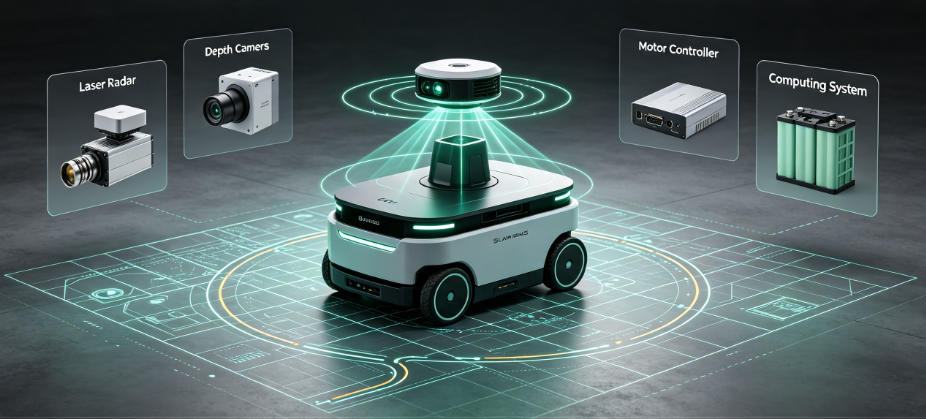
Modern autonomous robot systems typically include core components such as Robot LiDAR Sensors, Depth Cameras, Motor Controllers, Embedded Computers, Battery Systems, IMU Sensors, and Navigation Modules.
Among these components, the Robot LiDAR Sensor is one of the most important perception devices for autonomous navigation. Through laser scanning technology, LiDAR enables robots to obtain real-time distance information from the surrounding environment, supporting obstacle detection, SLAM mapping, precise localization, and path planning. Especially in AMRs (Autonomous Mobile Robots), AGVs, warehouse robots, and delivery robots, LiDAR sensors for robotics have become key components for improving autonomous mobility.
Besides LiDAR, Depth Cameras provide richer visual and depth information, helping robots recognize people, objects, and spatial structures. Motor Controllers manage robot movement, including speed adjustment, direction control, and motion coordination, ensuring smooth and stable operation. Embedded Computers handle AI algorithms, SLAM calculations, sensor fusion, and real-time decision-making, providing robots with powerful intelligent processing capabilities.
For mobile robots, a reliable Battery System is also essential. Efficient battery solutions extend operating time and support long-duration tasks such as warehouse automation, inspection, and outdoor operations. Meanwhile, IMU Sensors measure acceleration, angular velocity, and motion status. When combined with LiDAR and vision sensors, IMU improves robot localization stability in complex environments.
Finally, the Navigation Module serves as the connection between the perception system and motion control system. By integrating LiDAR data, SLAM algorithms, AI navigation technologies, and map information, navigation modules allow robots to autonomously plan routes, avoid obstacles dynamically, and complete complex tasks.
With the continuous development of robotics technology, autonomous robot components are becoming smaller, smarter, and more powerful. Whether used in industrial automation, smart warehouses, service robots, or future household robots, high-quality robotics parts and components are essential for achieving safe, efficient, and autonomous operation.
Among these components, LiDAR sensors act as the robot’s “spatial perception core” and will continue to play an increasingly important role in next-generation intelligent robot systems.
Robotics Parts and Components: What Are the Best Robot Parts for Sale for Autonomous Robots?
With the rapid development of artificial intelligence (AI), automation technology, and smart manufacturing, robots are now widely used in industrial production, warehouse logistics, service industries, and smart home applications. For building a high-performance robot, choosing the right robot parts for sale is essential to achieving stable operation and intelligent functionality. From mechanical structures and motor systems to sensors, control systems, and navigation modules, different robotics parts and components work together to determine overall robot performance.
Among various robot components, sensors play a critical role in enabling autonomous perception. In particular, robot LiDAR sensors have become essential components for autonomous mobile robots, AGVs, AMRs, delivery robots, and industrial automation systems. Through high-precision laser scanning, LiDAR enables robots to understand their surroundings, detect obstacles, achieve accurate positioning, and perform autonomous navigation.
For developers and companies searching for robot parts for sale, selecting a reliable navigation sensor is a crucial step in robot development. For example, the Slamtec RPLIDAR A3M1 360° LiDAR is a laser radar component designed specifically for robot navigation and environmental perception. It provides stable 2D scanning data, supporting SLAM mapping and path planning for autonomous robots.
Why Choose 360° LiDAR for Robot Navigation?
Among various robot sensors, the 360° LiDAR sensor has become one of the most important solutions for achieving precise navigation and environmental perception in autonomous robots. Compared with traditional cameras, ultrasonic sensors, or single-point distance sensors, 360° LiDAR can continuously scan the surrounding environment and provide more complete and stable spatial data, allowing robots to understand their location and surrounding objects in real time.
Taking the Slamtec RPLIDAR A3M1 360 LiDAR as an example, this type of robot LiDAR sensor uses a full 360-degree scanning method to continuously collect distance information from the surrounding environment and generate high-precision 2D point cloud data. By analyzing these data, robots can build environmental maps, recognize walls, shelves, equipment, people, and other dynamic or static obstacles, enabling safer and more efficient autonomous movement.
For autonomous mobile robots (AMRs), 360° LiDAR is one of the core perception components. During operation, robots need to continuously acquire environmental information, and LiDAR provides accurate real-time spatial measurements to help robots achieve:
- Mapping: By continuously scanning the surrounding space, robots can create 2D or 3D environmental maps, providing essential data for navigation.
- Localization: Combined with SLAM algorithms, robots can determine their exact position within the map based on laser scanning data, reducing positioning errors.
- Obstacle Detection and Avoidance: The 360° scanning range allows robots to detect obstacles in advance and dynamically adjust their routes to improve safety.
- Autonomous Path Planning: Robots can calculate optimal movement paths based on real-time environmental data, improving transportation efficiency and task performance.
- Real-Time Perception: In dynamic environments such as warehouses, shopping centers, and factories, LiDAR enables robots to quickly respond to changes in surroundings.
This is why more and more AMR robot parts and intelligent robot platforms are adopting 360° LiDAR as their primary navigation sensor. Whether used in warehouse robots, delivery robots, inspection robots, or service robots, reliable environmental perception systems are essential for autonomous operation.
Furthermore, integrating 360° LiDAR with SLAM (Simultaneous Localization and Mapping) technology significantly improves robot autonomous navigation capabilities. In unknown environments, robots do not need a complete pre-built map. Instead, they can continuously scan their surroundings while simultaneously creating maps and determining their own location.
For example, in smart warehouse applications, AMR robots equipped with 360 LiDAR can scan shelves, aisles, workers, and equipment in real time. When warehouse conditions change, such as relocated products or blocked pathways, robots can quickly update environmental information and recalculate routes to avoid collisions and improve logistics automation efficiency.
Beyond warehouse robots, 360° LiDAR is widely used in many robotic applications:
- Warehouse robots: Used for automated material handling, goods transportation, and smart logistics management.
- Delivery robots: Help robots safely navigate through environments with pedestrians and dynamic obstacles.
- Cleaning robots: Enable indoor mapping and automatic route planning.
- Industrial inspection robots: Support autonomous inspection in complex industrial environments.
- Service robots: Improve robot mobility and navigation capabilities in human-interaction scenarios.
Compared with vision-based robotic systems, LiDAR for robotics provides stronger stability in environments with changing lighting conditions. Whether operating at night, in low-light environments, or in complex industrial areas, LiDAR can continuously provide reliable distance measurements and accurate spatial perception.
Therefore, for companies and developers looking for robot parts for sale, choosing a high-performance 360° LiDAR sensor can significantly improve robot navigation accuracy, system reliability, and intelligent capabilities. With the growth of AMR technology, smart manufacturing, and autonomous robotics, 360° LiDAR will continue to be an essential component in future robotics parts and components ecosystems.
Applications of Robotics Parts and Components
As robotic applications continue expanding, high-performance robot components are being adopted across more industries.
In smart warehouse applications, AMR robots rely on LiDAR sensors for material transportation, path planning, and autonomous navigation, improving logistics efficiency and reducing manual labor requirements.
In industrial automation, robotics components help manufacturers achieve smarter production processes, including automated inspection, material handling, equipment maintenance, and intelligent manufacturing operations.
In service robot applications, the combination of LiDAR and vision sensors allows robots to better understand people and environments, supporting applications such as hotel robots, delivery robots, and home service robots.
In addition, agricultural robots, inspection robots, and outdoor mobile robots increasingly depend on reliable autonomous robot components to complete complex tasks in challenging environments.

How to Choose the Right Robot Parts for Sale?
When selecting robot components, it is important to evaluate different factors based on specific application requirements.
First, sensor accuracy is a key consideration. High-precision LiDAR sensors can provide more stable distance measurements, improving robot localization and navigation performance.
Second, scanning range should be considered. Indoor robots typically require short- to medium-range detection, while industrial and outdoor robots may require longer-range environmental sensing capabilities.
System compatibility is another important factor. High-quality robot components usually support platforms such as ROS, Linux, and various robot development environments, allowing developers to integrate them quickly and efficiently.
For commercial robotics projects, reliability, stability, and long-term operation capability are equally important. High-quality robotics parts and components can reduce maintenance costs while improving overall robot performance.
Future Development of Robot Components
In the future, the robotics industry will continue moving toward greater intelligence, smaller form factors, higher precision, and deeper integration. With the continuous convergence of artificial intelligence (AI), machine vision, LiDAR, edge computing, and robot operating systems (ROS), robots will move beyond simple repetitive tasks and gain stronger environmental understanding, autonomous planning, and advanced decision-making capabilities.
For robotics parts and components, future development will focus on improving perception capabilities, computing power, motion control, and human-robot interaction. High-performance robot components will become the foundation for the growth of industrial automation, smart logistics, service robots, and autonomous mobile robots.
Future key robot components include:
AI Vision Sensors will become an important part of robotic perception systems. By combining deep learning algorithms, AI vision sensors allow robots to recognize people, objects, environmental changes, and complex scenes with greater accuracy. For example, in smart manufacturing environments, robots can use AI vision for quality inspection, component recognition, and automated assembly, improving production efficiency and accuracy.
Compact LiDAR Sensors will continue driving the development of autonomous robots. As robots become smaller and more lightweight, demand for low-power, compact, and high-performance robot LiDAR sensors will continue to increase. Future LiDAR systems will offer smaller designs while improving measurement accuracy, scanning speed, and environmental adaptability, making them suitable for AMRs, delivery robots, household robots, and industrial inspection robots.
Advanced Navigation Modules will also become a major development direction for future robot systems. Traditional robots often rely on fixed routes, while future robots will combine LiDAR, vision sensors, SLAM algorithms, and AI decision-making systems to achieve smarter autonomous navigation. By analyzing environmental changes in real time, robots will dynamically adjust routes and operate effectively in complex and unknown environments.
High-Performance Controllers will further improve robot movement and task execution efficiency. Future control systems will not only manage motor operations but also process data from multiple sensors for real-time computation and intelligent control. Combined with AI algorithms, robots will achieve more precise actions, including robotic arm grasping, automated transportation, and complex industrial operations.
Intelligent Robotic Arms will become another important direction in the robotics components market. With the development of collaborative robots, industrial robots, and embodied AI, intelligent robotic arms will gain stronger perception, learning, and interaction capabilities. By combining force sensors, vision systems, and AI models, robotic arms can perform advanced tasks such as precision assembly, logistics sorting, and medical assistance.
Beyond these core components, future robot systems will increasingly rely on multi-sensor fusion technology. For example, the combination of LiDAR + Camera + IMU + AI enables robots to obtain distance information, visual data, and motion status simultaneously, creating more reliable environmental understanding.
This sensor fusion technology will be widely applied in:
- Autonomous Mobile Robots (AMRs)
- Warehouse Automation
- Industrial Inspection Robots
- Delivery Robots
- Agricultural Robots
- Service Robots
Driven by Industry 4.0, smart logistics, and intelligent manufacturing, global demand for robot parts for sale and high-performance robotics components will continue to grow. Companies will require not only reliable mechanical structures and drive systems but also advanced sensors, intelligent control modules, and autonomous navigation components to improve robotic automation.
Future robots will evolve from machines that simply execute tasks into intelligent systems capable of understanding environments, learning, and making decisions. High-quality robotics parts and components will serve as the foundation for this transformation. Among them, LiDAR sensors, AI vision systems, and intelligent navigation modules will continue playing a key role in driving robots toward a smarter, more efficient, and more autonomous future.
SLAMTEC RPLIDAR A3M1 360° LiDAR Sensor 25M Range, 16000 Samples

Conclusion: How to Choose the Best Robot Parts for Sale?
For companies, developers, and robot manufacturers searching for robot parts for sale, selecting the right robotics parts and components is the foundation for building intelligent robotic systems.
As a critical environmental perception component, LiDAR sensors significantly improve autonomous navigation, obstacle avoidance, and SLAM positioning capabilities. Robot LiDAR solutions such as the Slamtec RPLIDAR A3M1 360° LiDAR can meet the precise perception requirements of AMRs, service robots, industrial robots, and intelligent devices.
As robotics technology continues advancing, high-performance LiDAR sensors, intelligent sensing systems, and autonomous navigation components will play an increasingly important role in future robotic ecosystems.




Please upload banner from store admin blog pages
Please select collection from store admin blog pages