
How ToF Cameras Boost Autonomous Forklift Accuracy & Warehouse Safety
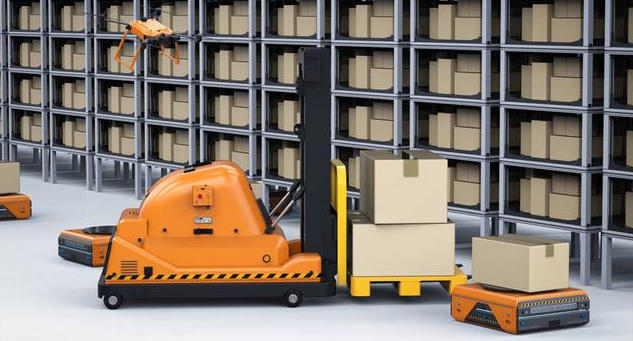
How Can ToF Cameras Help Autonomous Forklifts Operate More Safely and Efficiently?
Enabling Intelligent Warehousing and Safe AGV-Human Collaboration
With the rapid rise of smart warehouses, logistics automation, and Industry 4.0 technologies, autonomous forklifts (AGVs/AMRs) have become essential for modern material handling. Unlike traditional forklifts, autonomous forklifts require advanced environmental perception, accurate storage slot detection, and stable operations, especially in human-robot collaborative warehouse environments.
Among these, storage slot status recognition—understanding whether a slot is occupied, the height of cargo, and stack conditions—has emerged as a critical factor influencing AGV scheduling, operational safety, and warehouse efficiency.
1. Key Challenges for Autonomous Forklifts in Smart Warehousing
Autonomous forklifts must answer more than 'Can it move?'—they must operate safely, accurately, and efficiently.
1.1 Human-AGV Collaboration Delays
In real-world warehouses, human labor is still necessary for:
-
Temporary placement or removal of goods
-
Storage slot updates that are not reflected in real time in the WMS/WCS
This lag causes AGVs to receive inaccurate instructions, leading to:
-
Empty picks or misplacement
-
Increased collision risk
-
Reduced operational efficiency
⚠️ Delayed storage slot information is a major bottleneck for safe and efficient autonomous forklift operations.
1.2 High Requirements for Storage Slot Perception
Autonomous forklifts need more than simple occupancy detection:
-
Basic perception: Is the slot empty or occupied?
-
Advanced perception: Cargo stack height, tilted or over-height items, multi-layer stacking conditions
Traditional 2D vision solutions struggle to meet these high demands.

2. Case Study: East China Lithium Battery Warehouse
In a large-scale automated lithium battery warehouse, hundreds of AGVs handle palletized and boxed materials.
Challenges included:
-
Frequent human intervention in shelving/retrieval
-
Delayed slot status updates
-
AGVs operating on outdated information, causing inefficiencies and safety hazards
The solution: implement an automatic storage slot status recognition system to:
-
Monitor each slot in real time
-
Provide occupancy, height, and stacking information
-
Integrate data seamlessly with the WMS
The result: enhanced stability, safety, and throughput for AGV operations.
3. Sensor Solutions for Storage Slot Detection
3.1 Single-Point LiDAR
-
Measures only one point at a time
-
Easily misses gaps or irregular cargo
-
Cannot detect stack height accurately
❌ Not suitable for high-density or irregular warehouse layouts
3.2 RGB Industrial Cameras
-
Dependent on extensive training data
-
Cannot measure cargo height or volume
-
Struggles with non-standard cargo and stacking decisions
❌ 2D vision alone is insufficient for reliable AGV perception
3.3 Ultra-Wide Fisheye Cameras
-
Edge distortion affects accuracy
-
Complex calibration and high processing requirements
-
Increases deployment and operational cost
❌ Not ideal for large-scale warehouse applications
3.4 ToF Depth Cameras (Recommended)
Why ToF cameras are preferred:
-
Capture 3D depth + RGB for full spatial perception
-
Measure slot height, cargo volume, and structure directly
-
Often support edge AI processing, eliminating heavy servers
-
Provide real-time, high-precision slot recognition for stacking and safety decisions
✅ Mainstream solution for smart warehouse slot monitoring and AGV guidance

4. How ToF Cameras Work in Warehouse Slot Detection
TOF (Time-of-Flight) cameras emit modulated infrared light or pulses and calculate the distance by measuring the light’s travel time. This allows them to generate real-time 3D depth maps and point clouds of objects.
Key Advantages for Autonomous Forklifts
-
High-Precision 3D Perception
-
Directly measures height, edges, gaps, and volume
-
Millimeter- to centimeter-level accuracy for racks, pallets, and stacked cargo
-
Stable in Any Lighting
-
Infrared illumination works in low-light or complex lighting
-
Perfect for indoor warehouses, night operations, or shadowed environments
-
Unaffected by Cargo Color or Material
-
Reliable detection regardless of pallet or packaging color
-
Minimizes misdetection due to reflective surfaces
-
AI-Friendly Integration
-
Generates native 3D data for deep learning algorithms
-
Supports edge AI for real-time object recognition, pose estimation, and collision detection
-
Seamless integration with AGV/AMR systems
-
High Reliability and Real-Time Feedback
-
Real-time point cloud generation
-
Assists in obstacle avoidance, path planning, and high-speed AGV operations
5. ToF + AI Storage Slot Status Recognition Solution
A modern warehouse solution combines RGB-D ToF cameras with AI algorithms to achieve:
5.1 Slot Occupancy Detection
-
Real-time empty/occupied status
-
Reduces empty picks and misplacements
-
Updates WMS dynamically for accurate inventory
5.2 Stack Height & Over-Height Detection
-
Measures multi-layer cargo stack height precisely
-
Checks compliance with safe stacking rules
-
Reduces collision and tipping risks
5.3 Edge AI Deployment
-
Processes recognition locally on camera or edge module
-
Eliminates external industrial PC/server requirements
-
Low-latency, real-time decision-making
-
Supports high-density, continuous warehouse operations
Result: Accurate, intelligent slot recognition that enables a closed-loop AGV-human workflow, boosting efficiency, safety, and reliability.

6. Technical Advantages of ToF-Based Systems
-
Realistic 3D perception of height and spatial structure
-
Plug-and-play, simple deployment
-
Flexible communication: TCP/IP, UDP, HTTP, JSON
-
Millisecond-level real-time feedback
-
Scalable for hundreds or thousands of sensors
7. Efficient AGV-Human Collaboration
With ToF-based slot recognition:
-
Slot status is verified before AGV tasks
-
Human operation delays are eliminated
-
AGV scheduling becomes intelligent
-
Overall warehouse throughput significantly increases
In large-scale projects, hundreds of ToF cameras monitor all critical slots, reducing AGV errors and safety risks dramatically.
Conclusion
In today’s smart warehouse era, the standard for autonomous forklifts is accurate perception, fast response, and reliable deployment.
The ToF camera + AI storage slot recognition system addresses the limitations of traditional sensors, providing real-time 3D perception, stack height detection, and intelligent decision support.
As ToF sensor costs decline and AI algorithms improve, ToF cameras are expected to become the standard for autonomous forklifts, AGVs, and smart warehouse automation.
Robosense RS-lidar-M1/RS-lidar-M1 Plus 3D Vehicle grade intelligent solid-state LiDAR for autonomous driving

After-sales Support:
Our professional technical team specializing in 3D camera ranging is ready to assist you at any time. Whether you encounter any issues with your TOF camera after purchase or need clarification on TOF technology, feel free to contact us anytime. We are committed to providing high-quality technical after-sales service and user experience, ensuring your peace of mind in both shopping and using our products.





Please upload banner from store admin blog pages