QVGA vs VGA ToF Sensors: Which Resolution Is Best for 3D Depth Sensing?
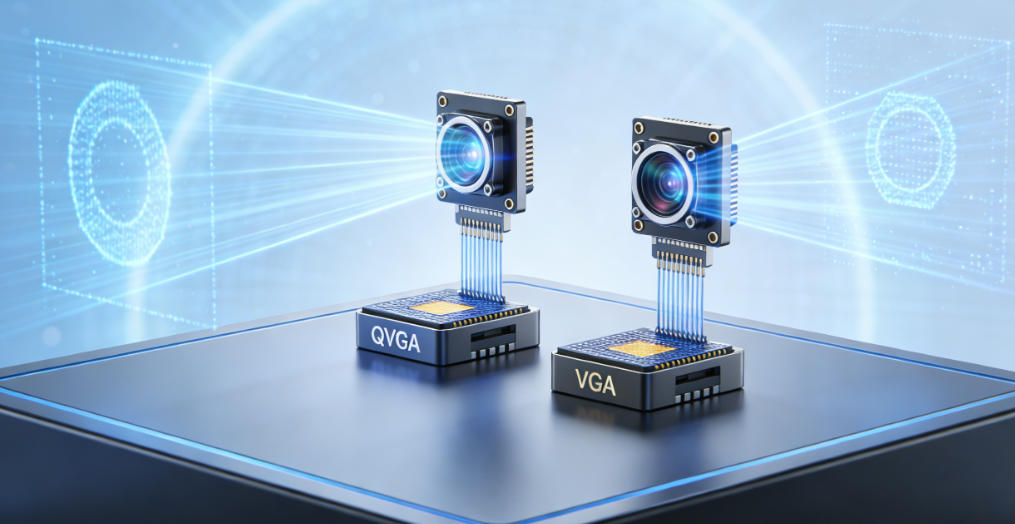
QVGA vs VGA ToF Sensors: How Do I Choose the Right Resolution for My Project?
When selecting ToF sensors, many developers and engineers often face a common question: QVGA vs VGA – which resolution is best for my application? Although it’s often assumed that 'higher resolution is always better,' the reality in ToF depth sensing systems is more nuanced. The optimal choice depends on the specific application scenario and performance requirements.
What Are QVGA and VGA Resolutions?
In the ToF sensor domain, QVGA (Quarter Video Graphics Array) and VGA (Video Graphics Array) are the two most commonly used image resolution standards. They directly affect the clarity of depth maps, detail capture, and overall distance measurement accuracy.
- QVGA resolution: 320 × 240 pixels, one-quarter of VGA’s total pixels. Fewer pixels reduce processing and storage requirements and lower power consumption, making QVGA ideal for resource-limited embedded systems or battery-powered devices. Larger pixel sizes allow each pixel to capture more photons, improving signal-to-noise ratio (SNR) and maintaining stable measurements in low-light or low-reflectivity conditions.
- VGA resolution: 640 × 480 pixels, four times the pixel count of QVGA. Higher pixel density provides greater spatial resolution, capturing finer details and producing more precise depth maps. For close-range measurements and accurate 3D modeling, VGA sensors more accurately represent object contours and edges, improving overall measurement precision.
In practice, choosing QVGA or VGA is not solely about pixel count. ToF sensor performance must consider several factors:
-
Pixel size and optical signal reception
- Larger pixels capture more photons, increasing SNR. In long-distance or low-light scenarios, QVGA may be more stable than VGA.
-
Spatial resolution and depth map detail
- VGA’s higher pixel count provides clearer depth maps, enabling precise edge detection, gesture recognition, 3D scanning, or complex environment mapping.
-
System processing and power consumption
- Higher resolution means more data to process and transmit, requiring more computing power. Resource-limited platforms like drones or embedded systems may benefit more from QVGA.
-
Application scenario and measurement range
- Close-range, high-precision tasks (e.g., industrial robot picking, AR/VR gesture recognition) → VGA preferred.
- Medium- to long-range or hardware-constrained applications → QVGA offers better cost-performance.
Understanding the fundamental differences in qvga vs vga allows developers to choose the right ToF resolution, balancing SNR, processing capacity, and application requirements for accurate and reliable 3D depth sensing.

Why VGA Resolution ToF Sensors Excel in Certain Scenarios
Practical testing shows:
- At close ranges (typically under 1.5 m), VGA resolution ToF sensors produce more stable and detailed depth maps. A denser pixel array captures more spatial information, enhancing overall depth analysis.
- VGA’s dense pixel grid improves edge detection and fine 3D imaging, which is crucial for high-precision applications like robot navigation and short-range obstacle avoidance in autonomous systems.
However, at distances beyond ~2 m, QVGA’s larger pixel advantage may be more significant:
- QVGA’s larger pixels capture more photons under the same lighting conditions, increasing SNR.
- In long-distance or low-reflectivity conditions, QVGA ToF sensors can provide more stable data.
Hence, selecting VGA or QVGA depends on both measurement range and application needs.
QVGA Advantages and Suitable Scenarios
While VGA ToF sensors excel in image detail and depth map resolution, QVGA has unique advantages for specific use cases:
-
Compact size and low power consumption
- Fewer pixels reduce processing and storage requirements, lowering power consumption.
- Ideal for embedded platforms, drones, or wearable devices where space and power are constrained.
-
Hardware-friendly and cost-effective
- Sufficient for applications that don’t require high resolution, such as indoor people counting, basic object detection, or low-complexity depth capture.
- Lower cost and higher integration make QVGA attractive for large-scale deployment or budget-sensitive projects.
-
Strong resistance to ambient light interference
- Larger pixels capture more photons, maintaining higher SNR under bright or variable lighting.
- Performs reliably in outdoor environments, near windows, or industrial spaces with rapidly changing light.
-
Suitable for long-distance measurement or low-reflectivity targets
- Large pixels improve signal capture for distant or low-reflectivity objects.
- Useful for warehouse robots, security monitoring, or large industrial facility depth scanning, offering smoother measurement than VGA in these scenarios.
How to Choose Between QVGA vs VGA ToF Sensors
When deciding on qvga vs vga, consider the following key factors:
-
Target measurement range
- Close-range (0.2 m–1.5 m) → VGA preferred for fine detail and high-precision 3D imaging.
- Medium- to long-range (>1.5 m) → QVGA more stable due to larger pixel SNR advantage.
-
Lighting conditions and SNR
- Strong or low light → QVGA’s larger pixels capture more photons, improving measurement stability.
- For fluctuating light or low-reflectivity objects, QVGA reduces measurement errors.
-
System resources and power
- VGA generates more data, requiring higher processing power and increasing power consumption.
- QVGA is energy-efficient and easier for real-time processing in embedded systems, drones, or robots.
-
Application scenario matching
- VGA: Industrial robot precise picking, gesture recognition, close-range AR/VR interaction, 3D body scanning.
- QVGA: Warehouse/logistics robot navigation, indoor people counting, environmental monitoring, security patrols.
QVGA is not a 'downgraded' version of VGA—it’s an optimized solution for specific scenarios. Understanding qvga vs vga advantages and limitations, combined with measurement range, lighting conditions, processing capabilities, and power constraints, ensures optimal ToF sensor selection for reliable 3D depth sensing.

QVGA and VGA ToF Development Trends
As 3D sensing technology and ToF sensors mature, resolution has become a key factor for product innovation and performance. Key trends include:
-
Coexistence of multiple resolution options
- Beyond QVGA and VGA, higher-resolution ToF sensors (HD or 1K+ pixel arrays) are emerging to meet diverse depth imaging needs—from basic indoor monitoring to precise 3D modeling.
- QVGA suits long-range monitoring, low-power embedded systems, or large-scale deployments; VGA fits close-range, high-precision, and complex applications like AR/VR or industrial robot navigation.
-
Improved pixel density and SNR
- Manufacturers optimize pixel density, pixel architecture, and signal-to-noise ratio to maintain accuracy under different lighting conditions.
- Higher-density arrays produce clearer depth maps, with advanced modulation and signal processing improving performance in low light, long distance, or complex reflective environments.
-
Higher frame rates for real-time applications
- Autonomous driving, robot navigation, and AR/VR require high frame rates.
- New VGA and higher-resolution ToF sensors support 60 fps or higher depth map output for precise real-time 3D capture.
-
Technology integration and broader applications
- Future ToF sensors will combine advanced pixel architecture, back-illuminated designs, phase unwrapping, and multi-frequency modulation, enhancing depth accuracy and environment adaptability.
- These upgrades enable widespread use in AR/VR, robotics, autonomous vehicles, smart homes, and industrial automation.
- High-resolution ToF sensors combined with AI allow real-time object recognition, gesture tracking, motion analysis, and 3D reconstruction.
-
Low-power and miniaturized designs
- To meet the needs of drones, wearables, and portable robots, future QVGA and VGA ToF systems aim to reduce power consumption while maintaining high accuracy.
- Compact, integrated modules make deploying high-resolution depth sensing technology easier across intelligent devices and industrial systems.
QVGA and VGA ToF sensors are evolving toward higher resolution, higher SNR, faster frame rates, and low-power miniaturization. Combined with AI algorithms and advanced pixel architecture, ToF technology is expanding into AR/VR, robotics, autonomous driving, and smart home applications, achieving higher accuracy, stability, and intelligent 3D depth perception.
Conclusion: QVGA vs VGA ToF Sensor Selection
In ToF resolution comparisons:
- Close-range, high-precision scenarios → prioritize VGA ToF sensors
- Long-distance measurement or resource-constrained systems → QVGA ToF sensors offer better cost-performance
Understanding the differences and applications of qvga vs vga is crucial for making the best decision in depth sensing projects.
Robosense 32-line 3D LiDAR sensor RS-Helios-5515 unmanned ranging navigation obstacle avoidance V2R RS-Helios-1615 Laser radar

After-sales Support:
Our professional technical team specializing in 3D camera ranging is ready to assist you at any time. Whether you encounter any issues with your TOF camera after purchase or need clarification on TOF technology, feel free to contact us anytime. We are committed to providing high-quality technical after-sales service and user experience, ensuring your peace of mind in both shopping and using our products.





Please upload banner from store admin blog pages