Precision Distance & Environment Sensing:TOF Laser Sensor Applications
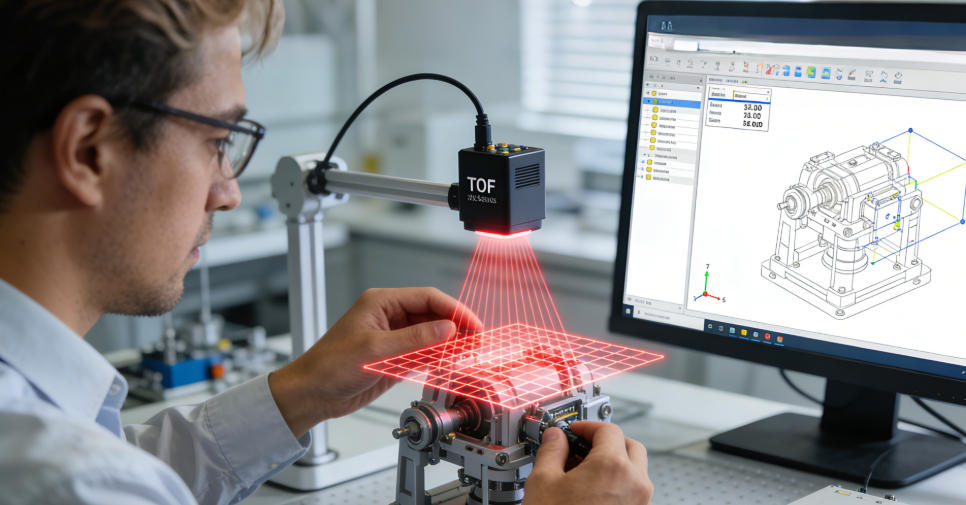
What is a TOF laser sensor and how does it improve distance accuracy and environment sensing?
With the rapid development of robotics, autonomous driving, industrial automation, and smart devices, various tof sensors (time-of-flight sensors) and time of flight sensors (TOF sensors) are playing an increasingly important role in precise distance measurement, environmental perception, and 3D modeling. In particular, time of flight laser sensors and laser range sensors have become core solutions in modern measurement technology due to their high accuracy, high speed, and non-contact measurement capabilities.
What is a TOF Sensor (Time‑of-Flight Sensors)?
TOF sensors (time of flight sensors) are advanced optical or laser-based distance measurement devices. Their core principle is to calculate the distance by measuring the time it takes for a light signal to travel from the emitter to the target and back (Time of Flight). These sensors are essential for high-precision non-contact measurement, 3D modeling, and intelligent environmental sensing.
Working Principle
- When a laser TOF sensor (laser tof sensor) or LED emits near-infrared pulse light, the light beam reflects off the target surface;
- The sensor's internal electronics precisely record the round-trip time of the light signal and calculate the distance between the sensor and the target;
- Distance is calculated using d = (c × Δt) / 2, where c is the speed of light and Δt is the round-trip time of the light signal;
- Depending on the measurement method, TOF sensors can be classified as direct TOF (dToF) and indirect TOF (iToF), suitable for long-distance high-precision measurements and short-range high-resolution scenarios, respectively.

Technical Advantages
Compared to traditional ultrasonic or structured-light distance measurement technologies, time of flight laser sensors (TOF laser distance sensors) have several significant advantages:
- High measurement accuracy: Can achieve millimeter or even sub-millimeter accuracy, suitable for industrial automation, robotic grasping, and autonomous driving applications;
- High-speed response: Real-time measurement capability allows capturing the position of fast-moving objects, meeting dynamic environment requirements;
- Non-contact measurement: Measures distance without touching the target, avoiding damage or interference;
- Strong environmental adaptability: Laser or optical measurement is less affected by dust, wind, or minor lighting changes, suitable for complex indoor and outdoor environments;
- Wide measurement range: With advanced algorithms and hardware, modern time of flight laser distance sensors can reliably measure distances from centimeters to tens of meters.
Application Examples
TOF sensors are widely used in various fields:
- Robotics and autonomous navigation: Using TOF data for real-time obstacle avoidance, path planning, and spatial mapping;
- Industrial automation: Measuring component sizes, monitoring material positions, and tracking inventory levels in production and warehouse systems;
- AR/VR and interactive devices: Generating depth maps and 3D spatial data to improve immersive experiences and interactive precision;
- Safety monitoring and smart homes: Triggering alerts or control actions based on distance measurement to improve security and convenience.
By combining tof sensors with color cameras, modern systems can achieve time of flight laser sensor + rgb cameras fusion, providing powerful data support for intelligent robots, autonomous vehicles, industrial inspection, smart homes, and 3D modeling applications.
TOF Laser Distance Sensors (Time of Flight Laser Distance Sensor): Principles and Advantages
Basic Working Principle
Time-of-Flight Laser Sensors (TOF laser sensors) emit laser beams toward a target and measure the distance by detecting the time difference of the reflected light. This process is similar to sonar or radar but uses high-speed laser pulses to achieve extremely high precision.
Two common TOF measurement methods:
- Direct TOF (dToF): Measures the round-trip time of short laser pulses directly for precise distance, suitable for long-distance measurement.
- Indirect TOF (iToF): Measures the phase difference of modulated continuous waves to calculate distance, suitable for short-range high-resolution measurement.
Key Advantages of TOF Laser Sensors
Laser TOF sensors have clear advantages over traditional measurement techniques:
- Non-contact measurement: Can measure distances without touching the target, suitable for long-range and multi-scenario applications;
- High accuracy and speed: Provides millimeter-level or higher precision distance measurements, meeting industrial automation and robotic navigation requirements;
- Strong environmental adaptability: Laser distance measurement is less affected by dust, wind, and other environmental factors;
- Long measurement range: Modern laser range sensors can reliably measure distances from a few meters to tens of meters.
Typical Applications of TOF Laser Sensors (Laser ToF Sensor)
As tof sensors technology matures, applications are expanding rapidly across industries. Modern time of flight laser sensors are not only used for traditional distance measurement but also as core components in intelligent, automated, and 3D perception systems.
Robotics and Smart Mobile Devices
In autonomous robots, unmanned vehicles, and drones, time of flight laser sensors play a key role:
- Real-time obstacle avoidance: Precisely measures distances to obstacles for dynamic path planning and collision prevention;
- Mapping and localization (SLAM): Uses dToF technology to generate high-precision spatial maps for navigation in complex environments;
- Multi-robot coordination: TOF data supports distance sensing and position coordination between multiple robots, optimizing logistics and warehouse efficiency;
- Drone altitude measurement and hovering: Provides stable height measurement and environmental perception for safe and accurate flight in confined spaces.
Compared to traditional ultrasonic or infrared distance measurement, TOF laser sensors provide higher accuracy, faster response, and stronger anti-interference capabilities, especially in dynamic and complex moving environments.
Industrial Automation and Manufacturing Inspection
In industrial production and automated inspection, laser range sensors are widely used:
- Component size measurement: Precisely measures industrial parts, electronic components, and mechanical parts to ensure product quality;
- Material level monitoring and warehouse management: Measures liquid, powder, or bulk material heights for automated inventory management;
- Production line automation: Integrates with PLC and industrial control systems to automate sorting, packaging, and material handling based on TOF data;
- Industrial robot grasping and positioning: Provides high-precision object positioning for robotic arms, supporting complex picking and assembly tasks.
Using time of flight laser distance sensors, industrial systems can obtain reliable and stable data in high-speed production and precision inspection, significantly improving efficiency and accuracy.
Safety Monitoring and Smart Interaction
In intelligent security and human-machine interaction scenarios, tof sensors provide reliable spatial awareness:
- Personnel monitoring and behavior analysis: Detects position, movement direction, and speed for applications such as access control, entry monitoring, and public safety;
- Triggering abnormal events: Alerts based on distance changes, such as intrusion detection or hazardous zone warnings;
- Smart home and interactive devices: Enables automated responses for lights, appliances, and environmental systems through gesture recognition and spatial control.
High-speed measurement and high-resolution capabilities of laser TOF sensors significantly enhance precision and responsiveness in security monitoring and interactive systems.
3D Imaging and Environmental Perception
Modern time of flight sensors are no longer limited to 1D distance measurement and can generate 3D depth maps or point cloud data through algorithmic processing:
- 3D modeling: Construction surveying, interior design planning, and digital twin creation;
- Posture analysis and motion capture: Optimizing robotic arm movements, VR, and AR interaction;
- Advanced scene understanding: Used in autonomous driving, logistics sorting, and warehouse management for complex environment analysis and intelligent decision-making.
By combining time of flight laser sensors with algorithms, systems can construct accurate real-time 3D spatial models, providing a solid data foundation for intelligent control, industrial automation, and virtual reality applications.

Key Selection Criteria for TOF Laser Sensors
To ensure tof sensors perform optimally in different applications, consider the following criteria when selecting time of flight laser sensors:
1️⃣ Measurement Range and Accuracy
- Determines the minimum and maximum distance the sensor can cover. Short-range TOF sensors are suitable for production lines, warehouse logistics, and gesture recognition, while long-range laser TOF sensors are suitable for autonomous driving, outdoor monitoring, and large industrial measurements.
- Accuracy is typically ± millimeters. High-precision dToF or time of flight laser distance sensors can achieve sub-millimeter measurements, ensuring reliable data for industrial inspection, robotic grasping, and 3D modeling.
- Response speed and measurement frequency are critical in dynamic environments to maintain stable data in fast-moving or continuous measurement scenarios.
2️⃣ Field of View (FOV)
- The field of view determines the spatial area covered by a single measurement.
- Narrow FOV allows longer range but smaller coverage, suitable for point-to-point measurements;
- Wide FOV covers larger areas, suitable for 3D modeling, robot navigation, and crowd monitoring;
- For time of flight sensors and laser range sensors, FOV design must balance accuracy and coverage based on the application.
3️⃣ Communication Protocols and Interfaces
- Modern TOF laser sensors support UART, CAN, I2C, SPI, etc.
- For industrial automation and robotics, choose protocols compatible with existing controllers or PLCs for seamless integration with time of flight laser sensors.
- Some high-end TOF sensors provide high-speed data output for 3D point cloud generation, real-time obstacle avoidance, and environmental mapping.
4️⃣ Ambient Light Immunity and Adaptability
- Outdoor or strong-light environments may interfere with laser measurements. High-performance tof sensors include ambient light suppression or filtering algorithms for stable measurement under varying lighting conditions.
- For industrial or outdoor applications, consider temperature range, IP protection rating, and vibration resistance of laser TOF sensors for long-term reliability.
5️⃣ Additional Functions and Application Suitability
- Some time of flight laser distance sensors support multi-point measurement, depth map generation, or 3D scanning, suitable for complex environmental perception, AR/VR, robotic SLAM, and intelligent monitoring.
- dToF-enabled TOF sensors excel in long-distance measurement, dynamic object tracking, and high-speed industrial scenarios.
- By evaluating measurement accuracy, FOV, interface compatibility, and environmental adaptability, you can select the most suitable laser range sensor or time of flight sensor for your application, maximizing system performance and data reliability.
Conclusion: TOF Laser Sensors Driving Intelligent Measurement
With the maturation and cost reduction of time of flight laser distance sensors and laser TOF sensors, TOF sensors are gradually replacing traditional distance measurement solutions, becoming an essential component for precise measurement, 3D perception, and intelligent automation. Whether in robotics, industrial automation, drones, or security monitoring, TOF laser sensors, with their high precision, multifunctionality, and strong adaptability, are pushing intelligent measurement technology toward broader application prospects.
SLAMTEC RPLIDAR S2L 30m TOF LiDAR Sensor for Navigation & Avoidance

After-sales Support:
Our professional technical team specializing in 3D camera ranging is ready to assist you at any time. Whether you encounter any issues with your TOF camera after purchase or need clarification on TOF technology, feel free to contact us anytime. We are committed to providing high-quality technical after-sales service and user experience, ensuring your peace of mind in both shopping and using our products.




Please upload banner from store admin blog pages