
Time of Flight Artificial Intelligence: Boosting ToF 3D Imaging
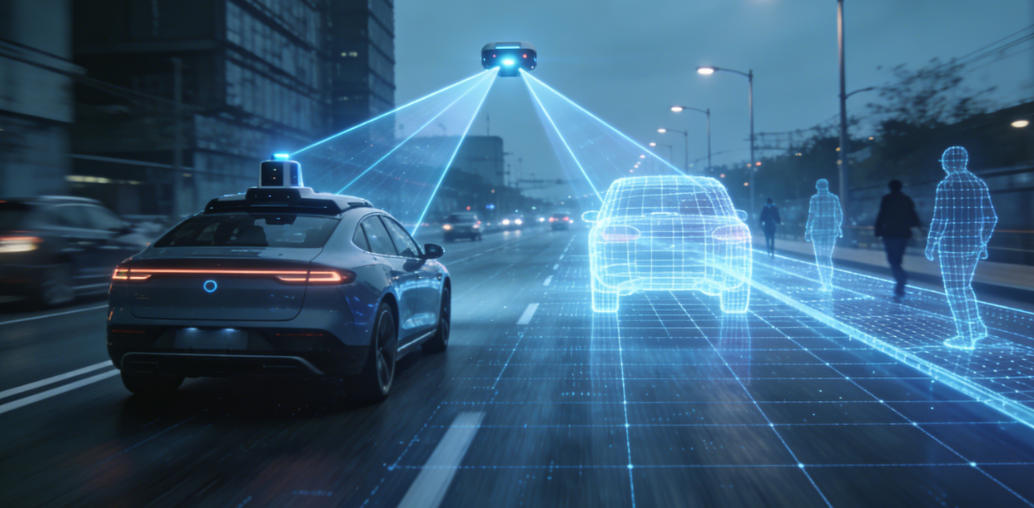
How Does Time of Flight Artificial Intelligence Improve ToF Sensors and 3D Imaging?
With the rapid advancement of time of flight artificial intelligence, traditional ToF (Time-of-Flight) sensors are evolving from simple distance measurement tools into intelligent depth sensing systems. The integration of AI not only improves data accuracy but also significantly expands the applications of ToF technology in autonomous driving, AR/VR, robotics navigation, and industrial automation.
What is Time-of-Flight (ToF)?
Time-of-Flight (ToF) is a technology used to measure distance or depth by calculating the time it takes for a signal—typically light or sound—to travel to an object and return. The core formula is:
Distance = (Signal Speed × Round-trip Time) ÷ 2
In most ToF systems, light (with a speed of approximately 3 × 10⁸ m/s) is used. The sensor emits infrared light or laser pulses, which reflect off objects and return to the sensor. By measuring this time difference, the system can quickly calculate the distance to the target.
ToF systems generally involve three steps: signal emission, reflection reception, and time calculation. This method provides high speed and high accuracy.
There are two main types of ToF technologies:
- Direct ToF (dToF): Measures the actual flight time of light pulses, suitable for long-range and high-precision applications like LiDAR.
- Indirect ToF (iToF): Calculates distance using phase shift of modulated light, offering lower cost and widely used in smartphones and facial recognition systems.
Thanks to its high accuracy, real-time capability, and strong performance in low-light environments, ToF technology has become a key component in modern 3D sensing systems.

1. How AI Improves ToF Sensor Accuracy and Precision Imaging
Traditional ToF sensors are often affected by ambient light variations, surface reflectivity differences, and environmental noise, leading to depth errors and incomplete depth maps. With the rise of time of flight artificial intelligence, AI—especially deep learning—has become a core tool for improving ToF data quality and enabling high-precision 3D imaging.
Key improvements include:
-
Noise Reduction and Data Correction
AI models can identify and remove noise caused by ambient light, reflections, or interference. Using neural networks such as CNNs, raw ToF data can be filtered and corrected in real time, producing smoother and more reliable depth maps while improving signal-to-noise ratio (SNR). -
Depth Completion and Fine Reconstruction
In low-reflectivity or long-distance scenarios, some pixels may lack sufficient signal. AI can fill in missing depth values through prediction and interpolation while preserving edges and structural details. Advanced models can even achieve sub-millimeter accuracy for high-quality 3D reconstruction. -
Adaptive Optimization in Dynamic Environments
AI can dynamically adjust processing parameters based on environmental changes. In applications like robotics or autonomous vehicles, it can detect anomalies and correct them in real time to maintain measurement accuracy. -
Overall Performance Enhancement
AI-enhanced ToF systems can reduce depth errors by 30%–50% in noisy environments. Combined with time of flight artificial intelligence, sensors can deliver high-frame-rate, full-resolution 3D depth maps for gesture recognition, spatial analysis, and modeling.
2. Real-Time Processing: AI Accelerates ToF Data Performance
ToF sensors generate large volumes of 3D depth data. Traditional processing methods often introduce latency, which can be critical in real-time applications such as autonomous driving and obstacle avoidance.
By leveraging time of flight artificial intelligence, AI enables parallel processing and accelerated inference:
-
Real-Time Depth Processing
AI reduces processing latency from tens of milliseconds to as low as 5–10 ms, enabling near-instant depth map generation and continuous tracking in dynamic environments. -
Fast Obstacle Detection and Response
AI models analyze depth data in real time to detect pedestrians, vehicles, and obstacles, enabling faster decision-making and improved safety. -
Intelligent Scene Understanding
AI can predict motion trajectories using historical and real-time data, allowing systems to anticipate changes and optimize navigation strategies.
This real-time capability is essential for high-speed, dynamic applications such as drones, mobile robots, and autonomous vehicles.
3. AI-Powered Object Recognition and 3D Tracking
With AI integration, AI ToF sensors go beyond depth sensing and enable advanced perception capabilities:
-
3D Object Classification
AI models can identify and classify objects (e.g., people, vehicles, industrial components) using depth and feature extraction. -
Motion Tracking and Pose Estimation
Systems can track object position, velocity, and trajectory in real time, and even estimate human or robotic poses for precise interaction. -
Industrial Automation
AI ToF systems provide accurate spatial data to guide robotic arms in picking, assembly, and inspection tasks. -
Multi-Object Tracking
AI enables simultaneous tracking of multiple objects in complex environments, ensuring safe and efficient navigation.

4. AI and ToF in Augmented Reality (AR)
AR applications require highly accurate and stable depth information. Traditional 2D cameras cannot provide reliable depth data, but AI-powered ToF systems can:
-
Enable Accurate 3D Environment Mapping
AI enhances depth data to create precise spatial models, allowing virtual objects to integrate seamlessly into real environments. -
Support Real-Time Depth Rendering
High frame-rate depth output (60 fps or higher) ensures smooth interaction between virtual and real-world elements. -
Enhance Immersive Experience
Improved occlusion, lighting, and spatial awareness significantly enhance realism in AR devices like smart glasses and smartphones. -
Adapt to Complex Environments
AI allows ToF systems to maintain performance under varying lighting conditions and dynamic scenes.
AI-enhanced ToF can improve AR depth rendering accuracy by up to 50%.
Multi-Industry Applications of AI ToF Sensors
With the maturity of time of flight artificial intelligence, AI-powered ToF sensors are transforming multiple industries:
-
Robotics and Human-Machine Interaction
Enables precise navigation, obstacle avoidance, and safer interaction. -
Autonomous Driving
Real-time detection and prediction of road conditions improve safety and decision-making. -
Smart Manufacturing
Supports defect detection, precision assembly, and automation optimization. -
Consumer AR/VR Devices
Enhances immersion and interaction quality. -
Medical Imaging and Surgery
Enables accurate 3D modeling for diagnostics and surgical planning. -
Security and Smart Home Systems
Supports people counting, motion detection, and intelligent monitoring.
6. Challenges and Future Trends
Despite its advantages, AI ToF sensor technology still faces challenges:
- High computational and power requirements
- Integration complexity and cost
- Latency in cloud-based processing
Future trends include:
- Edge AI integration for low-latency processing
- More efficient AI models for better depth reconstruction
- Sensor fusion combining vision, ToF, and radar
Conclusion
AI is redefining the future of time of flight artificial intelligence. By integrating AI into ToF sensing systems, depth accuracy and real-time performance are significantly improved, while expanding applications across autonomous driving, AR/VR, robotics, and industrial automation.
As AI and ToF technologies continue to evolve, they will become a cornerstone of intelligent vision systems, enabling faster, more accurate, and more reliable 3D perception.
Zhisensor D330 Series Industrial 3D Depth Camera – High Precision, Stereo Vision, RGB & Infrared, GigE Interface

After-sales Service: Our professional technical support team specializes in TOF camera technology and is always ready to assist you. If you encounter any issues during the usage of your product after purchase or have any questions about TOF technology, feel free to contact us at any time. We are committed to providing high-quality after-sales service to ensure a smooth and worry-free user experience, allowing you to feel confident and satisfied both with your purchase and during product use.




Please upload banner from store admin blog pages