ToF Depth Cameras in Industrial Automation and 3D Vision Systems
How Do ToF Depth Cameras Improve 3D Vision and Automation in Industry?
As Industry 4.0 transforms manufacturing and logistics, industrial automation increasingly relies on advanced vision systems to achieve precision, speed, and adaptability. At the heart of this revolution are Time-of-Flight (ToF) depth cameras and 3D vision systems, which provide high-resolution real-time spatial data, robust environmental perception, and automated decision-making capabilities. These systems empower robots and automated machinery to perform complex tasks with minimal human intervention, making them essential for smart factories, autonomous mobile robots (AMRs), and intelligent material handling.
What Are ToF Depth Cameras?
ToF depth cameras are specialized sensors that capture not only visual information but also precise distance measurements for every pixel. By emitting infrared light pulses and measuring the time-of-flight of reflected light, these cameras generate dense 3D point clouds and high-resolution depth maps in real time. Unlike 2D RGB cameras, ToF cameras can measure depth accurately regardless of ambient lighting, texture variations, or surface reflectivity.
This capability is particularly valuable for industrial robotics, automated palletizing, warehouse management, and quality inspection, where spatial awareness and precision directly affect productivity and safety.

Precision and Accuracy in 3D Vision for Industry
In industrial environments, precision and accuracy are critical for successful automation:
- Precision ensures consistent and repeatable depth measurements across multiple readings, reducing operational errors.
- Accuracy ensures that the measurements reflect the real-world dimensions and spatial relationships, which is vital for robotic manipulation, machine vision inspection, and AMR navigation.
ToF cameras achieve this through calibration of intrinsic parameters, focal length optimization, and environmental compensation. Proper calibration ensures that the 3D data collected can be reliably used for object detection, path planning, and automated quality control.
Industrial Applications of ToF Depth Cameras
1. Autonomous Mobile Robot (AMR) Navigation
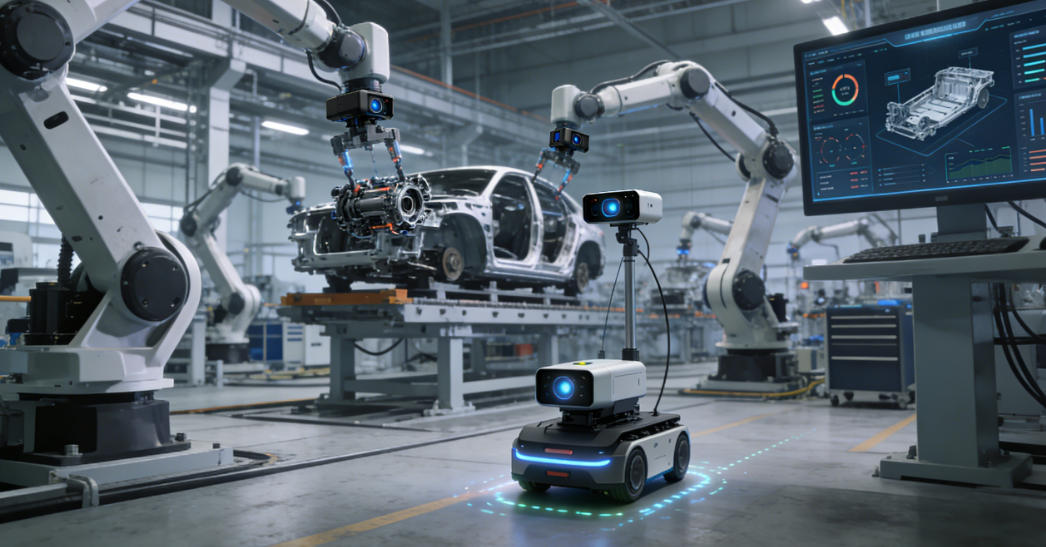
ToF depth cameras enable real-time 3D mapping and dynamic obstacle detection, allowing AMRs to navigate complex warehouse layouts, manufacturing floors, and multi-level storage areas. By providing continuous depth updates, robots can avoid collisions, optimize routes, and adjust their speed in real time.
2. Robotic Pick-and-Place and Palletizing
Depth sensing allows robots to grasp objects of varying sizes, shapes, and orientations. ToF cameras provide accurate object positioning, calculate optimal gripping angles, and ensure safe stacking and depalletizing, even when objects are overlapping or irregularly shaped.
3. Smart Warehousing and Inventory Management
In smart warehouses, ToF 3D vision systems enable automated case handling, package sorting, and shelf scanning. They also support human presence detection and real-time workflow optimization, enhancing both safety and efficiency in high-traffic environments.
4. Automated Quality Inspection
ToF depth cameras are used for surface profiling, dimensional measurement, defect detection, and verification of assembled components. This allows for non-contact inspection in industries such as automotive, electronics, consumer goods, and food production, improving throughput while reducing errors.
5. Dynamic Obstacle Avoidance in Mixed Environments
Depth cameras continuously monitor the surrounding environment, allowing robots to detect moving obstacles such as humans, forklifts, or other robots. This real-time 3D perception ensures safe and efficient navigation in shared industrial spaces.
Enhancing 3D Vision Performance
For optimal deployment of ToF depth cameras in industrial automation, several strategies are recommended:
- Intrinsic and Extrinsic Calibration – Align depth data with world coordinates for accurate 3D modeling and robotic control.
- Exposure and Lighting Optimization – Adjust camera exposure and use structured or diffuse lighting to minimize noise in challenging environments.
- Pixel Filtering and Noise Reduction – Apply median, Gaussian, or adaptive filters to remove spurious measurements.
- Field of View (FOV) Adjustment – Select FOV based on task requirements; wide FOV for navigation and tracking, narrow FOV for precision inspection.
- Regular Verification and Maintenance – Routine checks against known standards ensure measurement reliability over time.
These optimizations allow industrial robots, AMRs, and vision-guided automation systems to operate with maximum accuracy, speed, and reliability.

Advantages of ToF Depth Cameras Over Traditional Vision Systems
Compared to conventional 2D RGB cameras or simple range sensors, ToF depth cameras offer:
- True real-time 3D depth perception for complex industrial tasks
- High repeatability and measurement precision for critical quality inspections
- Robust performance under variable lighting, reflections, and textured surfaces
- High frame rates for dynamic obstacle detection and fast-moving operations
- Flexible field-of-view configurations to support both navigation and detailed inspection
These advantages make ToF depth cameras ideal for smart factories, automated warehouses, intelligent assembly lines, and vision-guided robotics systems.
Future Trends and Integration
ToF depth cameras are increasingly integrated with AI algorithms, edge computing, SLAM systems, and industrial IoT platforms. This allows for adaptive perception, predictive maintenance, and autonomous decision-making, creating a foundation for fully autonomous industrial environments. Companies are adopting these systems for:
- Autonomous material handling and logistics
- Robot-assisted assembly and packaging
- Smart warehouse optimization
- Automated inspection and quality assurance
As manufacturing and logistics evolve, ToF depth cameras will continue to be a critical component in enabling intelligent, flexible, and scalable industrial automation.
Conclusion
ToF depth cameras and 3D vision systems are transforming industrial automation by delivering real-time spatial awareness, high-precision depth sensing, and intelligent environmental perception. From AMR navigation and robotic palletizing to automated quality inspection and smart warehousing, ToF technology ensures faster, safer, and more efficient operations. With proper calibration, integration, and system optimization, these cameras empower modern factories and logistics hubs to achieve higher productivity, better safety, and advanced automation intelligence, paving the way for the factories of the future.
Zhisensor D330 Series Industrial 3D Depth Camera – High Precision, Stereo Vision, RGB & Infrared, GigE Interface

After-sales Service: Our professional technical support team specializes in TOF camera technology and is always ready to assist you. If you encounter any issues during the usage of your product after purchase or have any questions about TOF technology, feel free to contact us at any time. We are committed to providing high-quality after-sales service to ensure a smooth and worry-free user experience, allowing you to feel confident and satisfied both with your purchase and during product use.




Please upload banner from store admin blog pages