
Accuracy vs Precision in TOF Sensors: Key Differences Explained
What’s the Difference Between Accuracy and Precision in TOF Sensors?
Understanding the difference between accuracy vs precision is crucial in modern measurement systems, especially in TOF sensors, distance measurement, industrial automation, robotics, and 3D imaging technologies. Although these terms are often used interchangeably, they represent two fundamentally different concepts that directly impact performance, reliability, and data quality.
In this comprehensive guide, we will clearly explain accuracy and precision, explore their differences, and show how they affect Time-of-Flight (ToF) sensor performance in real-world applications.
What Is Accuracy in Measurement?
Accuracy refers to how close a measured value is to the true or actual value. It reflects the correctness of a measurement.
For example, if a TOF distance sensor measures a distance as 100 cm and the actual distance is also 100 cm, the sensor is considered highly accurate.

What Is Precision in Measurement?
Precision refers to the consistency or repeatability of measurements when repeated under the same conditions.
For example, if a sensor repeatedly measures 98 cm, 98 cm, and 98 cm, it is very precise, even if the true value is 100 cm.
Accuracy vs Precision: Core Differences
Understanding accuracy vs precision becomes easier when comparing them directly:
| Aspect | Accuracy | Precision |
|---|---|---|
| Definition | Closeness to true value | Consistency of results |
| Error Type | Systematic error | Random error |
| Focus | Correctness | Repeatability |
| Importance | True measurement | Stable measurement |
Visualizing Accuracy vs Precision (Simple Explanation)
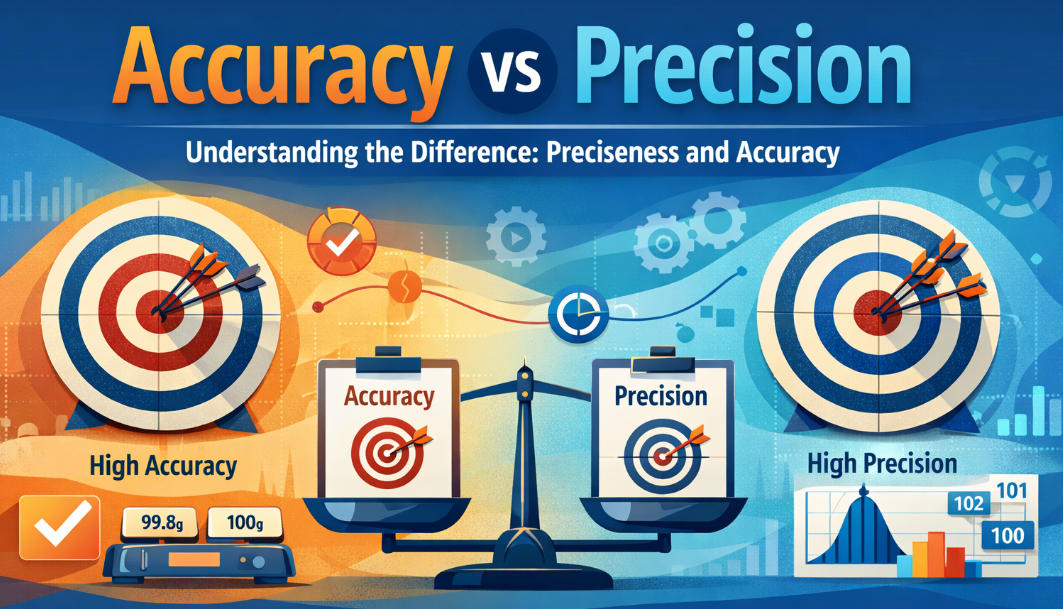
To better understand accuracy vs precision, imagine a target board used in shooting practice:
- High accuracy + high precision: All measurements hit the exact center repeatedly. This represents an ideal system with both correctness and consistency.
- High precision, low accuracy: Results are tightly grouped together but far from the center. The system is consistent but biased.
- High accuracy, low precision: Measurements are spread out, but their average is close to the center. The system is correct overall but unstable.
- Low accuracy and low precision: Results are scattered randomly with no clear pattern, indicating poor measurement quality.
This visualization is widely used in engineering, sensor calibration, data science, and measurement system analysis because it clearly demonstrates how systematic errors and random errors affect results differently.
In real-world sensor systems, especially distance measurement sensors and ToF sensors, engineers aim to minimize both types of errors to achieve high accuracy and high precision simultaneously. This is particularly important in applications where even small deviations can lead to performance degradation or safety risks.
Why Accuracy vs Precision Matters in TOF Sensors
Time-of-Flight (ToF) sensors measure distance by calculating the time it takes for light to travel from the sensor to an object and back. This principle enables fast, non-contact, and high-resolution distance measurement, making ToF technology essential in modern smart systems.
Common Applications of TOF Sensors:
- 3D cameras and depth sensing (facial recognition, AR/VR, 3D scanning)
- Autonomous robots and drones (navigation, obstacle avoidance)
- Industrial automation and inspection (quality control, object detection)
- Gesture recognition and smart devices (touchless interfaces, IoT systems)
In these applications, both accuracy and precision directly influence system performance:
- Accuracy ensures correct distance measurement, which is critical for positioning, mapping, and object recognition.
- Precision ensures consistent readings, which is essential for stability, repeatability, and smooth system operation.
For example:
- In robotics, low accuracy can cause positioning errors, while low precision can lead to unstable movement.
- In industrial inspection, poor accuracy results in incorrect measurements, while poor precision leads to inconsistent quality control.
Therefore, optimizing both is key to achieving high-performance TOF sensing systems.
Factors Affecting TOF Sensor Accuracy
Improving TOF sensor accuracy is critical for obtaining reliable and correct measurement results. Several environmental and technical factors can significantly influence accuracy.
Main Influencing Factors:
1. Surface Reflectivity
The reflectivity of the target object plays a major role in measurement accuracy.
- Dark or matte surfaces absorb more light, reducing the returned signal
- Highly reflective or shiny surfaces may cause signal distortion or saturation
- Transparent or semi-transparent objects (glass, water) can lead to incorrect readings
Optimizing reflectivity conditions or using advanced signal processing can improve distance measurement accuracy.
2. Ambient Light Conditions
External light sources can interfere with the sensor’s signal.
- Strong sunlight introduces optical noise
- Indoor lighting can create background interference
- Sudden lighting changes may affect measurement stability
Modern ToF sensors often include ambient light suppression algorithms, but extreme conditions can still reduce accuracy.
3. Measurement Distance
Distance has a direct impact on accuracy.
- At longer distances, the reflected signal becomes weaker
- Signal-to-noise ratio decreases
- Measurement uncertainty increases
High-end ToF systems use powerful emitters and sensitive receivers to maintain accuracy over longer ranges.
4. Sensor Calibration
Calibration is essential to eliminate systematic errors.
- Factory calibration ensures baseline accuracy
- Field calibration compensates for environmental changes
- Poor calibration leads to consistent measurement bias
Regular calibration is one of the most effective ways to improve TOF sensor accuracy.
5. Angle of Incidence
The angle between the sensor and the target surface affects measurement quality.
- Perpendicular surfaces provide the best reflection
- Tilted surfaces scatter light away from the sensor
- Large angles reduce signal strength and accuracy
This is especially important in 3D scanning and object detection applications.
6. Environmental Conditions
Environmental factors can also impact accuracy:
- Temperature variations affect electronic components
- Humidity and dust can scatter or absorb light
- Vibration can introduce measurement instability
Robust sensor design and environmental compensation help maintain performance.
7. Signal Processing and Algorithms
Advanced algorithms play a key role in improving accuracy.
- Noise filtering reduces random interference
- Signal averaging improves measurement stability
- Compensation algorithms correct systematic deviations
Modern ToF sensors rely heavily on software optimization in addition to hardware performance.
8. Hardware Quality and Sensor Design
The overall design of the sensor determines its baseline performance.
- High-quality optics improve signal transmission
- Better detectors increase sensitivity
- Advanced chips enable faster and more accurate processing
Choosing a high accuracy TOF sensor module is critical for demanding applications.

Factors Affecting TOF Sensor Precision
Precision determines how stable and repeatable the sensor readings are.
Key Influencing Factors:
-
Electronic Noise
Internal circuit noise affects consistency. -
Signal Stability
Weak or fluctuating signals reduce repeatability. -
Temperature Variations
Changes in temperature can impact sensor performance. -
Sampling Rate
Higher sampling improves consistency. -
Algorithm Optimization
Filtering and averaging improve precision.
Accuracy vs Precision in Industrial Applications
1. Industrial Automation
- Accuracy ensures components meet design specifications
- Precision ensures consistent production quality
2. Robotics and Navigation
- Accuracy allows correct positioning
- Precision ensures smooth and repeatable movement
3. 3D Imaging and Inspection
- Accuracy guarantees real dimensions
- Precision ensures consistent point cloud generation
4. Smart Devices and AI Systems
- Accuracy improves detection reliability
- Precision enhances user experience and stability
How to Improve Accuracy and Precision in TOF Systems
To achieve optimal performance, both accuracy and precision must be optimized together.
Ways to Improve Accuracy:
- Perform regular calibration
- Use controlled lighting environments
- Select high-quality sensors
- Optimize measurement angles
- Apply compensation algorithms
Ways to Improve Precision:
- Reduce electronic and environmental noise
- Use signal filtering techniques
- Increase sampling frequency
- Maintain stable operating conditions
- Implement averaging methods
Accuracy vs Precision in Sensor Selection
When selecting a TOF sensor or distance measurement system, consider the application:
- Choose high accuracy sensors for absolute measurements
- Choose high precision sensors for repeatable processes
- Choose both for high-end industrial and robotics applications
High-Value Long-Tail Keywords:
- accuracy vs precision in sensors explained
- TOF sensor accuracy vs precision difference
- best high precision distance sensor
- how to choose a TOF sensor
- difference between accuracy precision and repeatability
Common Misconceptions About Accuracy and Precision
- Precision means accuracy – False
- Accurate measurements are always consistent – Not necessarily
- You only need one of them – Incorrect; both are important
- Calibration improves precision – Mostly improves accuracy
Understanding these misconceptions helps in better sensor system design and optimization.
Conclusion
The difference between accuracy vs precision is fundamental in any measurement system, especially in TOF sensor technology and distance measurement applications.
- Accuracy ensures the measurement is correct
- Precision ensures the measurement is consistent
For best results in industrial automation, robotics, and 3D sensing, both must be optimized together. A system that is both accurate and precise delivers reliable, stable, and high-performance results, which is essential for modern smart technologies.
OS1 32/64 /128 lines for autonomous delivery Autonomous driving 3D lidar Ouster Mid-Range High-Resolution Imaging Lidar

After-sales Support:
Our professional technical team specializing in 3D camera ranging is ready to assist you at any time. Whether you encounter any issues with your TOF camera after purchase or need clarification on TOF technology, feel free to contact us anytime. We are committed to providing high-quality technical after-sales service and user experience, ensuring your peace of mind in both shopping and using our products.





Please upload banner from store admin blog pages