
AI Mobile Robot Navigation in Factories AMR Best Practices Guide
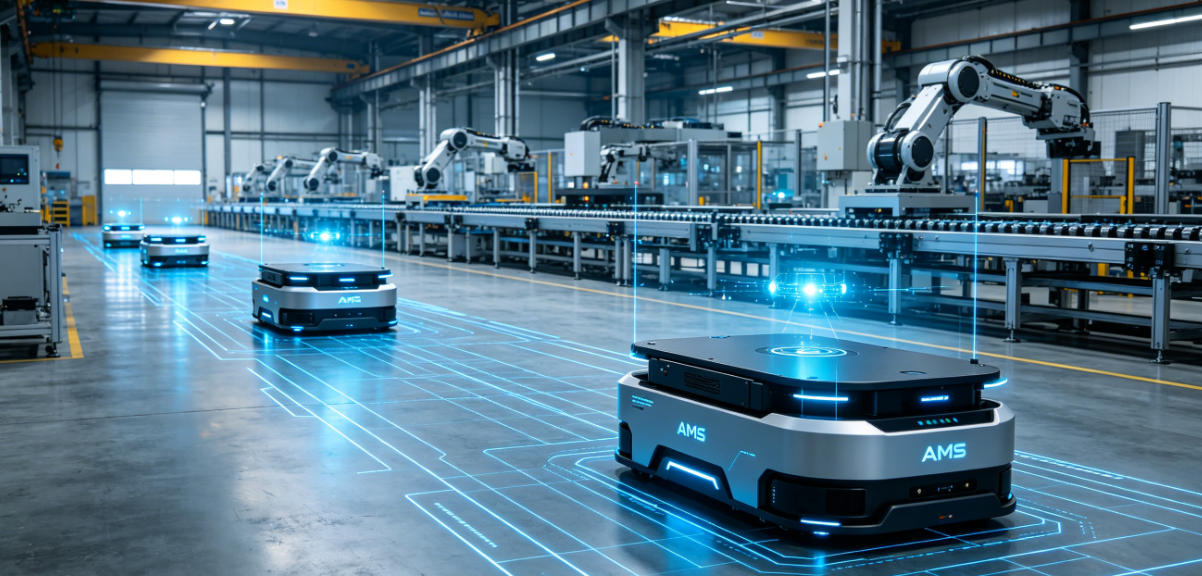
How Do AI-Powered Mobile Robots Navigate in Factories and Warehouses Effectively?
Introduction: Why AMR Navigation Matters in Modern Factories
In today’s smart manufacturing and logistics environments, Autonomous Mobile Robots (AMRs) have become a core part of industrial automation. From warehouse robot navigation systems to factory intralogistics optimization, AMRs are reshaping how materials move inside production facilities.
The key to their performance is not just hardware, but AI-powered navigation, especially SLAM-based mapping, sensor fusion, and real-time decision-making. Poor navigation design leads to congestion, inefficiency, and safety risks, while optimized systems significantly improve throughput, scalability, and ROI.
This article explores AI navigation best practices for AMRs in factories, including real-world deployment strategies, SLAM optimization, and high-performance navigation architecture for smart warehouse automation.
What Is AMR Navigation in Factory Environments?
AMR navigation refers to how autonomous robots move inside dynamic industrial environments using onboard intelligence instead of fixed infrastructure.
Unlike traditional AGVs (Automated Guided Vehicles) that rely on magnetic tracks or predefined routes, AMRs use natural feature navigation and continuously adapt their path in real time.
Modern AMRs typically rely on:
- LiDAR-based SLAM (Simultaneous Localization and Mapping)
- AI-based path planning algorithms
- Depth cameras and vision sensors
- IMU + sensor fusion systems
- Fleet management software for coordination
These technologies allow robots to operate in complex environments such as:
- Smart factories
- E-commerce warehouses
- Automotive production lines
- Pharmaceutical logistics centers
- Cold-chain distribution hubs

Core Technology Behind AI-Based AMR Navigation
1. SLAM: The Foundation of Autonomous Navigation
At the heart of AMR systems is SLAM technology, which enables robots to build a map while simultaneously localizing themselves within it.
SLAM is critical because factories are:
- Dynamic (people, forklifts, pallets move constantly)
- Unstructured (temporary storage, changing layouts)
- Environmentally complex (reflective surfaces, narrow aisles)
Modern AMRs use SLAM to:
- Build real-time maps of factory floors
- Detect obstacles dynamically
- Recalculate routes instantly
- Maintain centimeter-level positioning accuracy in advanced systems
This makes SLAM essential for warehouse robot navigation accuracy improvement and industrial mobile robot localization systems.
2. AI Path Planning and Decision Making
AI enhances AMR navigation by enabling intelligent route selection instead of static shortest-path logic.
Key AI functions include:
- Dynamic obstacle avoidance (humans, forklifts, pallets)
- Traffic-aware route optimization
- Multi-robot coordination in shared spaces
- Predictive congestion avoidance
- Task prioritization in fleet operations
These capabilities are especially important in high-density warehouse automation environments, where multiple robots operate simultaneously.
3. Sensor Fusion for Robust Navigation
A single sensor is never enough in real factory conditions. Modern AMRs rely on sensor fusion navigation systems, combining:
- 2D/3D LiDAR
- RGB-D cameras
- Ultrasonic sensors
- Wheel odometry
- IMU data
This improves reliability in challenging conditions such as:
- Low light or reflective surfaces
- Narrow corridors
- Repetitive warehouse layouts
- Outdoor-to-indoor transitions
Sensor fusion significantly enhances AMR safety navigation in human-robot collaborative environments.
Best Practices for AMR Navigation in Factories
1. Design High-Quality Digital Maps Before Deployment
One of the most critical steps in AMR deployment is creating a stable SLAM reference map.
Best practices include:
- Map the entire facility before operation
- Include all dynamic zones (loading docks, staging areas)
- Update maps regularly after layout changes
- Avoid overly repetitive visual environments when possible
A clean mapping foundation improves factory navigation accuracy and route stability.

2. Optimize Warehouse Layout for Robot Traffic
Even with advanced AI navigation, physical layout matters.
Recommended layout practices:
- Maintain aisle width ≥ 1.2m for safe passing
- Reduce sharp blind corners
- Separate human and robot traffic zones where possible
- Standardize pallet placement zones
- Avoid unnecessary reflective surfaces in key navigation paths
These changes improve warehouse robot traffic efficiency and collision avoidance performance.
3. Use Fleet Management Systems for Multi-Robot Coordination
In large factories, navigation is not just individual—it is collective.
Fleet management systems help:
- Assign tasks to the nearest available robot
- Prevent traffic congestion
- Coordinate multi-robot workflows
- Balance workload across fleet
- Integrate with ERP/WMS systems
This is essential for scalable AMR fleet management in smart logistics systems.
4. Implement Real-Time Obstacle Avoidance Logic
Factories are unpredictable environments. AMRs must handle:
- Human workers crossing paths
- Forklift movement
- Temporary storage obstacles
- Sudden layout changes
Best practice: combine reactive obstacle avoidance + predictive path planning for safer navigation.
This improves industrial robot safety navigation in mixed human-robot environments.
5. Ensure Strong Sensor Calibration and Maintenance
Navigation accuracy depends heavily on sensor health.
Recommended practices:
- Regular LiDAR calibration
- Camera lens cleaning schedules
- IMU drift correction checks
- Wheel odometry validation
- Software updates for SLAM algorithms
Poor calibration is one of the main causes of AMR localization drift in warehouse environments.
Common Challenges in Factory AMR Navigation
Despite advanced technology, real-world deployment still faces challenges:
1. Repetitive Environment Confusion
Long corridors and identical racks can confuse SLAM systems, causing localization drift.
2. Dynamic Obstacle Density
High human traffic increases navigation complexity and collision risk.
3. Reflective Industrial Surfaces
Metal shelves and glossy floors can degrade LiDAR accuracy.
4. Network and Fleet Latency
Delayed communication affects multi-robot coordination and task allocation.
5. Rapid Layout Changes
Frequent warehouse restructuring requires constant map updates.
Future Trends in AI Navigation for AMRs
The next generation of AMR navigation systems is evolving toward:
- AI-driven predictive navigation models
- 3D semantic mapping of factories
- Edge computing for real-time decision-making
- Vision-language navigation systems
- Fully autonomous multi-robot collaboration
- Digital twin integration for simulation-based optimization
These advancements will further enhance smart factory automation and autonomous logistics systems.
OS1 32/64 /128 lines for autonomous delivery Autonomous driving 3D lidar Ouster Mid-Range High-Resolution Imaging Lidar

Conclusion
AI-powered AMR navigation is the backbone of modern factory automation. By combining SLAM mapping, sensor fusion, AI path planning, and fleet coordination, industrial robots can operate safely and efficiently in complex environments.
To achieve optimal performance, enterprises must focus on:
- High-quality environment mapping
- Robust sensor fusion systems
- Intelligent fleet management
- Real-time obstacle avoidance
- Continuous system calibration
As factories continue evolving toward full automation, advanced AMR navigation systems will become a key driver of Industry 4.0 smart manufacturing transformation.






Please upload banner from store admin blog pages
Please select collection from store admin blog pages