
Time-of-Flight Camera News Today 2026: ToF Trends & AI Vision
What Is Happening in Time-of-Flight Camera Technology in 2026?
Time-of-Flight Camera News Today: Global 3D Vision Industry Enters a New Growth Cycle
With the rapid advancement of artificial intelligence (AI), robotics, industrial automation, and spatial computing technologies, the Time-of-Flight (ToF) camera market is entering a new phase of expansion. According to recent industry observations, time-of-flight camera news today has become a highly searched topic in the global intelligent sensing industry.
From smart robotics to industrial automation, from AR/VR devices to smart buildings, more and more companies are adopting ToF Camera, 3D ToF Camera, and dToF Sensor technologies to enhance environmental perception, spatial understanding, and autonomous decision-making capabilities.
Industry analysts believe that the next five years will be a critical window for the commercialization of ToF technology. With improvements in semiconductor performance, cost reduction, and continuous AI algorithm optimization, ToF Cameras are rapidly transitioning from high-end niche applications to large-scale commercial deployment.
What Is a Time-of-Flight Camera?
A Time-of-Flight Camera (ToF Camera) is a 3D vision sensor based on the Time-of-Flight principle. It measures the distance between the sensor and an object by calculating the time it takes for a light pulse to travel to the target and return, generating high-precision depth images in real time.
Unlike traditional cameras that only capture 2D images, ToF Cameras can perceive spatial depth information directly, making them widely used in robotics navigation, industrial automation, smart surveillance, AR/VR devices, and autonomous driving assistance systems.
Its working principle includes:
- Emitting infrared or modulated light pulses
- Light reflects off the target surface
- Reflected light returns to the ToF sensor
- The system calculates the flight time of the signal
- Distance is derived based on time-of-flight
- A real-time 3D depth map is generated
Through this process, ToF Cameras can simultaneously obtain:
- Distance data
- Depth information
- 3D spatial coordinates
- Object contour information
- Scene mapping data
Compared with traditional 2D cameras and stereo vision systems, 3D ToF Cameras offer faster response, higher measurement accuracy, and stronger resistance to ambient light interference.

Why Are ToF Cameras Gaining So Much Market Attention?
In recent years, driven by robotics, AI vision, and industrial automation, demand for Time-of-Flight Cameras has been growing rapidly worldwide.
Higher Precision Depth Sensing Capability
Traditional RGB cameras often suffer from unstable performance in complex environments due to lighting changes, shadows, and background interference.
In contrast, ToF Cameras directly measure real distance using light flight time.
They provide:
- Accurate distance measurement
- High-precision 3D spatial mapping
- Real object depth contour detection
- Real-time scene reconstruction
This makes them highly suitable for:
- Robotics SLAM navigation
- Autonomous driving assistance (ADAS)
- Smart surveillance and intrusion detection
- Industrial inspection and measurement
Strong Environmental Adaptability
Modern dToF Sensor (Direct Time-of-Flight Sensor) technology offers strong robustness in challenging environments.
Key advantages include:
- Stable performance under strong sunlight
- Operation in complete darkness
- Resistance to dust and fog interference
- Seamless indoor-outdoor switching
For systems requiring 24/7 operation, such as:
- Industrial automation production lines
- AGV / AMR autonomous mobile robots
- Smart warehouse systems
- Intelligent security monitoring systems
ToF Camera becomes a highly reliable long-term sensing solution.
Higher Data Processing Efficiency
Compared with stereo vision systems, ToF Cameras offer significant computational advantages:
- Simpler processing algorithms
- No feature matching required
- Direct depth data for AI models
- Lower latency and faster response
As a result, more edge AI systems are adopting ToF Camera technology, including:
- AI robotics vision systems
- Smart depth cameras
- Industrial edge computing devices
- IoT perception sensors
ToF Cameras Driving Robotics Industry Upgrades
AMR Autonomous Mobile Robots
Autonomous Mobile Robots (AMR) rely heavily on 3D ToF Cameras for perception.
They enable:
- Environmental mapping
- Obstacle detection
- Real-time obstacle avoidance
- Path planning
- Dynamic target tracking
In logistics environments, dToF Sensors improve safety and efficiency by enabling early obstacle detection.
Popular keywords:
- Robot ToF Camera
- AMR navigation sensor
- Autonomous mobile robot sensor
- Robot obstacle avoidance sensor
- AI navigation camera
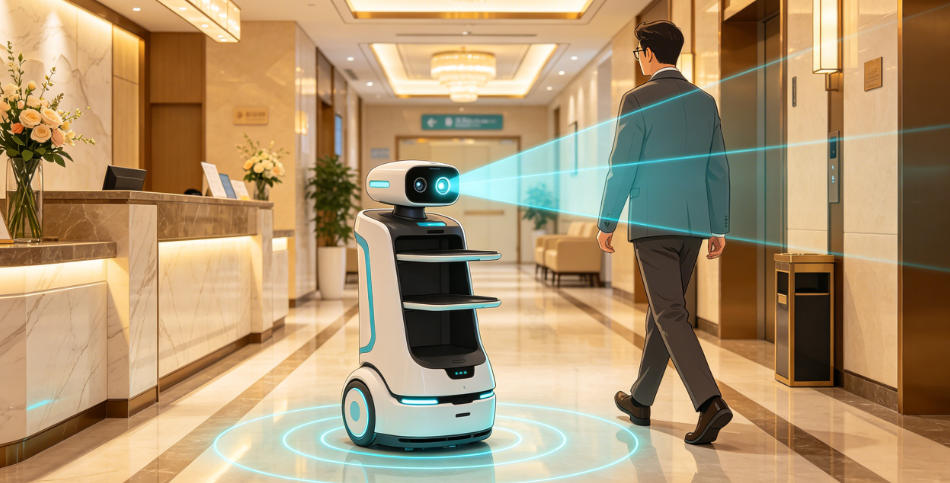
Service Robots
The service robotics market is rapidly expanding.
Applications include:
- Hotel delivery robots
- Medical service robots
- Retail guide robots
- Food delivery robots
ToF Cameras enable:
- Human detection
- Navigation
- Distance measurement
- Safe obstacle avoidance

Industrial Automation: Fastest-Growing ToF Market Segment
Industrial Inspection
ToF Cameras are widely used in:
- Product dimension measurement
- Defect detection
- Packaging inspection
- Surface contour analysis
Benefits include:
- Higher accuracy
- Faster speed
- Greater stability
Robotic Picking
Industrial robots use 3D ToF Cameras for:
- Object positioning
- Volume measurement
- Object recognition
- Grasp planning
Smart Logistics
Logistics automation relies on:
- Automated sorting systems
- AGV vehicles
- Intelligent conveyor systems
ToF Cameras enable:
- Parcel volume measurement
- Cargo recognition
- Path planning
- Automatic obstacle avoidance
AI Vision and ToF Integration Trend
AI + Time-of-Flight Camera is a major industry trend.
Human Detection
Used in:
- Smart offices
- Smart buildings
- Security systems
- Retail analytics
Behavior Analysis
AI + ToF enables:
- Human pose estimation
- Motion tracking
- Fall detection
- Abnormal behavior detection
AR/VR and Spatial Computing Growth
With devices like Apple Vision Pro, ToF Camera demand is rising.
AR Glasses
- Spatial mapping
- Environmental understanding
- Gesture recognition
VR Headsets
- Room scanning
- Motion tracking
- Mixed reality interaction
Smart Buildings & Security Applications
Smart Buildings
- People counting
- Space utilization
- Energy optimization
Smart Security
- Face recognition
- Liveness detection
- Intrusion detection
2026 ToF Camera Market Trends
Higher Resolution
- VGA ToF Camera
- HD depth camera
- Megapixel ToF sensor
Longer Range
- 5m range
- 10m range
- 20m+ industrial range
Lower Power Consumption
- Wearables
- AR glasses
- IoT devices
AI Edge Integration
- AI processors
- Edge computing modules
- Smart vision sensors
Robosense RS-lidar-M1/RS-lidar-M1 Plus 3D Vehicle grade intelligent solid-state LiDAR for autonomous driving

Conclusion
From the latest time-of-flight camera news today, it is clear that ToF Cameras, 3D ToF Cameras, and dToF Sensors are becoming core technologies in modern intelligent sensing systems. As robotics, industrial automation, AI vision, and spatial computing continue to expand, Time-of-Flight Camera technology will play an increasingly important role in bridging the physical and digital worlds.




Please upload banner from store admin blog pages