
Arduino Laser Sensor Tutorial: Build a High-Precision Detection System
How Can You Build a High-Precision Detection System Using an Arduino Laser Sensor?
In today’s rapidly evolving world of smart hardware and IoT, the Arduino laser sensor project (Arduino Laser Sensor) has become one of the most popular entry-level solutions for DIY developers and engineers. By combining laser distance measurement technology with the Arduino controller board, it is easy to build high-precision distance detection, obstacle recognition, and automated control systems.
Whether you are building a robot obstacle avoidance system, a smart security device, or an industrial-grade distance measurement prototype, this laser sensor arduino project can provide stable, fast, and highly accurate data output.
This article explains in detail how to build a complete arduino laser detector system (Arduino Laser Detector), including wiring methods, code implementation, and real-world applications, while naturally integrating such as arduino laser sensor, laser sensor arduino, and arduino laser detector.
Why Choose an Arduino Laser Sensor?
In various distance measurement and object detection solutions, the Arduino laser sensor (Arduino Laser Sensor) offers significant advantages over traditional ultrasonic or infrared sensors:
- High-precision measurement: Laser distance sensors can achieve millimeter-level accuracy (±1mm), allowing detection of even tiny objects or subtle movements. This makes them ideal for robotics positioning, precision engineering, and component inspection.
- Long-distance detection capability: Some laser modules can measure several meters or even over 100 meters, making them more suitable for large-scale indoor and outdoor environments.
- Fast response speed: Laser sensors can update data at millisecond-level speeds, ideal for real-time control and fast-moving object detection.
- Strong anti-interference ability: They are less affected by ambient light, temperature, or air conditions, ensuring stable performance in complex industrial environments.
- Compact and easy integration: Modular design allows easy connection with Arduino or other microcontrollers, making them suitable for DIY and industrial automation systems.
- Low power consumption and expandability: Many laser sensor modules support low-power modes and can be integrated with wireless communication or display modules for remote monitoring and data logging.
Therefore, laser sensor arduino solutions are widely used in many fields:
- Arduino robot obstacle avoidance systems: Enable precise obstacle detection and autonomous navigation for mobile robots, improving path planning efficiency.
- Smart warehouse automation systems: Used for measuring cargo height, volume, or position, supporting unmanned warehouse management and logistics automation.
- DIY laser distance meter projects: Build portable measuring tools for home, construction, or landscaping applications.
- Industrial safety zone monitoring: Detect object or human entry into restricted areas to ensure workplace safety.
- Smart agriculture height detection systems: Measure plant height, soil variation, or greenhouse conditions for precision farming.
- Automated production line positioning systems: Detect part positions, calibrate robotic arms, or control material flow in manufacturing.
By using the Arduino laser sensor (arduino laser sensor), developers can improve measurement accuracy and response speed while significantly reducing development costs, making it an ideal solution from DIY projects to industrial applications.

Arduino Laser Detector System Principle Overview
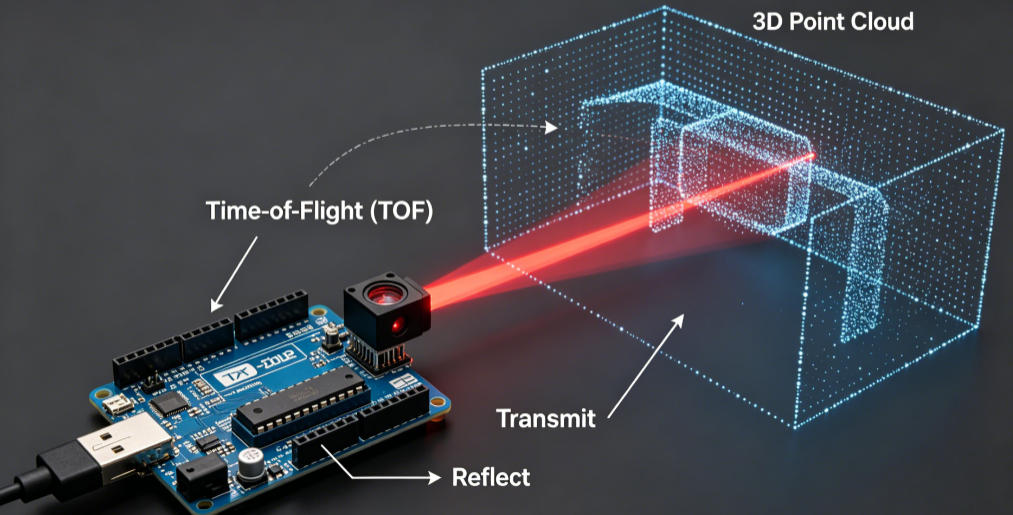
The core principle of the Arduino laser detector is based on Time of Flight (ToF) distance measurement technology:
- The laser emitter sends out a light beam
- The beam reflects off an object
- The sensor receives the reflected signal
- The system calculates the flight time of the light
- The result is converted into distance data output
This process enables the arduino laser sensor module (Arduino laser module) to achieve real-time, high-precision distance measurement.
Arduino Laser Sensor Wiring Guide
A typical laser sensor arduino module usually uses UART or TTL communication and can be connected easily.
Wiring Example:
| Sensor Pin | Arduino Pin | Function |
|---|---|---|
| VCC | 3.3V | Power |
| GND | GND | Ground |
| TX | D2 | Data TX |
| RX | D3 | Data RX |
⚠️ Note:
Arduino uses 5V logic levels, while some laser sensor arduino modules only support 3.3V. A level shifter may be required to prevent damage.
Arduino Laser Detector Project Applications and Implementation Methods
1. Robot Obstacle Avoidance System
The Arduino laser sensor can be used to build precise robot obstacle avoidance systems. By mounting the laser sensor arduino module on the front of a robot or on a rotating servo, distance data can be collected in real time. When an object is detected within a predefined threshold, the Arduino laser detector triggers motion control logic such as stopping, reversing, or turning toward a free direction. Combined with motor driver modules, this can form a complete autonomous navigation robot system. This approach is widely used in DIY robotics and AGV (Automated Guided Vehicle) development.
2. Smart Warehouse Automation
In warehouse management systems, the laser sensor arduino can be used to monitor cargo height, position, and inventory levels. By installing the Arduino laser sensor above shelves or at fixed positions, the system periodically scans height and stacking conditions. The Arduino laser detector analyzes the data to determine whether inventory is decreasing or if stacking exceeds safe limits. When combined with ESP8266 or ESP32 modules, data can be uploaded to the cloud for real-time monitoring and smart warehouse management, significantly improving logistics efficiency.
3. Industrial Safety Monitoring
In industrial environments, an Arduino laser detector can be used to build high-precision safety monitoring systems. For example, when installed around robotic arms or high-voltage equipment zones, the laser sensor arduino continuously detects whether a person or object enters restricted areas. If intrusion is detected, the system can trigger alarms, stop machines, or send IoT notifications. This greatly enhances industrial safety and reduces accident risks.

4. DIY Laser Distance Meter
Using the Arduino laser sensor, you can build a portable high-precision laser distance meter. Distance data from the laser sensor arduino is displayed on an OLED screen in real time, and the Arduino laser detector can support single-shot or continuous measurement modes. With button controls, signal filtering, and battery power supply, the system becomes a compact handheld measuring device. This laser sensor arduino DIY project is ideal for construction measurement, interior design, and engineering applications.
5. Smart Agriculture Monitoring
In precision agriculture, the Arduino laser detector can be used for plant height measurement, crop growth tracking, and terrain variation analysis. By mounting the laser sensor arduino module on a fixed stand or moving rail system, crop height is scanned regularly. Data collected by the Arduino laser sensor is transmitted wirelessly to the cloud, generating growth curves and integrating with temperature and humidity sensors. This enables advanced smart farming systems, greenhouse automation, and data-driven agriculture.
Arduino Laser Sensor Common Troubleshooting
1. No data output?
→ Check if TX and RX pins are correctly connected.
2. Garbled data?
→ Verify baud rate settings (e.g., 115200).
3. Sensor not responding?
→ Ensure correct 3.3V power supply.
4. Unstable readings?
→ Add filtering capacitors or avoid strong reflective environments.
Advantages of Arduino Laser Sensor / Laser Detector Systems
Using an arduino laser sensor or arduino laser detector system provides:
- Higher measurement accuracy
- More stable real-time data
- Strong scalability (LCD, WiFi, IoT integration)
- Better suitability for industrial prototyping
Vzense NYX Series ToF Sensor -NYX650-NYX660

Conclusion
The Arduino laser sensor project is an ideal entry point into IoT and smart hardware development. With simple wiring and coding, you can build a powerful arduino laser detector system widely used in industrial automation, robotics, and smart sensing applications.
If you are looking for a practical and highly educational project, the laser sensor arduino development solution is definitely worth exploring.





Please upload banner from store admin blog pages
Please select collection from store admin blog pages