Laser Range Sensor vs Triangulation Sensor: Which Is Best?
How Does a Laser Triangulation Sensor Work and When Should You Use It?
In industrial automation, smart manufacturing, and precision inspection, laser range sensors (Laser Range Sensor) and laser triangulation sensors (laser triangulation sensor / triangulation laser) are commonly used measurement solutions. While both utilize laser technology, they differ significantly in principle, accuracy, measurement range, and application scenarios. Understanding these differences helps engineers and developers choose the most suitable solution.
This article provides a detailed comparison of laser triangulation sensor, triangulation laser, lasertriangulation, and triangulation sensors, including their features, advantages, and practical applications, helping you make the best choice for automation, industrial measurement, and robotic control.
1. Introduction to Laser Range Sensors
Laser range sensors are precision distance measurement devices based on optical principles. They are widely used in industrial automation, smart robotics, unmanned warehousing, and construction measurement. Most sensors use Time-of-Flight (ToF) or phase measurement methods, emitting laser beams and receiving reflected light to accurately calculate the distance between the sensor and the target object.
Key features include:
- Long-distance measurement: Some laser range sensors can measure distances from a few centimeters up to hundreds of meters, suitable for large warehouses, factories, or outdoor environments.
- High-speed response: With millisecond-level measurement updates, they are ideal for fast-moving object detection, robot obstacle avoidance, and dynamic production line monitoring.
- Strong interference resistance: Advanced optical filtering and signal processing ensure stable measurements even under varying lighting, dust, or fog conditions.
- Versatile interfaces and easy integration: Most modules offer UART, I2C, or analog voltage outputs, allowing seamless integration with Arduino, STM32, or industrial PLC systems for automation and data acquisition.
- Wide application scenarios: From robot navigation and unmanned warehouse logistics to industrial automation measurement, and even construction or drone-based altitude measurement, laser range sensors provide reliable and stable data.
Although laser triangulation sensors excel in micron-level precision, laser range sensors have the advantage of longer measurement range, broader applicability, and simpler installation, especially in industrial or research scenarios requiring mid-to-long distance, fast response, and stable output.
Moreover, combining laser range sensors with triangulation sensors or other sensors enables multi-dimensional measurements, such as capturing distance, position, and surface profile simultaneously, providing a comprehensive solution for smart manufacturing, 3D modeling, and quality control.

2. Introduction to Laser Triangulation Sensors
Laser triangulation sensors (triangulation laser / lasertriangulation) are high-precision measurement devices based on the optical triangulation principle. They are widely used in industrial automation, precision machining, robotic grasping, quality inspection, and 3D surface scanning. By measuring the angular displacement of reflected laser beams, these sensors accurately calculate object position, distance, or height, achieving micron-level precision.
Working Principle
- The laser emitter projects a beam onto the target surface.
- The reflected light is captured by a receiver and produces angular displacement.
- Using geometric triangulation and sensor algorithms, the precise distance, height, or profile of the object is calculated.
This method enables triangulation sensors to deliver extremely high accuracy and stability over short measurement ranges.
Key Features
- High precision: Achieves micron-level resolution, ideal for precision part inspection, micro-surface profiling, and industrial assembly line quality control.
- High-speed sampling: Real-time acquisition can reach kilohertz levels, supporting rapid feedback for automated production lines and robotic grasping.
- Compact and modular design: Easy to integrate into robotic arms, production line inspection equipment, 3D scanners, and automated assembly systems, saving space and reducing retrofit costs.
- Adaptability to complex surfaces: Can measure transparent, reflective, or irregular surfaces, commonly used in electronic component inspection, glass thickness measurement, and plastic mold precision control.
- Multi-functional expansion: High-end lasertriangulation modules can be combined with cameras or PLCs for multi-point profile measurement, 3D scanning, and dimensional inspection, enhancing industrial automation intelligence.
Compared to traditional laser range sensors, laser triangulation sensors / triangulation sensors are unmatched in short-distance, high-precision measurement and micro-part inspection, making them ideal for precision industry, research labs, and smart manufacturing.
3. Laser Range Sensor vs. Triangulation Sensor Comparison
| Feature | Laser Range Sensor | Laser Triangulation Sensor |
|---|---|---|
| Principle | ToF / Phase Measurement | Optical Triangulation |
| Accuracy | Millimeter-level | Micron-level |
| Measurement Range | Medium to long (cm to hundreds of meters) | Short (mm to tens of cm) |
| Response Speed | Medium-high | High-speed, ideal for production lines |
| Cost | Relatively low | Relatively high |
| Applications | Robot navigation, warehousing, industrial automation | Precision part measurement, surface inspection, industrial detection |
From the comparison, if your application requires high precision and micro-movement detection, laser triangulation sensors are the best choice; if measurement range is more important, standard laser range sensors are more suitable.

4. Recommended Applications
1. Industrial Part Inspection
Laser triangulation sensors / triangulation sensors can measure thickness, diameter, and height at micron-level accuracy, making them ideal for precision part inspection, quality control, and real-time monitoring on automated assembly lines. They can quickly identify dimensional deviations, defects, and deformations, ensuring products meet strict standards while reducing manual inspection costs. Applications include automotive components, machined parts, and precision mold inspection.
2. Robotic Vision and Positioning
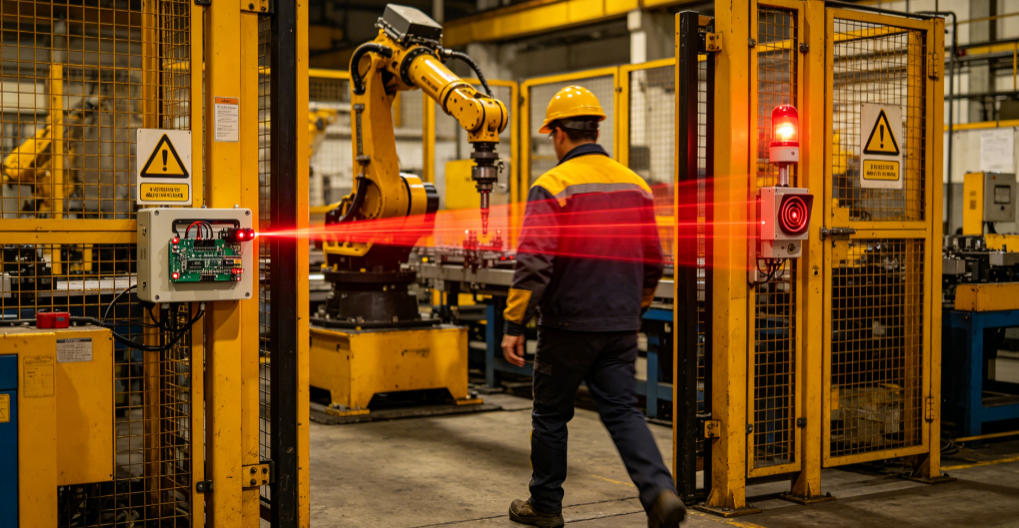
In robotic automation systems, triangulation lasers are widely used for object positioning and grasping. By accurately measuring object position and height, robots can adjust angles and paths quickly, improving handling accuracy and avoiding collisions. Integrated with vision systems and PLCs, lasertriangulation modules enable smart warehousing, industrial handling, AGV navigation, and collaborative robots (Cobots) with high-precision operation.
3. Surface Profile Scanning
Lasertriangulation technology can scan surfaces of metals, glass, plastics, and other materials to generate micron-level 3D surface models. Whether flat, curved, or complex geometry, triangulation sensors capture precise data quickly, applied in precision manufacturing, reverse engineering, mold inspection, and 3D printing quality control, enhancing product accuracy and production efficiency.
4. Small Object or Microstructure Measurement
In electronics, semiconductor chips, or MEMS devices, triangulation sensors can measure tiny parts, microstructures, and intricate profiles with micron-level precision. Applications include chip packaging inspection, PCB dimension measurement, micro-sensor R&D, providing accurate data for high-tech manufacturing and research experiments, ensuring product performance and reliability.
5. Other High-Precision Industrial Applications
Besides the above, laser triangulation sensors / triangulation laser / lasertriangulation are widely used in film thickness measurement, material flatness detection, automated assembly line monitoring, and smart factory quality management, offering reliable measurement solutions for modern manufacturing and intelligent factories.
5. Selection Recommendations
- High precision, short distance → Choose laser triangulation sensors / triangulation laser
- Long distance, medium precision → Choose standard laser range sensors
- Industrial production lines and precision assembly → Triangulation sensors are optimal
- Robot navigation and warehouse management → Laser range sensors are more cost-effective
Understanding the principles and applications of lasertriangulation and triangulation sensors allows you to select the most suitable sensor for different scenarios, improving efficiency and measurement accuracy.
IHaw Structured Light Camera P050 0.50M

Conclusion
Whether in precision industrial inspection, robotic automation, or smart manufacturing, laser triangulation sensors / triangulation laser / lasertriangulation / triangulation sensors demonstrate irreplaceable advantages. With micron-level accuracy, high-speed response, and adaptability to complex surfaces, these sensors not only meet the needs of industrial part inspection, surface profile scanning, and microstructure measurement but also provide reliable data support for automated production lines, smart warehousing, and 3D modeling.
Choosing the right triangulation sensors solution can significantly improve measurement precision and production efficiency while reducing labor costs and error risks. For manufacturers or R&D teams pursuing high precision, efficiency, and intelligence, mastering and applying lasertriangulation technology is a critical step toward enhancing competitiveness and realizing smart manufacturing.
Advanced laser sensors use precise laser light measurement technology to support applications such as industrial inspection and 3D measurement. Compared with traditional methods, laser displacement solutions and lasertriangulation technology provide accurate distance detection and reliable performance for high-precision sensing systems.




Please upload banner from store admin blog pages