
High Precision ToF Laser Distance Sensor for AGV & AMR Robots
How Do ToF Laser Distance Sensors Improve AGV and AMR Robot Navigation?
In the context of continuously advancing smart manufacturing and industrial automation, high-precision distance measurement has become a core component of robotic perception systems. Time-of-Flight (ToF sensor) technology is gradually replacing traditional ultrasonic and infrared ranging solutions and is now widely used in AGV obstacle avoidance system, AMR autonomous mobile robot navigation, smart warehouse automation, and industrial inspection equipment.
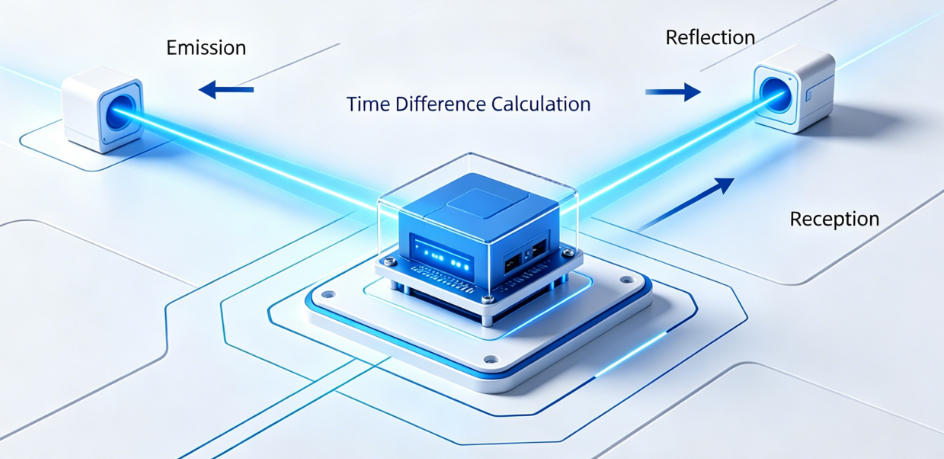
These laser distance sensors emit modulated optical signals and calculate the time difference between emission and echo return, enabling stable distance measurement. As a result, they offer high precision, low latency, and strong environmental adaptability, making them particularly suitable for continuous operation in complex industrial environments.
What is a ToF (Time-of-Flight) sensor?
A ToF sensor is a type of distance measurement technology that determines how far an object is by measuring the time it takes for a light signal to travel from the sensor to the target and back.
Inside the sensor, a VCSEL laser emitter (Vertical-Cavity Surface-Emitting Laser) emits invisible infrared light. When the light hits an object, it reflects back to the receiver. By calculating the round-trip time of the light, the system accurately determines the distance.
Compared with traditional sensing methods, ToF technology provides several key advantages:
- Millimeter- or centimeter-level measurement accuracy with stable output
- Fast response speed suitable for real-time robotics control systems
- Strong resistance to ambient light interference
- Reliable performance under complex reflective surfaces
I. Principles and Advantages of ToF laser distance technology
The core principle of ToF measurement lies in time-difference calculation. The sensor emits a modulated laser pulse and measures the time required for the reflected signal to return.
This approach offers several significant advantages:
In terms of accuracy, ToF distance sensors can maintain highly stable centimeter- or millimeter-level measurements. Even during long-term continuous operation, they show minimal drift, ensuring reliable performance in industrial automation systems.
In terms of response speed, laser ranging modules based on ToF enable millisecond-level real-time feedback, which is essential for dynamic obstacle avoidance and fast decision-making in robotics applications.
In addition, ToF sensors demonstrate strong resistance to ambient light variation. Whether in strong sunlight, low-light conditions, or environments with complex reflective surfaces, they maintain stable performance. This makes them far more reliable than ultrasonic or infrared-based solutions in industrial environments.

II. Core Features of Industrial-Grade ToF distance sensor modules
Based on typical industrial sensor designs, high-performance ToF modules offer several key features:
1. High Stability and Continuous Measurement Capability
These laser distance sensors support long-term continuous operation. Built-in signal filtering algorithms and multi-sampling techniques reduce noise and ensure smooth and stable output data, making them ideal for robotic navigation and automated production lines.
2. Compact Design for Embedded Integration
The modules are designed with a compact footprint, allowing easy integration into AGV robots, robotic arms, smart terminals, and edge computing nodes. This enables fast system deployment in industrial environments.
3. Multiple Industrial Communication Interfaces
To adapt to different applications, ToF distance sensors commonly support UART, I2C, or RS485 communication protocols. Some industrial-grade versions also support Ethernet interfaces, enabling seamless integration with PLC systems and ROS robotics platforms.
4. High Refresh Rate and Low Latency Output
In robotic navigation systems, real-time performance is critical. These modules provide high-frequency data output, ensuring continuous updates so that AGV navigation systems and AMR robots can accurately detect obstacles even during high-speed movement.
5. Strong Environmental Adaptability
Whether in dusty warehouse environments or outdoor industrial sites, laser distance modules maintain stable operation. Optimized optical design reduces multi-path reflection errors, ensuring consistent measurement accuracy.
6. Industrial-Grade Reliability
Designed with industrial-grade components and protective structures, these sensors support 24/7 continuous operation, making them suitable for smart factories, logistics warehouses, and automated production systems.
III. Applications of ToF laser distance sensors in robotics systems
In modern smart warehouse and industrial automation systems, AGV (Automated Guided Vehicle) and AMR (Autonomous Mobile Robot) platforms serve as key execution units in logistics and production lines. These robots rely heavily on high-precision sensors for environmental perception, distance measurement, and path planning.
In AGV obstacle avoidance systems, ToF distance sensors continuously scan the forward environment at high refresh rates and provide real-time distance information. When obstacles such as humans, shelves, or moving equipment are detected, the system can immediately trigger deceleration, stopping, or rerouting strategies, significantly improving operational safety.
In AMR navigation systems, ToF depth data is typically combined with SLAM (Simultaneous Localization and Mapping) algorithms. By continuously acquiring depth information, robots can build high-precision 3D maps and update their positions in dynamic environments, enabling stable operation in complex warehouses and narrow aisles.
In industrial robotic arm applications, ToF sensors are used for workpiece positioning, grasp calibration, and spatial distance correction. Real-time feedback helps improve grasping accuracy and assembly precision, especially in high-precision manufacturing environments.
In smart warehouse sorting systems, ToF modules are also used for package height detection, stacking recognition, and volume estimation. Through multi-point depth sampling and data fusion, systems can optimize logistics efficiency and storage planning.

IV. Comparison Between ToF sensors and traditional distance measurement technologies
In industrial automation systems, common distance measurement technologies include ultrasonic sensing, infrared reflection, and laser-based ranging. However, their performance differs significantly.
Ultrasonic sensors are low-cost and suitable for short-range detection, but they are highly affected by air turbulence, temperature changes, and material absorption. This limits their reliability in complex industrial environments.
Infrared sensors have fast response times but limited measurement range and strong sensitivity to ambient light conditions, making them less suitable for high-precision robotics applications.
In contrast, ToF laser distance sensors provide superior accuracy, faster response, and stronger environmental robustness. They maintain stable performance under low light, strong light, and multi-reflection conditions.
More importantly, ToF technology integrates naturally with modern robotics systems such as SLAM algorithms, AI vision systems, and edge computing platforms. As a result, ToF sensors have become a standard component in smart factories, unmanned warehouses, and automated logistics systems.
V. Core value of ToF sensors in smart manufacturing
With the development of Industry 4.0, more enterprises are adopting automation systems based on laser distance measurement and depth sensing technologies.
ToF sensors improve perception capability and enhance system safety. In unmanned logistics systems, they help prevent collisions. In production lines, they enable real-time inspection and positioning correction. In AI robotics systems, they enhance 3D environmental understanding when combined with vision algorithms.
With the rise of edge computing and AI vision, ToF depth data is increasingly used as key input for machine learning models, supporting more intelligent decision-making systems.
Continental ARS548 RDI imaging millimeter wave radar 4D high-precision stereo perception 77GHz long range detection radar

VI. Conclusion
ToF laser distance sensors are driving rapid development in industrial automation and robotics. With high precision, industrial-grade stability, and flexible integration capabilities, they have become essential components in AGV systems, AMR navigation, smart warehouses, and industrial inspection applications.
In future smart factories and unmanned logistics ecosystems, ToF sensing technology will continue to play a central role in advancing machine perception and spatial intelligence.





Please upload banner from store admin blog pages
Please select collection from store admin blog pages