
How ToF Depth Sensing Improves Navigation in Warehouse Robots
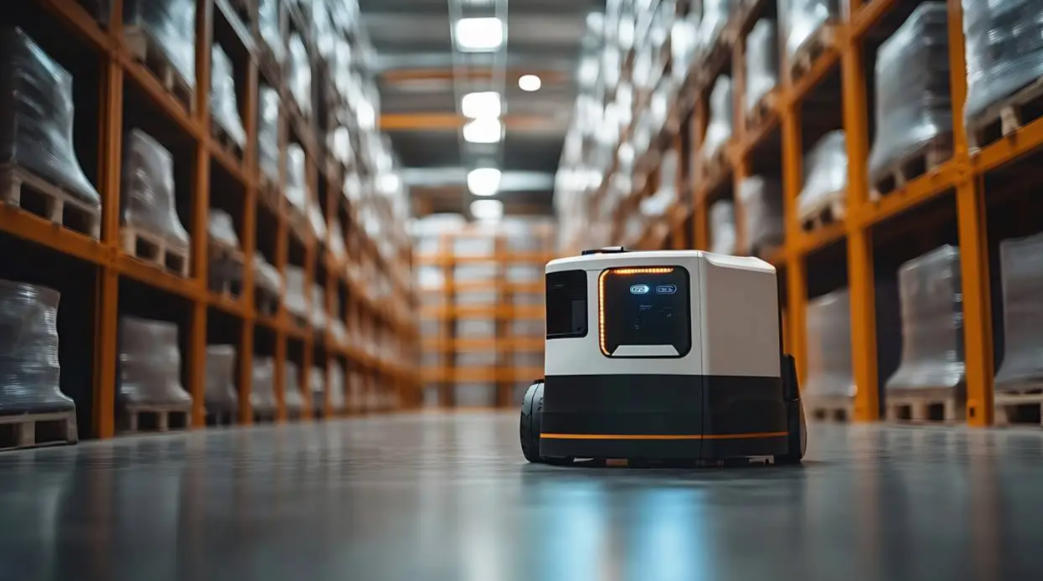
How Can ToF Depth Sensing Improve Navigation and Obstacle Avoidance for Warehouse Robots?
ToF Depth Sensing Accelerates Intelligence Upgrades for AGVs and AMRs
With the rapid global expansion of smart warehousing, intelligent logistics, and Industry 4.0, mobile robots for warehouse automation—including AGVs (Automated Guided Vehicles), AMRs (Autonomous Mobile Robots), autonomous forklifts, and mobile handling robots—have become core infrastructure in modern logistics systems.
As warehouse environments grow more complex, dynamic, and high-density, robots face rising requirements for environmental perception accuracy, autonomous decision-making, operational safety, and system-level efficiency. In this context, Time-of-Flight (ToF) 3D depth sensing technology is emerging as a critical enabler for next-generation intelligent warehouse robots.
What Is Time-of-Flight (ToF) Depth Sensing Technology?
TOF (Time-of-Flight) is an active 3D sensing technology that measures distance by emitting modulated light—typically infrared—and calculating the time or phase difference of the reflected signal. This allows the sensor to compute accurate distance information between the robot and surrounding objects.
Unlike passive vision systems, ToF depth cameras generate real-time depth maps and 3D point clouds independent of ambient lighting or surface texture. Key advantages include:
-
High measurement accuracy: millimeter- to centimeter-level depth precision
-
Real-time performance: high frame rates suitable for dynamic scenes
-
Strong environmental robustness: stable operation under strong light, low light, or complete darkness
-
AI-friendly structured output: depth data aligns naturally with image coordinates
As a result, ToF technology is widely applied in robot navigation, obstacle avoidance, pallet recognition, industrial automation, autonomous forklifts, service robots, and 3D inspection systems, where reliable spatial perception is essential.

1. Intelligence and Automation: ToF Strengthens Core Robot Capabilities
As smart logistics systems evolve, warehouse robots are shifting from rule-based execution tools to intelligent autonomous systems capable of perceiving, understanding, and interacting with their environment. At the heart of this transformation lies highly reliable 3D perception, where ToF depth sensing plays a foundational role.
1.1 Autonomous Navigation and Obstacle Avoidance Upgrades
Traditional AGVs depend on magnetic strips, QR codes, or fixed tracks, offering limited flexibility. Modern warehouses increasingly deploy AMRs with autonomous navigation, requiring real-time perception, dynamic path planning, and adaptive decision-making.
By integrating ToF depth cameras with LiDAR, IMUs, SLAM algorithms, and AI models, mobile robots can achieve:
-
High-precision 3D environment modeling
-
Real-time detection of dynamic obstacles such as people, forklifts, and pallets
-
Autonomous navigation and on-the-fly path replanning
-
Stable operation in unknown or frequently changing environments
Compared with LiDAR, which excels at mid- and long-range contour detection, ToF sensors provide superior near-field perception, accurately capturing low obstacles, edges, and height differences—critical in narrow aisles, dense shelving, and mixed human-robot environments.
2. Enhanced Visual Recognition Stability in Real Warehouses
Warehouse environments present significant challenges for traditional 2D vision systems, including variable lighting, reflective surfaces, low-texture goods, and cluttered backgrounds. These conditions often cause misdetections under:
-
Strong or uneven lighting
-
Shadowed or backlit areas
-
Similar-colored goods and flooring
-
Stacked or partially occluded items
ToF depth sensing directly measures physical distance, effectively bypassing these limitations:
-
Lighting-independent performance
-
Accurate measurement of object height, volume, and spatial structure
-
Reduced false positives through physically constrained depth data
-
Cleaner, more interpretable input for AI perception algorithms
As a result, ToF has become a core sensor for warehouse robot vision systems, supporting tasks such as navigation, gripping, alignment, obstacle avoidance, and collision prevention.
3. Adapting to Narrow Spaces and Maximizing Storage Density
To improve space utilization, modern warehouses increasingly adopt high-density shelving, narrow aisles, and vertical storage systems, placing higher demands on robot maneuverability and perception accuracy.
AGVs and AMRs equipped with ToF depth cameras and omnidirectional drive systems (such as Mecanum wheels) can achieve:
-
Centimeter-level positioning accuracy in tight spaces
-
Safe navigation through narrow aisles and dense storage zones
-
Precise recognition of shelf edges, columns, and boundaries
-
Reduced dependence on fixed infrastructure, enabling flexible deployment
ToF sensors offer particularly high accuracy within the 0–2 meter range, making them ideal for docking, alignment, precise manipulation, and short-range collision avoidance.
4. Accurate Cargo Positioning and Intelligent Handling
Beyond movement, intelligent warehouse robots must handle goods precisely and reliably. When combined with AI algorithms, ToF depth cameras enable fine-grained spatial understanding:
-
Accurate detection of cargo position, orientation, and posture
-
Real-time evaluation of stack height, volume, and stability
-
Compatibility with diverse cargo shapes, sizes, and placements
-
Reduced picking errors and minimized human intervention
Compared with 2D vision, true depth data significantly improves robustness in complex backgrounds, occluded scenes, and variable lighting—making ToF indispensable for autonomous forklifts, robotic picking systems, and flexible logistics automation.

5. Multi-Robot Collaboration and Intelligent Scheduling
Large-scale warehouses increasingly rely on multi-robot coordination to maximize throughput. ToF depth sensing provides reliable local perception data that supports:
-
Real-time spatial awareness around each robot
-
Dynamic path adjustment to prevent congestion
-
Collision-free task allocation and cooperation
-
Efficient fleet-level scheduling and optimization
Accurate 3D perception is the foundation for stable, scalable multi-AGV and multi-AMR systems.
6. 5G + ToF + Edge AI: Enabling Real-Time Smart Warehousing
The integration of 5G networks, ToF depth sensing, and edge AI computing is redefining intelligent logistics systems.
6.1 5G Enhances Data Transmission and System Responsiveness
5G enables low-latency, high-bandwidth transmission of ToF depth maps and point clouds, supporting:
-
Millisecond-level response for navigation and obstacle avoidance
-
Real-time cloud-based analytics and coordination
-
Edge-cloud collaboration for scalable robot fleets
-
Simultaneous operation of dozens or hundreds of robots
6.2 ToF + Edge AI for Local Autonomy
With edge computing, robots can process depth data locally to achieve:
-
Real-time AI inference for obstacle and cargo recognition
-
Autonomous path planning and collision avoidance
-
Reduced reliance on central servers
-
Improved fault tolerance and system resilience
Together, ToF + Edge AI + 5G form a mainstream architecture for high-density, flexible, and intelligent warehouse systems.

7. Human-Robot Collaboration and Safety
In mixed human-robot environments, safety is critical. ToF depth sensing enables:
-
Real-time monitoring of human-robot distance
-
Dynamic safety zone configuration
-
Speed reduction, warnings, or emergency stops
-
Reliable close-range human detection and posture recognition
This makes ToF a key sensor for safe human-robot coexistence in modern warehouses.
8. Continuous Operation and System Reliability
Modern ToF sensors feature compact size, low power consumption, and high reliability, making them ideal for:
-
Seamless robot integration
-
Extended battery life
-
24/7 continuous operation in industrial environments
These characteristics provide a strong foundation for long-term stable warehouse automation.
Future Outlook: ToF Becomes a Standard Sensor for Warehouse Robots
As intelligent logistics continues to expand, mobile warehouse robots are evolving toward:
-
Stronger perception and autonomy
-
Higher coordination efficiency
-
Safer human-robot collaboration
With its high precision, robustness, and AI compatibility, Time-of-Flight depth sensing is transitioning from a premium feature to an industry-standard sensor for AGVs, AMRs, autonomous forklifts, and smart warehouse robots.
Conclusion
Amid global and China-led upgrades in intelligent logistics and warehouse automation, ToF depth sensing is reshaping robotic perception systems. Through deep integration with AI, 5G, IoT, and edge computing, ToF not only enhances navigation and obstacle avoidance, but also enables intelligent scheduling, safe collaboration, and efficient operations.
As technology matures and costs continue to decline, ToF will play a central role in driving smart warehousing and logistics automation to new levels of efficiency, flexibility, and intelligence.
AllSENSOR 20M Outdoor Fully Solid-State LiDAR S150

After-sales Service: Our professional technical support team specializes in TOF camera technology and is always ready to assist you. If you encounter any issues during the usage of your product after purchase or have any questions about TOF technology, feel free to contact us at any time. We are committed to providing high-quality after-sales service to ensure a smooth and worry-free user experience, allowing you to feel confident and satisfied both with your purchase and during product use.




Please upload banner from store admin blog pages