Laser Distance Sensor Selection Guide | Measurement & Applications
What is a measurement laser sensor and how do you choose the right laser distance module or high precision laser distance sensor for industrial use?
In the context of rapid development in industrial automation, smart manufacturing, and robotics, the measurement laser sensor has become a core component of modern high-precision distance measurement systems.
Whether in AGV/AMR navigation systems, industrial production lines, smart warehouses, or structural monitoring, the demand for measurement accuracy and stability continues to increase. This has made the laser distance module and high precision laser distance sensor the mainstream solutions.
This article systematically explains how to select the right laser measurement solution, covering principles, types, selection methods, and application scenarios.
1. What is a measurement laser sensor?
A measurement laser sensor is a non-contact industrial sensor that uses laser technology to measure distance or position. It emits a laser beam toward a target object and receives the reflected signal. Based on ToF (Time-of-Flight), phase measurement, or triangulation principles, it calculates distance, displacement, or height with high precision.
Compared with ultrasonic or infrared sensors, a measurement laser sensor provides more stable and accurate performance in complex industrial environments due to the strong directionality and stability of laser propagation.
In operation, the core mechanism relies on precise calculation of time differences or phase shifts. ToF measures the travel time of light, phase-based methods analyze modulation phase differences, and triangulation uses geometric displacement of the light spot. Together, these technologies enable millimeter-level or even sub-millimeter accuracy.
Structurally, a typical measurement laser sensor consists of a laser emitter, photodiode receiver, signal processing chip, and communication interface. Output interfaces usually include UART, I2C, and RS485, where UART is widely used in industrial control systems, RS485 is suitable for long-distance multi-node networks, and I2C is commonly used in low-power embedded or IoT devices.
Compared with traditional sensing technologies, it offers higher precision, longer range, faster response, and stronger anti-interference capability. It maintains stable performance even in dust, lighting changes, or electromagnetic interference, making it widely used in high-reliability measurement tasks.
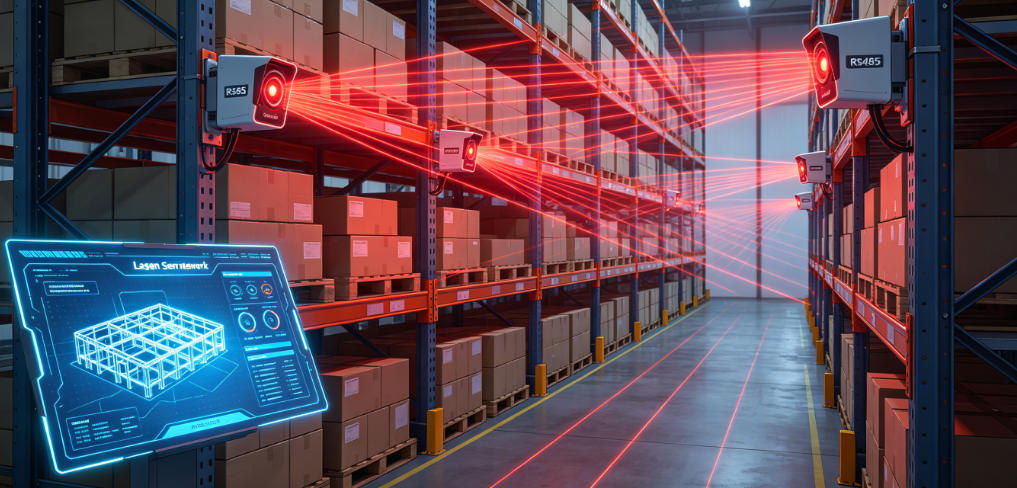
In applications, it has become a key component of industrial automation systems, including production line positioning and dimensional inspection; smart warehouses for height detection and shelf distance measurement; robotics navigation and AGV/AMR systems for obstacle avoidance and path planning; as well as infrastructure monitoring, bridge displacement detection, and smart city traffic systems. With Industry 4.0 and smart manufacturing, it is becoming an indispensable sensing technology.

2. Working principle of laser distance module
A laser distance module is a typical implementation of a measurement laser sensor.
Its main principles include:
1. ToF (Time-of-Flight)
Distance is calculated by measuring the time difference between laser emission and return reflection.
2. Phase Shift Method
Improves accuracy by analyzing phase differences of modulated light signals, widely used in industrial applications.
3. Triangulation
Uses geometric displacement of the laser spot for short-range high-precision measurement.
Typical structure
A laser distance module generally includes:
- Laser emitter
- Photodiode receiver
- Signal processing IC
- Communication interface (UART / I2C / RS485)
3. Core advantages of high precision laser distance sensor
Compared with traditional sensing methods such as ultrasonic, infrared, or mechanical contact measurement, the high precision laser distance sensor offers significant advantages in industrial environments, especially in terms of accuracy, stability, and environmental adaptability.
1. High precision measurement capability
A high precision laser distance sensor can achieve ±1 mm accuracy or even sub-millimeter performance in some systems. This makes it suitable for precision measurement applications such as dimensional inspection, automated assembly positioning, and high-resolution displacement monitoring. In high-speed production lines, it ensures consistent quality control and improved manufacturing accuracy.
2. Non-contact measurement method
It operates without physical contact, preventing wear or interference with moving targets. This makes it ideal for high-temperature, high-pressure, or high-speed environments such as steel manufacturing, automated production lines, robotic handling systems, and hazardous area detection. It also enhances safety and extends equipment lifespan.
3. Long measurement range
The sensor supports a wide range from a few centimeters to several hundred meters. It is suitable for both short-range precision tasks and long-range industrial monitoring. For long range laser sensor applications such as port logistics, warehouse stacking, bridge monitoring, or large machinery positioning, it provides stable and reliable distance data.
4. Strong anti-interference capability
In complex industrial environments, factors such as lighting changes, dust, smoke, or electromagnetic interference can affect traditional sensors. However, the high precision laser distance sensor uses narrow laser beams and advanced signal processing to filter noise and maintain stable output. It performs reliably even in outdoor or harsh environments such as mining sites or construction areas.
5. Fast real-time response
It supports high-frequency data output with millisecond-level response, making it suitable for dynamic control systems. In fast-moving or continuous production environments such as AGV/AMR navigation, automated sorting, or high-speed inspection systems, it ensures rapid response to environmental changes and improves system efficiency and safety.

4. How to choose a measurement laser sensor
Key selection factors include:
1. Measurement range
- Indoor: 0–4 m (ToF sensors)
- Industrial: 10–50 m
- Surveying: 100 m+
2. Accuracy requirement
- General applications: ±5 mm
- Industrial control: ±1–3 mm
- Precision manufacturing: ≤±1 mm
3. Communication interface
- I2C: low-power IoT devices
- UART: industrial standard
- RS485: long-distance industrial networks
4. Environmental adaptability
- Outdoor laser sensor capability
- IP protection rating
- Vibration resistance
5. Power supply
- 3.3V IoT devices
- 5–24V industrial systems
5. Applications of measurement laser sensor
1. Industrial automation systems
Used for positioning and detection in production lines.
2. AGV/AMR navigation systems
Using high precision laser distance sensors for:
- Obstacle avoidance
- Path planning
- Dynamic navigation
3. Smart warehouse logistics
- Cargo height detection
- Shelf distance measurement
- Automated sorting
4. Construction and infrastructure monitoring
- Structural displacement monitoring
- Bridge safety inspection
- Tunnel deformation detection
5. Smart city applications
- Parking detection
- Traffic monitoring
- Infrastructure safety systems
6. Comparison with other distance measurement technologies
| Technology | Accuracy | Range | Cost | Application |
|---|---|---|---|---|
| Ultrasonic | Medium | Short | Low | Basic obstacle avoidance |
| Infrared | Low | Short | Low | Simple detection |
| ToF laser sensor | High | Short | Low–Medium | IoT devices |
| measurement laser sensor | Very high | Medium–Long | Medium–High | Industrial systems |
7. Future trends of measurement laser sensor
1. Higher precision (sub-millimeter level)
Meeting advanced manufacturing requirements.
2. Longer measurement range
For large-scale industrial and outdoor applications.
3. Miniaturization
Better integration into embedded and IoT devices.
4. AI + laser fusion
Combining vision and sensing for intelligent decision-making.
5. IoT cloud integration
Supporting MQTT, 5G, and cloud platforms.
XT-S240 Mini 106°×80°, Outdoor 10m, Indoor 12m Solid-State Flash Lidar

8. Conclusion
The measurement laser sensor is becoming an essential sensing technology in industrial automation and intelligent systems.
Both the laser distance module and high precision laser distance sensor are driving distance measurement technology toward higher precision and smarter applications.
As costs decrease and technology matures, these sensors will see large-scale adoption in AGV navigation, smart warehouses, industrial inspection, and smart city systems, becoming a foundational technology for future intelligent sensing systems.





Please upload banner from store admin blog pages
Please select collection from store admin blog pages