
Laser Divergence : How Beam Divergence Affects Range & Accuracy
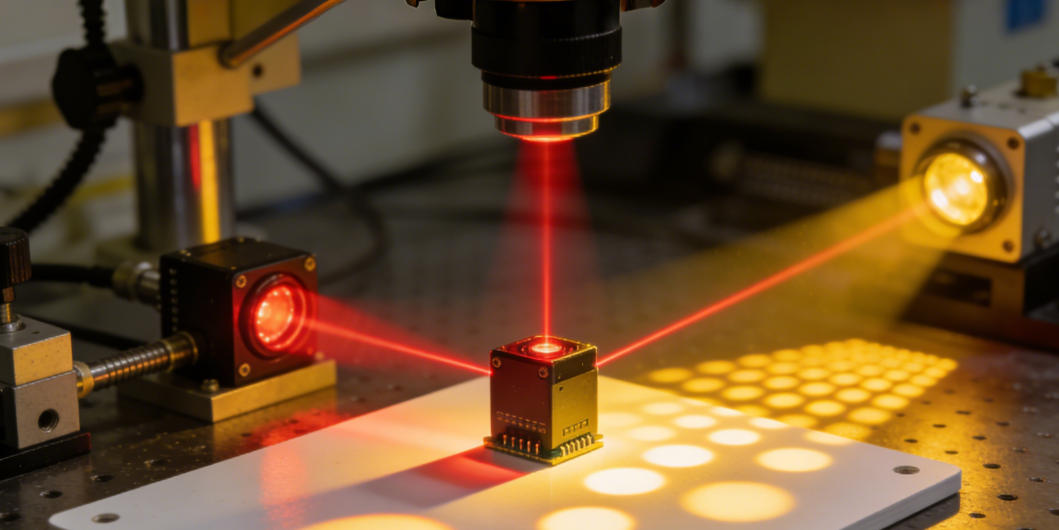
What Is Laser Divergence and How Does It Affect Rangefinder Accuracy?
In modern optoelectronic systems, Laser Rangefinders (LRF) are widely used in industrial measurement, drones, autonomous vehicles, and military applications. Whether it’s a handheld laser or a high-end laser designator, a key performance parameter is the angle of divergence.
This article provides a comprehensive analysis of beam divergence, its definition, calculation methods, impact on ranging performance, and real-world applications, including systems like the US Army laser designator.
What is Laser Divergence Angle (Angle of Divergence)?
Beam divergence describes the angle at which a laser beam gradually spreads as it propagates. It is usually measured in milliradians (mrad). Simply put, a laser beam does not remain perfectly parallel; it spreads outward like a gradually widening cone. Smaller divergence angles mean more concentrated beams; larger angles mean more dispersed beams.
Laser divergence affects not only the beam spot size but also ranging accuracy, effective range, and target recognition capability. In industrial measurement, drone LRFs, handheld lasers, and military laser designators, understanding and controlling divergence is a core technical requirement.
Simply put:
👉 A laser is not a perfectly straight line—it widens with distance.
For example:
- 1 mrad divergence → At 1 km, the laser spot diameter is about 1 meter.
- 0.3 mrad divergence → At 1 km, the spot expands only to 0.3 meters.
This means that smaller divergence concentrates laser energy, reducing beam coverage and improving long-range measurement accuracy and target-lock capability. Conversely, a large divergence angle covers more area but reduces precision and effective distance.
Divergence is also affected by optical component quality, laser wavelength, and environmental factors (e.g., atmospheric scattering, fog). In high-end applications, such as the US Army handheld laser designator, extremely low divergence ensures long-range target designation and precise guidance.

Divergence Angle and Spot Size
The laser spot size on a target is directly determined by beam divergence and measurement distance. It can be estimated using:
Spot Size ≈ Distance × Beam Divergence
In other words, the spot size grows with distance; larger divergence spreads the beam faster, while smaller divergence keeps the beam concentrated for precise targeting.
For example:
- 0.3 mrad × 1000m = 0.3m (30cm) → Highly concentrated spot, suitable for long-range high-precision measurement or precision guidance.
- 1 mrad × 1000m = 1m → Larger spot, suitable for covering moving targets or short-range measurement, but less precise.
Why Spot Size Matters
-
Ranging Accuracy
Smaller spots concentrate laser energy on the target surface, producing stronger return signals for more accurate measurements. -
Target Recognition
Smaller spots can differentiate small or densely packed targets, reducing interference. Large spots may cover multiple targets, reducing accuracy. -
Effective Range
Spot size affects return signal strength. Small divergence → concentrated spot → longer range. Large divergence → dispersed spot → shorter effective distance. -
Application Scenarios
- Handheld Lasers: Slightly larger spots make it easier to quickly lock onto targets.
- Industrial or drone LRF modules: Smaller spots improve precision and stability.
- Military Laser Designators (US Army): Tiny spots ensure accurate long-range target marking and guidance.
Summary: Beam divergence is a key factor influencing spot size. Understanding this relationship helps select the right LRF device for optimal measurement accuracy and target recognition.
How Beam Divergence Affects Ranging Performance
Beam divergence not only affects spot size but also ranging accuracy, effective range, and target recognition. Understanding this is crucial for optimizing performance in industrial, drone, or military applications.
1. Effect on Effective Range
Divergence directly affects beam energy density:
- Small divergence → concentrated beam → strong return signal even at long distances → longer effective range.
- Large divergence → dispersed beam → weaker return signal → shorter effective range.
Typical examples:
- 0.5 mrad → Can measure targets up to ~2 km, suitable for industrial long-range or drone applications.
- 3 mrad → Beam spreads too widely → effective range may be only ~300m, suitable for short-range or large target applications.
Thus, effective range is inversely proportional to beam divergence: smaller divergence → longer range; larger divergence → shorter range.
2. Effect on Ranging Accuracy
Larger divergence increases spot size, reducing precision:
- Spot covers target edges or nearby objects → potential measurement errors or “jump points.”
- Especially critical for small targets or high-precision applications.
Examples:
- Small targets (e.g., utility poles, pipeline markers) → require low divergence (0.3–0.5 mrad) for concentrated beams and high accuracy.
- Large targets (e.g., buildings, vehicles) → can tolerate larger divergence (1–3 mrad), easier to locate quickly but less precise.
Controlling divergence is key in drone-based or industrial automated measurements.
3. Effect on Target Recognition
In complex environments (forests, rain, cluttered backgrounds):
- Large divergence → beam covers multiple objects → confused return signal, reducing recognition accuracy.
- Small divergence → concentrated beam → precise single-target lock even at long distances or in complex environments.
Hence, high-end laser designators and military systems like the US Army handheld laser designator use extremely low divergence:
- Small spot → high energy density → reliable long-range target marking and guidance
- Enhanced precision → improves mission success in combat or measurement tasks
Summary:
- Effective range: small divergence → long distance; large divergence → short distance
- Ranging accuracy: small divergence → high precision; large divergence → lower precision
- Target recognition: small divergence → precise lock; large divergence → potential interference
Controlling beam divergence is essential when designing or selecting handheld lasers, LRF modules, or laser designators.
Advantages and Disadvantages of Divergence
| Type | Advantages | Disadvantages |
|---|---|---|
| Small divergence (≤0.3 mrad) | High precision, long range | Difficult to aim |
| Large divergence (≥1 mrad) | Easy to aim, good for moving targets | Low precision, shorter range |
👉 Essentially a trade-off between precision and usability.
Divergence Selection for Different Applications
1. Handheld Laser
- Typical divergence: 1–3 mrad
- Features: easy to aim, suitable for short-to-medium range
- Applications: golf, construction measurement, engineering surveys
2. Industrial LRF Modules
- Typical divergence: 0.3–1 mrad
- Applications: automated inspection, drone measurements
- Features: balanced precision and stability
3. Military Laser Designator
- Divergence: typically ≤0.3 mrad, sometimes lower
- Applications: precision guidance, long-range target designation
- In US Army systems, low divergence means:
- Smaller spot size
- Higher energy density
- Longer effective range
- Can mark targets several kilometers away, up to ~10 km

Why Divergence Can’t Be Zero
Ideally, lasers would be perfectly parallel, but in reality:
- Optical system errors
- Diffraction effects
- Atmospheric disturbances
…all cause unavoidable beam divergence.
👉 Therefore, beam divergence is an inherent property of all laser systems.
How to Optimize Laser Divergence
Optimizing angle of divergence is key for improving precision and effective range in LRF modules / laser rangefinder modules, handheld lasers, and military laser designators.
1. Improve Optical Collimation
- High-quality lenses → reduce beam scattering and maintain concentration
- Larger output aperture → reduces diffraction effects
Principle: smaller apertures cause more diffraction → wider beams. Increasing aperture reduces divergence and maintains energy density at long distances.
2. Choose Appropriate Wavelength
- Short wavelengths (e.g., 532nm) → smaller spots but more affected by atmospheric scattering
- Mid-infrared (e.g., 1535nm) → long-range measurement, less affected by fog, smaller divergence, stable signals
Choosing the right wavelength optimizes beam concentration and effective range depending on the application (industrial, drone, military).
3. Precision Mechanical Design
- Minimize optical axis misalignment → prevents additional beam spreading
- Vibration-resistant / stabilization design → maintains divergence consistency on handheld or mobile platforms
4. Other Methods
- Beam shapers → transform Gaussian beams into flat-top profiles → reduce effective divergence
- Temperature control → stabilizes wavelength and optical properties, keeping divergence consistent
Benefits
Optimized divergence in high-end laser rangefinder modules and laser designators enables:
- Concentrated beam → improved measurement accuracy
- Extended effective range → long-range target designation for military systems
- Enhanced target recognition → precise lock even in complex environments
Optimizing divergence is crucial—from optical design and wavelength choice to mechanical precision.
Conclusion: How to Choose the Right Divergence
When selecting divergence, consider:
- Measurement distance (effective range)
- Target size
- Operating environment
- Stability requirements
Summary:
👉 Long distance + small target → small beam divergence
👉 Short distance + large target → larger divergence
IHaw Structured Light Camera P050 0.50M

After-sales Service: Our professional technical support team specializes in TOF camera technology and is always ready to assist you. If you encounter any issues during the usage of your product after purchase or have any questions about TOF technology, feel free to contact us at any time. We are committed to providing high-quality after-sales service to ensure a smooth and worry-free user experience, allowing you to feel confident and satisfied both with your purchase and during product use.





Please upload banner from store admin blog pages