What is a ToF Camera? Complete Guide to ToF Cameras & 3D Depth Sensing
hat is a ToF Camera and How Do ToF Cameras Work in 3D Vision?
With the rapid development of 3D vision, artificial intelligence, and machine vision technologies, camera tof (Time of Flight camera) has become a key technology in various industries. From smartphones and industrial automation to robotics, the application of tof cameras is becoming increasingly widespread.
So, what exactly is a ToF camera? How does it work, and why does it stand out among other 3D vision technologies? This article provides a detailed explanation.
1. What is a ToF Camera (Time of Flight Camera)
A ToF camera (Time of Flight Camera) is a 3D depth camera based on the principle of measuring the time it takes for light to travel to an object and back. It is also commonly referred to as a ToF depth camera or ToF sensor. Unlike traditional cameras that only capture 2D images, camera tof can capture depth information for each pixel while taking an image, generating precise three-dimensional spatial data. This means that every point, edge, and even subtle surface details of an object can be accurately measured and modeled.
In other words, tof cameras not only 'see' images but also 'understand' space, determining the distance, shape, and position of objects. This capability makes ToF depth cameras critical in 3D vision, AI, robotic navigation, and augmented reality applications. For example, in smartphones, camera tof enables fast facial recognition and accurate depth-of-field effects. In industrial automation, tof cameras can measure object dimensions, assist robot navigation, and inspect production line quality.
Additionally, the ToF measurement principle allows these cameras to work reliably in complex lighting or low-light environments, overcoming the limitations of traditional cameras in dark or textureless conditions. With their high precision, real-time performance, and resistance to interference, camera tof has become an essential sensor for future smart devices, automation systems, and 3D modeling applications.

2. Principles of ToF Depth Cameras
The core technology of a ToF camera (Time of Flight Camera) is 'time-of-flight measurement.' It calculates the distance by measuring the time it takes for light to travel from the camera to the object and back, generating high-precision 3D depth data. In other words, camera tof can directly sense the distance of every point in space. Compared to traditional cameras, it can not only 'see' objects but also “measure” their position and shape.
The workflow of a ToF depth camera typically includes the following steps:
- The ToF sensor emits infrared or modulated light signals, covering the entire field of view.
- The light reflects off the surface of the target object and returns to the camera.
- The camera receives the reflected light and records the time of arrival.
- The system calculates the round-trip time (Time of Flight) to determine the distance for each pixel.
- Using the speed of light, the actual distance is calculated, generating a complete depth map and 3D spatial data.
Because the speed of light is constant, tof cameras can measure distances in microseconds, enabling real-time 3D perception. This makes ToF depth cameras especially effective in applications that require high-speed responses, such as robotic navigation, autonomous driving, industrial inspection, and augmented reality.
Compared to traditional stereo vision or structured light solutions, camera tof does not require complex image matching or projection coding to generate depth data. This reduces computational delays and makes ToF depth cameras more stable in dynamic environments, even when objects move quickly or lighting conditions change.
Modern ToF cameras are also equipped with high-sensitivity sensors and specialized algorithms to reduce ambient light interference, improving measurement accuracy in low-light or textureless scenarios. This is why tof cameras are widely used in industrial automation, 3D facial recognition in smartphones, and robotic vision systems.
3. Key Advantages of tof cameras
The rapid growth of ToF technology in the 3D depth camera market is driven by its multiple advantages.
First, camera tof provides real-time 3D perception, quickly capturing scene depth and generating precise 3D models. This capability makes it ideal for applications that require immediate spatial feedback, such as robotic navigation, autonomous vehicles, drones, and industrial automation, significantly improving system responsiveness and operational precision.
Second, ToF depth cameras offer high measurement accuracy, capable of precisely capturing object distance, size, and shape. In industrial inspection, volume measurement, logistics sorting, and quality control, tof cameras provide crucial data. Compared to traditional measurement methods, ToF cameras are faster and more accurate, capable of stable operation in complex, dynamic environments.
Additionally, tof cameras maintain performance in low-light or even no-light conditions, giving them significant advantages in security surveillance, smart homes, and nighttime monitoring. Compared to other 3D vision technologies, ToF depth cameras are less sensitive to ambient light changes and surface textures, providing reliable depth information in complex environments.
In short, camera tof combines real-time performance, high accuracy, and environmental adaptability, making it a core sensor for smart devices and industrial systems.
4. ToF Cameras vs. Traditional Cameras
Traditional cameras mainly capture 2D images, while camera tof focuses on depth information and 3D spatial structure. Regular cameras only record color, brightness, and texture, whereas tof cameras output full 3D data with distance information, allowing systems not just to 'see' objects but to understand their location, shape, and size in space.
This makes ToF depth cameras highly valuable in robotics, industrial automation, smart warehousing, 3D modeling, and augmented reality. By providing real-time, precise depth data, camera tof can optimize path planning, improve production efficiency, and support autonomous decision-making in complex environments.
As a result, more companies are upgrading to ToF industrial cameras to replace traditional vision systems, achieving more intelligent, efficient visual perception and data analysis.

5. Applications of tof cameras
In practice, camera tof has become a core 3D sensing technology across multiple industries, with rapidly expanding applications in smart devices, industrial automation, and robotics.
In smartphones and consumer electronics, ToF depth cameras are widely used for 3D facial recognition, gesture interaction, and augmented reality (AR), enhancing security and user experience. Camera tof also provides accurate depth information for natural-looking photos and realistic bokeh effects.
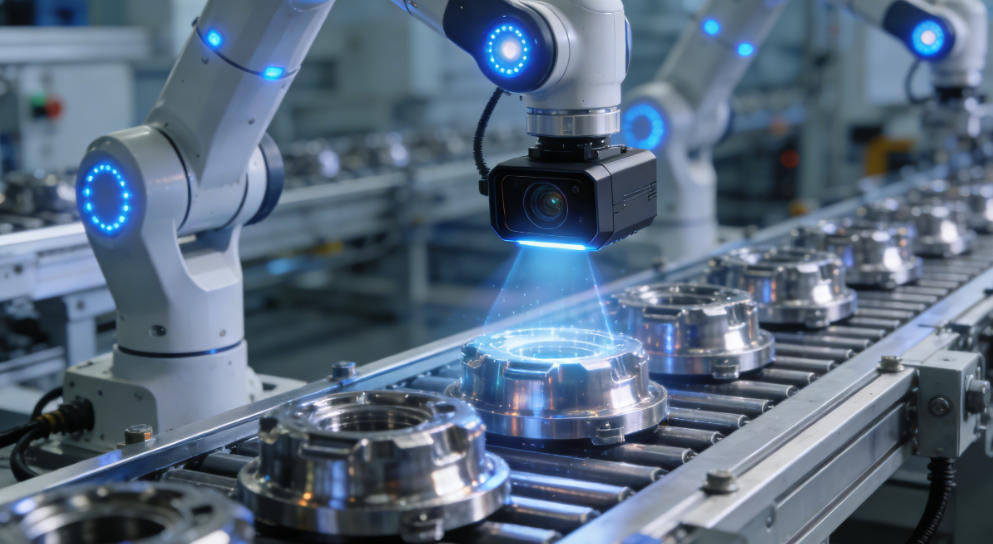
In industrial automation and manufacturing, ToF industrial cameras are used for automated sorting, volume measurement, object inspection, and machine vision systems. They can capture 3D data at high speeds on production lines, improving efficiency and accuracy. With real-time depth data, tof cameras enable robots to perform precise picking and path planning, supporting highly efficient automation.
In robotics and autonomous driving, tof cameras act as core sensors for environment perception, obstacle avoidance, SLAM mapping, and path planning, providing reliable 3D spatial information for intelligent mobile devices. In smart home and security, ToF sensors enable human detection, gesture recognition, intrusion alerts, and intelligent access control.
Moreover, in medical and 3D scanning applications, 3D depth cameras can perform body modeling, posture recognition, rehabilitation monitoring, and surgical planning, providing high-precision data for healthcare and rehabilitation. Whether for motion capture or medical imaging, tof cameras deliver critical 3D information.
In summary, camera tof and tof cameras are continuously expanding their application scope, from consumer electronics to industrial manufacturing, from smart homes to healthcare, becoming a core technology driving digitalization and intelligent systems.
6. ToF vs. Structured Light Technology
In the field of 3D vision, ToF cameras and structured light cameras are two main approaches, each with its advantages in principle, performance, and application scenarios.
ToF depth cameras emphasize real-time performance, high speed, and environmental adaptability, enabling rapid 3D depth capture in dynamic scenes. They are suitable for robotic navigation, autonomous driving, and industrial production line inspection, where speed and real-time processing are critical. ToF cameras can directly output depth data without complex projections or image matching, maintaining stable performance in varying lighting or low-texture environments.
By contrast, structured light technology achieves higher accuracy at close range, making it suitable for scanning small objects, precision measurements, and facial recognition. However, it is more sensitive to ambient light and surface conditions, and its performance in dynamic environments is not as robust as that of ToF depth cameras.
Therefore, in robotic vision systems, industrial automation, and real-time sensing for mobile devices, tof cameras are often the better choice, providing precise 3D data and reliable spatial perception for intelligent applications.
7. Development Trends of ToF Cameras
With the rapid advancement of artificial intelligence (AI), the Internet of Things (IoT), and smart manufacturing, camera tof technology is continuously evolving, becoming a key sensor for future smart devices and industrial systems. Modern ToF depth cameras are moving towards higher resolution, longer measurement range, lower power consumption, and more compact form factors to meet the growing demands for precision, speed, and energy efficiency.
In the future, tof cameras will achieve higher depth sampling density and more precise 3D modeling, allowing robots, autonomous vehicles, and drones to perceive their environment faster and more accurately, enabling high-precision navigation and obstacle avoidance. At the same time, low-power designs for ToF depth cameras will expand their use in mobile devices, smart homes, and portable 3D scanners.
Moreover, the integration of camera tof with AI algorithms will be a key trend for next-generation 3D perception. By combining deep learning and computer vision, ToF cameras can not only provide raw depth data but also enable real-time scene understanding, gesture recognition, human motion capture, and anomaly detection in complex environments. This further enhances the application value of tof cameras in autonomous driving, smart cities, intelligent manufacturing, healthcare, and AR/VR.
As technology matures and costs decrease, ToF depth cameras will expand from high-end industrial and research applications into consumer-grade products, becoming an indispensable component of future intelligent sensing systems. Whether in robotics, drones, smartphones, or smart homes, camera tof will empower devices with accurate, real-time, and reliable 3D spatial perception.
Okulo™ P1 Precision RGB-Depth Sensing Camera: High-Quality Imaging, Advanced Time-Of-Flight Technology,100FPS, And Robust Hardware Integration

After-sales Service: Our professional technical support team specializes in TOF camera technology and is always ready to assist you. If you encounter any issues during the usage of your product after purchase or have any questions about TOF technology, feel free to contact us at any time. We are committed to providing high-quality after-sales service to ensure a smooth and worry-free user experience, allowing you to feel confident and satisfied both with your purchase and during product use.




Please upload banner from store admin blog pages