
RGB-D Camera in AR: 3D Vision, Gesture Recognition & Spatial Mapping
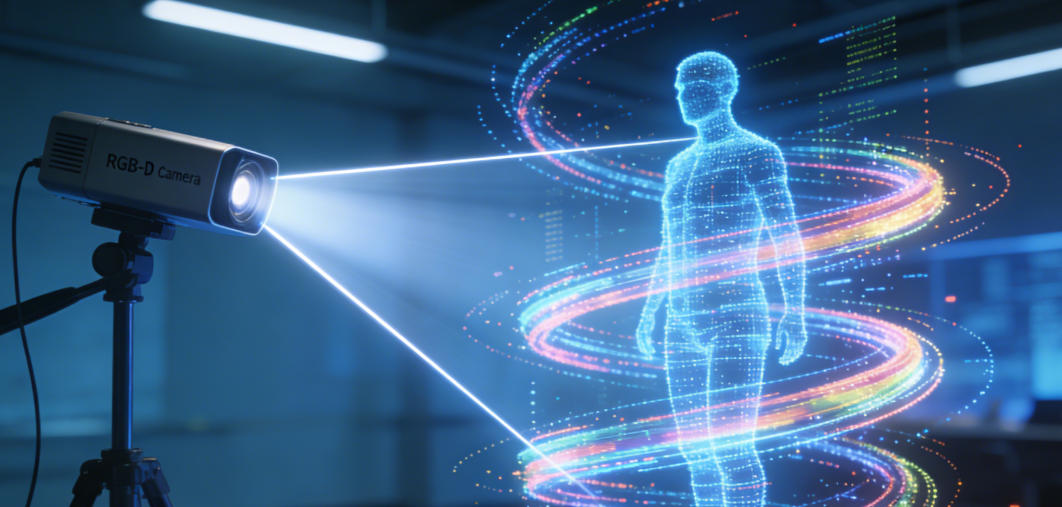
What is an RGB-D Camera and How Does It Improve AR Experiences?
With the rapid development of augmented reality (AR) technology, RGBD cameras have become essential core hardware for achieving immersive interactive experiences. Compared to traditional 2D cameras, RGB-D cameras not only capture color image information but also simultaneously collect depth data, enabling the creation of more realistic and precise 3D environments.
In popular fields such as AR, 3D vision, artificial intelligence, and machine vision, the application value of RGB-D cameras continues to grow. They have become key components in smart devices and spatial computing systems. This article will provide an in-depth analysis of the core functions and application advantages of RGB-D cameras in AR.
1. What is an RGB-D Camera and Why is it Important in AR?
An RGB-D camera is a 3D vision sensor that integrates RGB color images with depth information. Unlike traditional cameras that only capture 2D images, RGB-D cameras can obtain both color (RGB) and distance (Depth) data, enabling three-dimensional perception and modeling of the real world.
Technically, RGB-D cameras often use multiple depth sensing methods, such as ToF (Time of Flight), structured light, or stereo vision, to measure the distance between objects and the camera, generating high-precision 3D point cloud models. This capability allows devices not only to 'see' but also to 'understand' spatial structures, forming the foundation for 3D vision and spatial computing.
The combination of color and depth enables AR systems to accurately interpret the real world and achieve natural integration between virtual and real environments, including:
- High-precision spatial localization: Provides stable spatial anchors for AR, improving the alignment of virtual content
- Real-time environment perception: Dynamically detects surrounding changes, enhancing the accuracy and responsiveness of interactions
- Virtual-real occlusion handling: Ensures proper layering of virtual objects with real-world elements, improving realism
- More natural human-computer interaction: Supports gesture recognition, motion capture, and other contactless interactions
Moreover, RGB-D cameras enhance AR’s visual effects while increasing the system’s intelligence. In scenarios such as AR navigation, virtual try-ons, and industrial inspection, depth data can significantly improve recognition accuracy and interactive experience. It also provides richer data for AI vision algorithms, enabling devices to have stronger environment understanding and decision-making capabilities.
Therefore, RGB-D cameras have become core technologies in AR glasses, smart terminals, robots, and industrial vision systems, playing an increasingly crucial role in spatial computing and intelligent perception.

2. Core Functions of RGB-D Cameras in AR
1. Object Recognition and Real-time Tracking (3D Target Detection)
RGB-D cameras leverage depth information and RGB images to accurately capture the shape, contour, position, and distance of objects. Even in complex or dynamic environments, they provide stable 3D visual recognition and real-time target tracking. By combining AI image recognition with depth data, these systems reduce the impact of lighting changes, occlusions, or background interference, ensuring smooth and reliable AR experiences.
In practice, RGB-D cameras are widely used in AR gaming, smart navigation, industrial automation inspection, intelligent warehousing, and logistics management. For example, on industrial production lines, RGB-D cameras can rapidly identify components, products, or materials using real-time tracking, enabling automated sorting, inspection, and quality control, significantly improving efficiency and reducing labor costs. In smart city infrastructure and security, they can monitor moving objects and track dynamic targets for precise management and risk prevention.
2. Spatial Mapping and 3D Reconstruction (AR Space Scanning)
RGB-D cameras have powerful spatial perception capabilities, allowing fast scanning of environments and generating high-precision 3D models. They are critical for AR space scanning technology and SLAM (Simultaneous Localization and Mapping). RGB-D cameras capture detailed depth and positional data of walls, furniture, roads, and obstacles, providing a reliable foundation for accurately overlaying virtual content onto real spaces.
In indoor AR navigation, digital twins, smart home modeling, architectural planning, real estate visualization, and industrial digitization, the 3D modeling capabilities of RGB-D cameras enable real-time environmental mapping, precise localization, path planning, and spatial analysis. High-precision 3D reconstruction allows seamless integration of virtual and real-world spaces, supporting autonomous robot navigation, drone inspection, and industrial automation with accurate and interactive digital data.
3. Gesture Recognition and Natural Interaction (AR Gesture Control)
By capturing hand depth changes and motion trajectories, RGB-D cameras can achieve high-precision AR gesture recognition, allowing users to interact with virtual objects without controllers or touch devices. This natural human-computer interaction system enhances intuitiveness and immersion, making it a key trend in future AR interaction design.
RGB-D cameras can recognize simple gestures (clicking, swiping, pinching) and complex movements (multi-hand collaboration, dynamic gesture combinations), driving virtual interfaces and 3D models. In AR education, virtual training, gaming, remote collaboration, and virtual office environments, users can complete tasks, design models, or interact with multiple participants using gestures, greatly improving interactivity and engagement.
4. Human Pose Recognition (Motion Capture Systems)
RGB-D cameras can analyze human skeletal structures in real time, achieving precise human skeleton recognition and motion capture. AI-based pose recognition enables systems to interpret human movements and provide instant feedback or virtual control.
In AR fitness, sports training, virtual character control, medical rehabilitation, posture monitoring, and dance or esports training, RGB-D cameras play an indispensable role. For instance, in sports training, systems can analyze posture angles, motion range, and body balance to correct improper movements, improve performance, and reduce injury risk. In virtual character animation, they provide accurate motion synchronization for high-quality animation. In medical rehabilitation, they monitor patient movements and generate data reports for clinical evaluation.
5. Virtual Try-On and Smart Retail (AR E-commerce Applications)
In AR e-commerce and smart retail, RGB-D cameras have tremendous potential. They support AR virtual try-on solutions, enabling real-time trials of clothing, glasses, accessories, and other products. By matching depth data to the human body structure, virtual items fit users accurately, enhancing realism and immersive experience.
In the context of rapidly developing smart retail technology, this AR e-commerce application optimizes shopping processes, improves conversion rates, reduces return rates, and facilitates digital transformation for brands. Customers can try on products at home, see accessory combinations, and make informed decisions. Retailers can analyze try-on data to understand preferences, optimize inventory, and implement integrated online-offline marketing strategies.
By combining RGB-D cameras with 3D vision, AI algorithms, and spatial computing, their applications in AR continue to expand, driving intelligent interaction and digital experience upgrades.
3. Technical Advantages of RGB-D Cameras in AR
Compared to traditional cameras, RGB-D cameras offer distinct advantages in augmented reality:
- High-precision depth sensing: Measures distances with millimeter-level accuracy, crucial for precise alignment of virtual objects
- Stronger environmental adaptability: Stable performance under low light, backlight, or complex conditions
- Support for realistic occlusion and lighting effects: Depth data ensures proper layering of virtual objects with the real environment
- High-quality point cloud data: Provides reliable basis for 3D modeling, virtual try-ons, and spatial reconstruction
- AI and deep learning integration: Enhances capabilities in smart recognition, gesture control, and motion capture, making RGB-D cameras essential for 3D vision systems, intelligent robots, and industrial automation

4. Development Trends and Future Prospects of RGB-D Cameras
With the rapid advancement of metaverse, spatial computing, and artificial intelligence, the application prospects of RGB-D cameras are expanding significantly. As high-precision 3D vision sensors integrating RGB and depth information, RGB-D cameras not only capture environmental details and object dimensions but also provide core spatial perception capabilities for AR, VR, and XR applications, serving as essential hardware for seamless virtual-real integration.
In the future, RGB-D cameras are expected to become standard sensors for AR/VR devices, widely deployed in head-mounted displays, smart glasses, handheld devices, and holographic projectors, offering stable, precise, and immersive experiences. Their role in intelligent robotic vision systems will also become increasingly vital, enabling autonomous navigation, environmental recognition, and precise object manipulation for service robots, logistics robots, and industrial robots.
In autonomous driving and smart transportation, RGB-D cameras can capture real-time 3D data of roads, vehicles, pedestrians, and obstacles, supporting route planning, collision warning, and automated driving decisions to enhance safety and intelligence. In industrial settings, they enable high-precision 3D inspection, measurement, and automated production optimization, reducing manual intervention, improving efficiency, and driving smart factories and digitalized production.
Technological development trends for RGB-D cameras include:
- Higher resolution and more precise depth perception: Captures finer 3D details for accurate object recognition and point cloud modeling
- Lower power consumption: Suitable for portable AR/VR devices, smart terminals, and long-running industrial systems
- Smaller, lightweight designs: Easily integrated into AR glasses, drones, and mobile robots for portability and flexibility
- Stronger AI integration: Combined with deep learning algorithms, enabling automatic scene understanding, gesture recognition, human pose analysis, and intelligent interaction
Additionally, with the development of edge computing and cloud computing, the data processing capabilities of RGB-D cameras will further improve, enabling more efficient real-time 3D modeling, environmental perception, and virtual interaction. They will continue to create value in entertainment, education, and retail, as well as professional applications such as medical rehabilitation, industrial manufacturing, intelligent transportation, and urban management.
In summary, RGB-D cameras are not only key hardware for AR implementation but also a driving force for intelligent vision, spatial computing, digital twins, and smart environments. As technology advances, they will continuously enhance the integration of virtual and real worlds, making augmented reality more accurate, natural, and intelligent, and promoting a highly immersive and intelligent digital ecosystem.
5. Conclusion
By integrating RGB images and depth information, RGB-D cameras provide AR systems with powerful 3D perception capabilities. From 3D visual recognition and spatial modeling to gesture interaction and virtual try-on, their functionality is driving the widespread adoption and implementation of augmented reality technology.
As market demand continues to grow, RGB-D cameras will play an increasingly important role in smart devices, industrial vision, and digital applications, becoming a critical bridge connecting the real and virtual worlds.
RGB-D cameras combine depth data with color information to deliver more complete 3D perception, enabling advanced applications such as AR experiences, gesture recognition, and spatial mapping with improved accuracy and realism.
Okulo™ C1 Precision RGB-Depth Camera with iToF Technology & Integration

After-sales Service: Our professional technical support team specializes in TOF camera technology and is always ready to assist you. If you encounter any issues during the usage of your product after purchase or have any questions about TOF technology, feel free to contact us at any time. We are committed to providing high-quality after-sales service to ensure a smooth and worry-free user experience, allowing you to feel confident and satisfied both with your purchase and during product use.




Please upload banner from store admin blog pages
Please select collection from store admin blog pages