Arduino Laser Distance Sensor Guide: Setup, Principles & Applications
How Does a Laser Proximity Sensor Arduino Work and How Can You Use It?
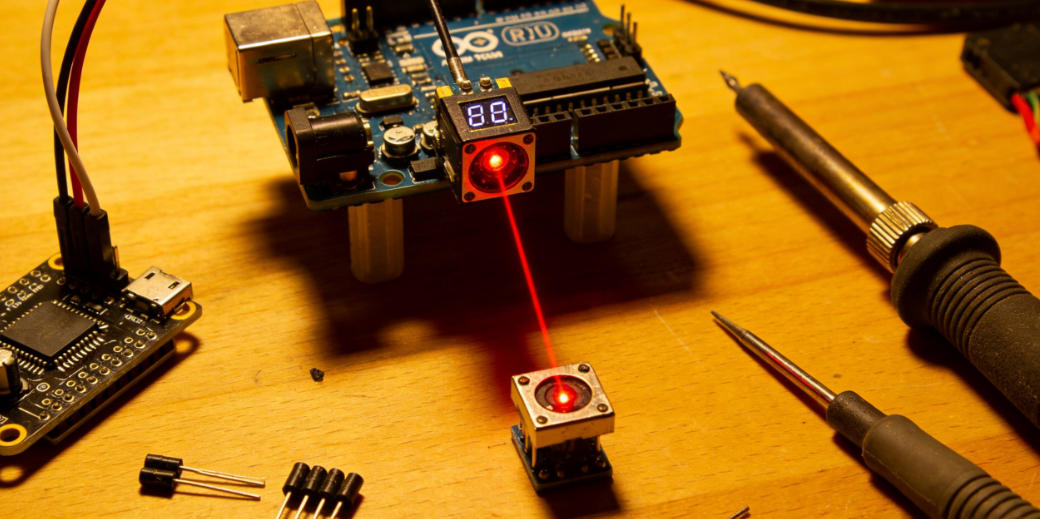
With the growing popularity of robotics, automation, and smart hardware projects, laser distance sensor Arduino and Arduino laser distance sensor have gained increasing attention among developers and makers. This article provides a comprehensive guide on Arduino laser distance sensors (including laser proximity sensor Arduino), explaining what they are, how they work, the common types, and how to use them in Arduino projects.
What is an Arduino Laser Distance Sensor?
An Arduino laser distance sensor is an intelligent sensor module that integrates laser distance measurement technology with an Arduino microcontroller. It enables non-contact, high-precision distance measurement by emitting a laser beam and detecting the reflected signal to calculate the distance to an object. The measured data is transmitted in real time to an Arduino board (such as Arduino Uno, Arduino Mega, or Arduino Nano) for processing.
This sensor can measure the absolute distance between the sensor and an object, and it can also detect whether an object enters a specific range, enabling precise distance awareness and position monitoring. Developers can easily use it in various project scenarios, such as:
- Robot obstacle avoidance: Allows mobile robots to sense nearby obstacles in real time, enabling autonomous navigation and path planning.
- Automation systems: Detects object positions or heights on industrial production lines for automated control.
- Smart home devices: Triggers actions like automatic doors, lighting, or security systems based on human or object proximity.
- Measurement and monitoring projects: Ideal for warehouse, logistics, and construction applications, providing fast and accurate data collection.
Compared to traditional ultrasonic or infrared sensors, Arduino laser distance sensors offer higher accuracy, faster response, and stronger anti-interference capabilities. With seamless compatibility with Arduino, developers can quickly prototype projects with simple wiring and programming, making it an ideal choice for both beginners and professional engineers.
In short, an Arduino laser distance sensor combines precise laser measurement technology with a microcontroller platform, offering ease of use, high precision, and versatility. It is an ideal tool for building intelligent hardware and robotic projects.

How Laser Distance Sensors Work
Arduino laser distance sensors achieve non-contact distance measurement using laser technology. The core principles mainly include the following three methods, each with unique advantages and applications:
1. Time-of-Flight (ToF)
ToF sensors emit a very short laser pulse toward the target and measure the time it takes for the laser to return. Using the speed of light, the distance to the object is calculated.
- Features: Fast measurement and high precision, up to millimeter-level accuracy.
- Applications: Widely used in mobile robot obstacle avoidance, UAV altitude control, and automated production line object positioning.
- Advantages: Not affected by object color or material and effective for long-distance measurement, making it ideal for laser distance sensor Arduino projects requiring rapid response.
2. Phase-Shift Measurement
This method modulates a continuous laser signal and measures the phase difference between the emitted and returned signals to calculate distance.
- Features: Excellent for short to medium-range measurements, with micrometer-level accuracy.
- Applications: Precision measuring instruments, industrial automation detection, and precise robot positioning systems.
- Advantages: Strong anti-interference capability, suitable for Arduino laser distance sensor applications in experimental and engineering projects.
3. Triangulation
Triangulation calculates the distance using the geometry of the laser emitter, reflected point, and receiver.
- Features: Ideal for high-precision, close-range measurements.
- Applications: Small robot obstacle avoidance, precision assembly inspection, surface contour scanning.
- Advantages: Simple structure, real-time measurement, perfect for laser proximity sensor Arduino projects for proximity detection and trigger applications.
These methods are all non-contact measurement techniques. Compared to ultrasonic or infrared sensors, Arduino laser distance sensors have several advantages:
- Faster response: Millisecond-level measurement cycles, ideal for real-time monitoring and automated control.
- Higher accuracy: Millimeter or even micrometer-level precision.
- Strong anti-interference: Less affected by ambient light, temperature, or object color.
- Versatility: Can perform distance measurement, proximity detection, obstacle avoidance, and precise positioning.
Understanding these principles helps developers select the right Arduino laser distance sensor module and apply laser distance sensor Arduino, Arduino laser distance sensor, and laser proximity sensor Arduino effectively in projects for precise, efficient smart measurement and control.
Common Arduino Laser Distance Sensor Modules
There are several Arduino-compatible laser distance sensor modules available, each with different measurement principles, range, interfaces, and applications.
1. VL53L0X / VL53L0X V2
VL53L0X is one of the most popular Arduino laser distance sensor modules, based on Time-of-Flight (ToF) technology.
- Measurement range: 0.03–2 meters, millimeter-level accuracy.
- Interface: I2C, easy to connect to Arduino.
- Advantages: Small size, low power consumption, ideal for mobile robots, UAVs, automated measurement systems, and DIY projects.
-
Applications:
- Small robot obstacle avoidance and navigation
- Smart home proximity detection (automatic doors, lighting)
- Precise object positioning and height measurement
- Additional feature: VL53L0X V2 offers improved anti-ambient light interference and measurement stability.
2. Laser Arrays & LiDAR Modules
Laser arrays or LiDAR modules are suitable for long-distance measurement and full-area scanning.
- Measurement range: Several meters to tens of meters depending on the model.
- Interface: I2C, UART, or SPI, compatible with Arduino.
- Advantages: Supports point cloud scanning and environment mapping, crucial for robot navigation, SLAM, and autonomous vehicles.
-
Applications:
- Indoor/outdoor unmanned vehicle navigation
- 3D mapping and building measurement
- High-precision obstacle avoidance and path planning
- Additional feature: Some advanced LiDAR modules support multi-line scanning and dynamic object detection.
3. Laser Proximity Sensors (laser proximity sensor Arduino)
Laser proximity sensors detect whether an object enters a specific distance range rather than providing exact measurements.
- Range: Typically a few centimeters to several meters, ideal for close-range detection.
- Interface: Analog or digital output, can trigger Arduino control logic directly.
- Advantages: Simple, fast response, suitable for obstacle avoidance, proximity alerts, or trigger control.
-
Applications:
- Robot or vehicle front obstacle detection
- Automatic doors, curtains, or safety triggers
- Interactive smart devices
- Additional feature: Adjustable sensitivity and detection distance, ideal for laser proximity sensor Arduino projects.
By understanding these modules, developers can choose the right sensor to leverage laser distance sensor Arduino, Arduino laser distance sensor, and laser proximity sensor Arduino for precise, fast, and reliable measurements.
How to Connect a Laser Distance Sensor to Arduino
Connecting laser distance sensor Arduino or Arduino laser distance sensor modules correctly to an Arduino board is the first step toward precise measurement. Using a typical ToF module like VL53L0X:
1. Power Connection
- Connect the sensor’s VCC and GND to Arduino +5V or 3.3V and GND, based on the module voltage specification.
- Ensure stable power supply to prevent measurement errors or module malfunction.
- For long wires or complex setups, add a 0.1µF ceramic capacitor between VCC and GND for better stability and interference suppression.
2. Interface Connection
- I2C interface: Connect SDA/SCL to Arduino I2C pins (e.g., A4/A5 for Arduino Uno).
- UART interface (for advanced modules): Connect TX/RX to Arduino serial pins for high-speed or long-distance communication.
- For multiple sensors, modify I2C addresses to read multiple laser distance sensor Arduino modules in parallel.
3. Programming and Data Reading
- Install the corresponding Arduino library (e.g., VL53L0X library).
- Initialize the sensor, set measurement mode and timeout, and continuously read distance values to output to the serial monitor or display.
- Choose continuous or single measurement mode based on project needs:
- Continuous mode: Suitable for real-time obstacle avoidance and monitoring.
- Single measurement mode: Ideal for low-power or intermittent measurement applications.

Main Applications of Arduino Laser Distance Sensors
Arduino laser distance sensors are widely used in robotics, smart homes, drones, and industrial measurement due to their high precision, fast response, and strong anti-interference capabilities.
1. Robot Obstacle Avoidance and Navigation
Using laser distance sensor Arduino, robots can detect obstacles in real time and adjust their paths automatically.
-
Examples:
- Educational robot obstacle competitions
- Smart cleaning robots navigating complex indoor environments
- Industrial AGVs moving goods autonomously in warehouses
- Advantages: High accuracy and fast feedback ensure safe, efficient operation, outperforming ultrasonic or infrared sensors.
2. Measurement and Monitoring Systems
Ideal for precision measurement in construction, warehouse, logistics, and laboratory applications.
-
Examples:
- Monitoring warehouse stock height
- Counting and positioning items on production lines
- Construction distance measurement and monitoring
- Advantages: Enables real-time data logging and automatic alerts, and can integrate with displays or storage modules to create smart measurement systems.
3. Smart Home and Automation
Enables automatic control, collision detection, and environment sensing.
-
Examples:
- Automatic doors or curtains triggered by proximity
- Smart lighting based on human presence
- Home security detecting intrusions or unusual movement
- Advantages: More precise distance detection than infrared or ultrasonic sensors, reducing false triggers.
4. Drones and Flight Control
Used for altitude hold, terrain tracking, and obstacle detection in UAVs.
-
Examples:
- Indoor drones maintaining stable hover in confined spaces
- Outdoor drones navigating terrain and avoiding obstacles
- High-precision UAV surveying and photography
- Advantages: Real-time distance measurement ensures flight safety and stability.
5. DIY Maker Projects and Educational Applications
Arduino laser distance sensors are also popular in maker and educational projects:
-
Examples:
- DIY obstacle-avoiding cars or robots
- Distance-triggered interactive devices (exhibits, games)
- Teaching measurement principles and Arduino control in maker courses
- Advantages: Simple to operate and easy to develop, demonstrating laser proximity sensor Arduino functionality and principles clearly, inspiring learning.
By integrating laser distance sensor Arduino, Arduino laser distance sensor, and laser proximity sensor Arduino, developers can achieve everything from basic distance measurement to complex automated control systems.
Conclusion: Why Choose Arduino Laser Distance Sensors?
| Advantage | Description |
|---|---|
| High Precision | Laser measurement is more accurate than ultrasonic or infrared |
| Fast Response | Suitable for real-time control scenarios |
| Easy Integration | Strong Arduino compatibility |
| Versatile | Supports distance measurement, obstacle avoidance, proximity detection, etc. |
Whether you are an electronics maker or an engineering developer, mastering laser distance sensor Arduino, Arduino laser distance sensor, and laser proximity sensor Arduino will give your projects more powerful performance and stability.
XT-S240Pro 3D ToF Lidar| Compact, Solid State, 240 Lines, 20m Working Distance

After-sales Service: Our professional technical support team specializes in TOF camera technology and is always ready to assist you. If you encounter any issues during the usage of your product after purchase or have any questions about TOF technology, feel free to contact us at any time. We are committed to providing high-quality after-sales service to ensure a smooth and worry-free user experience, allowing you to feel confident and satisfied both with your purchase and during product use.





Please upload banner from store admin blog pages