Best Laser Distance Sensors for Robotics: Brands & Selection Guide
What Are the Best Laser Distance Sensors for Robotics?
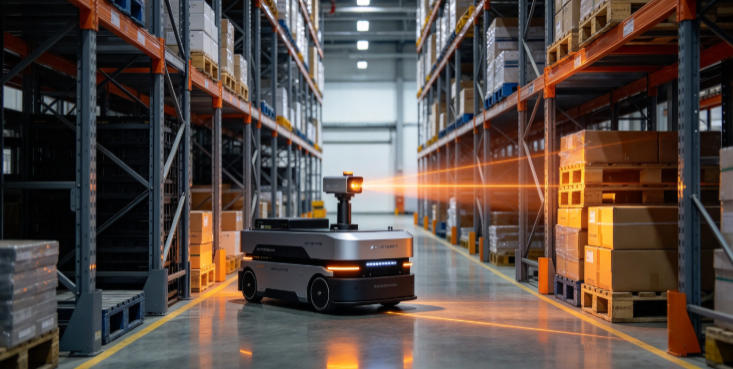
As industrial automation, smart warehousing, and mobile robotics continue to develop, laser distance measurement sensors for robotics are becoming an important part of robotic sensing systems. AGVs, AMRs, industrial robots, warehouse robots, and autonomous mobile platforms all need reliable distance information to determine the position of objects, shelves, walls, pallets, and other equipment.
If you search for 'Can you recommend top brands for laser distance measurement sensors for robotics?', several established industrial sensor brands are worth considering, including SICK, KEYENCE, ifm, OMRON, Pepperl+Fuchs, Baumer, and Banner Engineering. However, these brands do not focus on exactly the same applications. Some products are designed for high-precision industrial measurement, while others are better suited for long-range detection, robot positioning, object detection, or automated control.
Instead of simply looking for the 'number one' brand, it is more practical to select a robot distance sensor based on the required measurement range, accuracy, response time, ambient-light resistance, communication interface, IP rating, and specific robotic application.
What Is a Laser Distance Sensor for Robotics?
A laser distance measurement sensor uses laser or laser-based optical measurement technology to determine the distance between a sensor and a target. Unlike a traditional proximity sensor, a laser distance sensor can not only detect whether an object is present but also provide continuous distance information.
A typical laser distance sensor for robotics can be used for:
-
Robot obstacle detection;
-
AGV path detection;
-
AMR autonomous navigation;
-
Robotic arm positioning;
-
Workpiece position detection;
-
Shelf distance measurement;
-
Pallet positioning;
-
Conveyor positioning;
-
Robot safety-zone detection;
-
Warehouse robot environment sensing.
Depending on the design and measurement principle, industrial laser distance sensors may use laser triangulation, Time of Flight (ToF), phase measurement, or other optical measurement technologies.
For applications requiring extremely high precision over short distances, laser triangulation sensors can be useful. For AGVs and AMRs, however, measurement range, response time, target detection, and environmental resistance are often equally important.

Can You Recommend Top Brands for Laser Distance Measurement Sensors for Robotics?
Several major industrial sensor manufacturers can be considered, but the most suitable brand depends on the robot's application and technical requirements.
1. SICK: Suitable for Robotics, Logistics, and Industrial Automation
SICK is a well-known manufacturer of industrial sensors, with product categories covering photoelectric sensors, distance sensors, LiDAR, and safety sensors.
For robotic applications, SICK offers solutions ranging from single-point distance detection to two-dimensional laser scanning. Therefore, if a project requires a robot navigation sensor, industrial laser sensor, or 2D LiDAR, SICK can be included in the selection process.
For AMR and AGV applications, it is important to distinguish between a conventional laser distance sensor and a LiDAR system designed for two-dimensional environmental scanning. A laser distance sensor generally measures the distance to a specific target or direction, while LiDAR can collect distance information across multiple angles.
2. KEYENCE: Suitable for High-Precision Industrial Measurement
KEYENCE is widely used in industrial automation and precision measurement applications and offers a broad range of laser sensors.
For example, its IL series uses CMOS-based laser measurement technology. Different models cover various measurement ranges, including applications extending to several meters. The IL-2000 models, for example, offer measurement ranges from 1000 to 3500 mm. (keyence.com)
This makes KEYENCE worth considering for applications involving high precision laser distance sensors, laser displacement sensors, and robotic arm position measurement.
If a robot needs to detect the position, height, or dimensional changes of components, a high-precision laser measurement sensor can provide more detailed information than a basic proximity sensor.
3. ifm: Suitable for Industrial Automation and IO-Link Systems
ifm offers a range of laser distance sensors, including products in its O1D and other sensor families.
Some O1D laser distance sensors can measure distances up to 10 m and support IO-Link. ifm also uses PMD Time-of-Flight technology in its distance measurement solutions. These sensors can provide distance information while being designed for industrial automation applications. (ifm.com)
For robotic systems that need to connect a robot distance sensor to PLCs, industrial networks, or smart factory systems, IO-Link compatibility can be an important consideration.
For AGVs, automated conveyors, warehouse systems, and robotic workstations, IO-Link can also simplify parameter configuration, device diagnostics, and data communication.
4. OMRON: Suitable for Factory Automation and Robotic Systems
OMRON offers products covering sensors, controllers, machine vision, and industrial automation.
In a robotic system, a distance sensor rarely works as an isolated device. It often needs to communicate with PLCs, motion controllers, machine vision systems, and safety equipment.
Therefore, when selecting a laser distance measurement sensor, it is useful to consider the communication interface, controller compatibility, software support, and overall automation ecosystem rather than comparing only maximum measurement distance.
5. Pepperl+Fuchs: Suitable for Industrial Environments
Pepperl+Fuchs is another established supplier of industrial sensors and automation technologies. Its product portfolio includes proximity sensors, photoelectric sensors, distance measurement solutions, and industrial communication technologies.
For robots, conveyor systems, automated production lines, and logistics equipment, distance sensors may need to operate continuously in demanding environments.
Important factors include:
-
IP protection rating;
-
Vibration resistance;
-
Operating temperature;
-
Ambient-light immunity;
-
Target reflectivity;
-
Output interface;
-
Installation space.
These factors can sometimes be more important than the advertised maximum measurement range.
6. Baumer: Suitable for High-Precision and Compact Robotic Applications
Baumer offers OADM laser distance sensors designed for different measurement ranges and precision requirements.
Some OADM products provide measurement ranges from several tens of millimeters to several hundred millimeters and use pulsed red laser diodes. Certain models also feature IP67 protection. (baumer.com)
For robotic end effectors, component positioning, dimensional inspection, and compact automation equipment, these types of laser distance sensors can provide accurate distance information while taking up relatively little installation space.
Some Baumer products also offer cable configurations designed for applications involving continuous movement, which can be useful for robotic arms and other moving equipment.
7. Banner Engineering: Suitable for Medium- and Long-Range Detection
Banner Engineering provides several laser measurement solutions. Its LTF series, for example, is a long-range Time-of-Flight laser sensor family.
According to Banner Engineering, LTF sensors can provide measurement ranges from 50 mm to 24 m and use IP67-rated metal housings. The LT3 series can provide reflective measurement ranges of up to 50 m.
These products can therefore be considered for applications involving long range laser distance sensors, warehouse automation, AGV detection, and material handling.
How Are Laser Distance Sensors Used in AGVs and AMRs?
AGVs and AMRs are important applications for laser distance sensing.
Traditional AGVs often follow predefined routes, while AMRs need to use real-time environmental information to navigate and plan their paths. As a result, AMRs typically require more advanced environmental sensing capabilities.
A distance sensor mounted at the front of a robot can continuously detect:
-
Obstacles;
-
Walls;
-
Shelves;
-
Pallets;
-
Other robots;
-
People;
-
Work-area boundaries.
For example, when an AMR approaches a warehouse rack, a laser distance sensor can measure the distance between the robot and the rack. When the robot moves through a narrow aisle, distance information can help determine whether sufficient space is available on either side.
However, a single-point laser distance sensor generally provides distance information in only one direction. If a robot needs 360-degree environmental awareness, a 2D LiDAR, 3D LiDAR, ToF camera, or another multi-sensor solution may be more appropriate.
What Is the Difference Between a Laser Distance Sensor and LiDAR?
This is an important distinction when selecting sensors for robotics.
A laser distance sensor generally focuses on measuring the distance to a specific target or direction. It is suitable for applications such as position detection, distance measurement, and industrial inspection.
LiDAR, on the other hand, typically scans multiple directions and collects many distance points to create two-dimensional or three-dimensional environmental information.
For example:
Single-point laser distance sensor:
Sensor → Target → Distance data
This is mainly used for position detection, distance measurement, and industrial inspection.
2D LiDAR:
Sensor → Multi-directional scanning → Multiple distance points → 2D environment map
This is more suitable for mobile robot navigation, obstacle avoidance, and localization.
3D LiDAR:
Sensor → 3D scanning → 3D point cloud → Spatial environment model
This is suitable for more complex robotics, warehouse automation, autonomous systems, and three-dimensional perception.
Therefore, when choosing a robot distance sensor, the first question should be whether the robot needs to measure 'one distance' or understand the spatial structure of its surrounding environment.

What Parameters Should You Consider When Choosing a Laser Distance Sensor for Robots?
1. Measurement Range
The first step is to determine the actual working distance required by the robot.
Typical applications can be divided into:
-
Less than 100 mm: precision positioning and dimensional inspection;
-
0.1–1 m: robotic arms and short-range detection;
-
1–10 m: industrial automation and robot detection;
-
10–50 m: warehouse, logistics, and mobile robots;
-
More than 50 m: long-range measurement, outdoor robots, and specialized LiDAR systems.
Do not look only at the advertised “maximum range.” Actual measurement distance can be affected by target color, reflectivity, angle of incidence, ambient light, and environmental conditions.
2. Accuracy and Repeatability
Accuracy describes how close a measurement is to the actual distance, while repeatability describes how consistently the sensor produces the same result under the same conditions.
Both are important in robotic positioning.
For example, a sensor may provide highly consistent measurements while still having a systematic measurement offset. Therefore, when choosing a high precision distance sensor, it is useful to review accuracy, linearity, repeatability, resolution, and other relevant specifications.
3. Response Time
Mobile robots are constantly moving.
When an AMR operates at higher speeds, sensor response time can directly affect how quickly the robot can react to obstacles.
Therefore, a fast response laser distance sensor can be important for AGVs, AMRs, and high-speed industrial equipment.
4. Ambient Light Resistance
Outdoor robots may encounter direct sunlight, highly reflective surfaces, and changing lighting conditions.
Therefore, the sensor's ambient-light immunity should be carefully evaluated.
For indoor warehouses, lighting conditions are generally easier to control. Outdoor AGVs, inspection robots, and autonomous vehicles may require stronger resistance to sunlight and other optical interference.
5. Communication Interface
Common interfaces for industrial robot sensors include:
-
IO-Link;
-
Ethernet;
-
RS-232;
-
RS-485;
-
CAN;
-
Analog output;
-
Digital output.
If the sensor needs to communicate with a PLC or industrial controller, interface and protocol compatibility should be confirmed early in the project.
For example, some ifm laser distance sensors support IO-Link and can transmit distance data directly to an automation system.
6. IP Rating
Industrial robots, AGVs, and AMRs may operate in environments containing dust, oil, moisture, and vibration.
For these applications, it is useful to consider sensors with IP65, IP67, or higher protection ratings.
For example, Banner's LTF series uses IP67-rated housings, while some Baumer OADM products also offer IP67 protection.
How Do You Choose Between Laser Distance Sensors, ToF Sensors, and Ultrasonic Sensors?
Robotics projects often require engineers to compare laser distance sensors vs ultrasonic sensors vs ToF sensors.
Laser sensors generally provide a narrow measurement beam and good directional accuracy, making them useful for detecting specific targets.
Ultrasonic sensors can also be useful in certain environments and applications, but their directional characteristics and spatial resolution differ from those of laser sensors.
A ToF sensor measures distance using the propagation time or phase-related characteristics of light. ToF technology can be used for single-point distance measurement and can also be developed into ToF cameras and 3D depth-sensing systems.
If a robot only needs to detect the distance to an object in front of it, a single-point laser distance sensor may be sufficient.
If the robot needs distance information across an area, a 2D LiDAR may be more appropriate.
If the robot requires detailed three-dimensional environmental information, engineers can consider 3D LiDAR, ToF cameras, stereo cameras, or multi-sensor fusion.
How Should You Choose a Brand for Your Robotic Application?
There is no single brand that is ideal for every robotic distance measurement application. A more practical approach is to select products according to the application.
For industrial robotic arms and precision positioning:
Consider manufacturers such as KEYENCE and Baumer, especially when accuracy, repeatability, linearity, and response time are critical. KEYENCE IL series and Baumer OADM products offer laser measurement solutions for different distance ranges.
For AGVs and AMRs:
Consider SICK, ifm, Banner Engineering, and other industrial sensor manufacturers, while also determining whether the application actually requires a 2D LiDAR or another scanning sensor instead of a single-point laser distance sensor.
For smart warehousing and logistics robots:
In addition to measurement range, consider how shelves, pallets, dark objects, and reflective materials affect measurement stability. Long-range ToF laser sensors may be suitable for some applications.
For high-precision industrial automation:
Pay particular attention to accuracy, repeatability, linearity, resolution, and temperature drift.
For outdoor robots:
Evaluate ambient-light immunity, IP rating, operating temperature, and target reflectivity in addition to measurement range.
Do Robots Always Need Laser Distance Sensors?
Not necessarily.
What a robot really needs is reliable environmental perception and distance information, and there are many ways to obtain it.
A simple positioning application may only require a single laser distance sensor. Basic obstacle detection may require multiple distance sensors. AMR autonomous navigation may use LiDAR, cameras, or other localization sensors. More advanced robotic systems can combine LiDAR, cameras, ToF sensors, and IMUs through multi-sensor fusion.
Therefore, when searching for the best laser distance sensor for robotics, it is better to first identify the actual problem the robot needs to solve instead of choosing a product based only on brand reputation or price.
for AGV,AMR,laser forklifts,robot outdoor Navigation VanJee WLR-720 3D LiDAR 16-line Hybrid Navigation LiDAR sensor

Conclusion
For laser distance measurement sensors for robotics, established manufacturers such as SICK, KEYENCE, ifm, OMRON, Pepperl+Fuchs, Baumer, and Banner Engineering can all be considered for industrial projects. However, their product ranges, measurement technologies, and application focuses are different.
Some KEYENCE and Baumer products are designed for high-precision short-range measurement, while ifm emphasizes industrial automation and IO-Link connectivity. Banner Engineering provides longer-range ToF laser measurement products, while SICK and other manufacturers offer broader solutions for robotics, logistics, and laser scanning applications.
If you are selecting a distance sensor for a robotic arm, AGV, AMR, warehouse robot, or industrial robot, a practical selection process is to evaluate the application, measurement range, accuracy, response time, environmental conditions, communication interface, and installation requirements in sequence.
This approach is generally more useful than simply searching for “top laser sensor brands” because it helps identify the industrial laser distance sensor that actually matches the robot's operating environment and sensing requirements.




Please upload banner from store admin blog pages