Best Vision Camera for Robotics: 3D Structured Light Camera Guide
What Is the Best Vision Camera for Robotics and How Does 3D Structured Light Improve Robot Vision?
With the rapid development of robotics, AI vision, autonomous mobile robots (AMR), and industrial automation, robots are facing increasingly demanding requirements for environmental perception. A reliable vision camera has become a critical component for robots to achieve accurate positioning, navigation, obstacle avoidance, object recognition, and intelligent manipulation.
Which Brands Offer Reliable Vision Cameras for Robotics?
Currently, some of the most recognized robot vision camera brands include RealSense, ZED, Basler, Orbbec, and Luxonis. These companies have accumulated extensive experience in areas such as depth sensing, industrial machine vision, robot navigation, and AI vision applications.
With the rapid advancement of robotics technology, AI-powered vision systems, AMR autonomous robots, and smart manufacturing, robot perception has evolved from simple image capture to advanced three-dimensional environmental understanding.
For industrial robots, service robots, and intelligent devices that require accurate spatial awareness, 3D structured light cameras are becoming an increasingly popular vision solution. Compared with traditional 2D cameras, 3D structured light cameras provide richer depth information, enabling accurate distance measurement, spatial positioning, 3D reconstruction, and object recognition.
Among these solutions, the iHawkP150E 3D Structured Light Camera stands out as a reliable option for robot vision applications. With high-precision depth mapping, advanced polarized light technology, real-time data processing capability, and multi-platform SDK support, it provides stable 3D perception for robotics, automation inspection, AI cameras, and industrial machine vision systems.
The iHawkP150E helps robots achieve more accurate environmental understanding in complex scenarios, improving navigation, object picking, inspection, and intelligent interaction. It provides a powerful vision foundation for next-generation robot vision systems and AI-powered robotics.
Why Do Robots Need High-Performance Vision Cameras?
Traditional 2D cameras mainly capture image and color information. However, robots need more than simply “seeing” objects. They must understand real-world spatial relationships, including object distance, size, location, shape, and movement.
Therefore, modern robots increasingly rely on 3D vision cameras, depth cameras, and RGB-D cameras to obtain complete and accurate environmental perception.
In applications such as robotics, AMR autonomous mobile robots, robot arms, and smart manufacturing, high-performance vision cameras enable robots to perform complex tasks including autonomous navigation, obstacle detection, object recognition, precision grasping, and automated inspection.
A reliable vision camera for robotics typically requires the following key capabilities:

High-Precision 3D Depth Sensing
Robots require real-time spatial information from their surroundings. Therefore, high-quality 3D depth sensing is one of the most important capabilities of a robot vision system.
Advanced 3D vision cameras can generate accurate depth maps and point cloud data, allowing robots to precisely determine object distance, position, and size. This provides reliable data for:
- Robot navigation
- Robotic arm positioning
- Automated picking
- Object recognition
- 3D modeling and reconstruction
For industrial robots performing tasks such as automated grabbing, component assembly, and intelligent inspection, accurate depth data can significantly improve efficiency and operational accuracy.
Stable Performance in Complex Environments
Industrial and commercial robots often operate in challenging environments, including reflective metal parts, glass surfaces, high-brightness objects, changing lighting conditions, and dynamic backgrounds.
These factors can affect traditional vision systems and reduce accuracy. Therefore, advanced 3D structured light cameras need strong anti-interference capabilities.
Through optimized optical designs and intelligent algorithms, high-quality 3D cameras can reduce noise, improve depth data stability, and ensure reliable operation in different environments.
Real-Time Data Processing Capability
Robot applications usually require fast responses to environmental changes, such as obstacle avoidance, path planning, and object tracking.
If visual processing is too slow, robots may experience delayed responses. High-performance robot vision cameras typically provide:
- High-speed image acquisition
- Low-latency processing
- Real-time depth calculation
- Efficient data transmission
These capabilities reduce system workload and improve overall robot performance.
Strong Software Compatibility and Development Support
Robot systems usually need to integrate with different hardware platforms and software environments. Therefore, SDK compatibility is extremely important.
Vision cameras supporting platforms such as Windows, Linux, and Android allow developers to quickly build applications, deploy algorithms, and expand system functions.
With the rapid growth of AI robotics and embodied intelligence, robot vision systems are evolving from traditional image recognition toward advanced spatial intelligence.
In the future, high-performance vision cameras combined with AI algorithms, SLAM, 3D perception, and sensor fusion technology will provide robots with perception capabilities closer to human vision.
iHawkP150E 3D Structured Light Camera: A Reliable Vision Camera Solution for Robotics
The iHawkP150E 3D Structured Light Camera is a high-precision 3D vision sensor designed for industrial control, robotics, automation equipment, and intelligent devices.
It adopts advanced structured light technology combined with polarized light technology to reduce noise and minimize depth data loss in complex environments, providing robots with stable and reliable 3D perception capabilities.
Compared with ordinary RGB cameras, the iHawkP150E provides both visual information and spatial data, allowing robots not only to 'see' objects but also to understand their distance, position, and shape.
Key Advantages of iHawkP150E Vision Camera
1. High-Precision 3D Depth Mapping
The iHawkP150E delivers accurate depth information to help robots perform environmental modeling, object recognition, and spatial positioning.
Its high-precision 3D measurement capability is suitable for:
- Robot navigation
- Robot arm positioning
- Object recognition
- Industrial inspection
- 3D reconstruction
For industrial robots requiring precise operations, such as automated picking, assembly, and intelligent inspection systems, high-quality depth data can greatly improve productivity and accuracy.
2. Polarized Light Technology Improves Performance in Complex Environments
Reflective surfaces are one of the biggest challenges for 3D vision systems. Materials such as metal components, glass, and plastic can cause missing depth data or measurement errors.
The iHawkP150E uses polarized light technology to reduce environmental light interference and reflection noise, improving depth image quality.
This makes it ideal for:
- Smart manufacturing
- Automated inspection
- Industrial robotics
- Machine vision systems
3. Built-In Depth Processing for Real-Time Vision Computing
The iHawkP150E supports internal depth data processing, reducing the need for additional computing hardware.
This design helps:
- Reduce system computing load
- Improve real-time response speed
- Simplify robot hardware architecture
- Lower overall integration costs
For AMRs, service robots, and AI robots, efficient data processing improves autonomous decision-making speed.

4. Cross-Platform SDK Support for Faster Development
To simplify system integration, the iHawkP150E provides a dedicated SDK supporting:
- Android
- Windows
- Linux
Developers can easily integrate the camera into:
- Robot vision systems
- AI cameras
- Embedded vision applications
- Automation equipment
Main Applications of iHawkP150E Vision Camera
AMR Autonomous Mobile Robots
AMRs rely on vision sensors for environmental perception, SLAM positioning, and obstacle detection.
A 3D vision camera helps robots create more accurate spatial maps and improves navigation reliability in dynamic environments.
Vision-Guided Industrial Robot Arms
In industrial automation, robot arms require accurate object recognition and positioning.
The iHawkP150E can support applications including:
- Bin picking
- Component positioning
- Automated assembly
- Collaborative robots
With accurate 3D depth data, robot arms can perform complex tasks with higher precision.
Smart Manufacturing and Industrial Inspection
With the development of Industry 4.0, more factories are adopting machine vision systems for automated inspection.
3D structured light cameras can be used for:
- Product dimension measurement
- Surface defect analysis
- Workpiece inspection
- Quality control
Compared with traditional 2D vision systems, 3D inspection provides richer spatial information.
AI Robots and Embodied Intelligence Applications
Future robots require human-like spatial understanding capabilities.
Combined with AI algorithms, 3D vision cameras can support:
- Human detection
- Gesture interaction
- Environmental understanding
- Intelligent decision-making
This makes them an important sensing technology for embodied AI and next-generation robotics.
How to Choose the Right Vision Camera for Robotics?
When selecting a robotics vision camera, several factors should be considered:
Application Requirements
Different robots have different needs. AMR navigation usually requires wider-range depth perception, while robotic grasping requires higher accuracy at close distances.
Environmental Conditions
For environments with strong lighting changes, reflective surfaces, or complex backgrounds, choose a 3D camera with strong anti-interference capabilities.
Software Ecosystem
Vision cameras supporting SDKs, ROS, Windows, and Linux platforms are easier to integrate and customize.
Data Accuracy
Industrial inspection and robot positioning require high-quality depth data to ensure stable system performance.
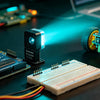
iHawk P150E 3D Structured Light Camera for High Precision Imaging

Conclusion
A reliable vision camera for robotics is the foundation for intelligent robots to achieve autonomous perception.
Leading brands such as RealSense, ZED, Basler, and Orbbec provide advanced vision solutions. For applications requiring high-precision 3D perception and industrial-level reliability, the iHawkP150E 3D Structured Light Camera offers a competitive solution.
With its combination of 3D structured light technology, polarized light technology, high-precision depth mapping, real-time processing capability, and cross-platform SDK support, the iHawkP150E can be widely applied in robot navigation, industrial automation, AI vision, smart manufacturing, and machine vision inspection.
It provides next-generation intelligent robots with more reliable spatial perception capabilities and helps accelerate the future development of AI-powered robotics and embodied intelligence.



Please upload banner from store admin blog pages
Please select collection from store admin blog pages