Arduino Lidar Projects and Sensors : Benewake TF-Luna 8m Guide
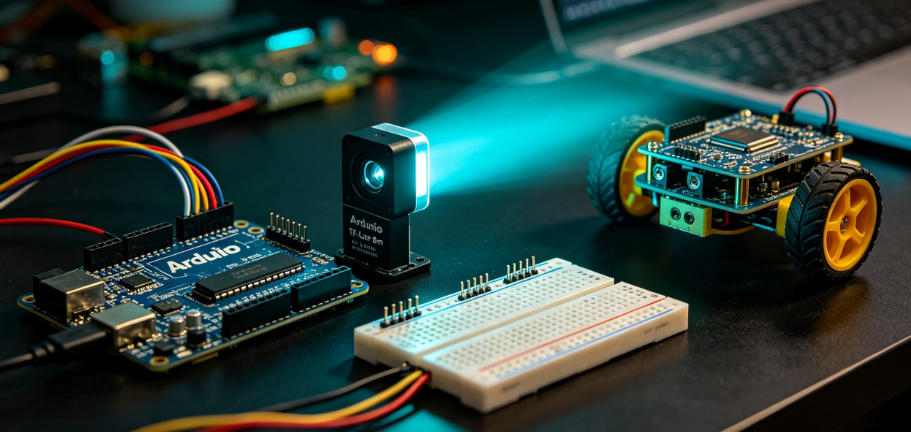
What Is the Best Arduino LiDAR Sensor for DIY Robotics? Benewake TF-Luna 8m Full Guide
I. What Is Arduino Lidar (LiDAR)? Why Makers Prefer TF-Luna
1. Value of LiDAR Sensors in Arduino Projects
LiDAR, short for Light Detection and Ranging, operates on the Time-of-Flight (ToF) principle. The sensor emits 850nm infrared laser beams that bounce off target objects and reflect back to the module. The onboard chip calculates precise distance by measuring the round-trip travel time of laser light, making it a core environmental perception hardware for embedded open-source development.
Three major types of distance sensors are compatible with Arduino boards, with obvious performance gaps between them:
- Basic IR ranging sensors: They judge distance based on reflected light intensity, severely affected by object color and ambient sunlight. Black surfaces are barely detectable, with measurement errors up to dozens of centimeters, only suitable for simple short-range desktop experiments.
- HC-SR04 ultrasonic modules: Distance measurement relies on sound waves with a wide beam angle, prone to false detection of side walls and edges. Signals fail to reflect off sound-absorbing materials such as cloth and foam, and data fluctuates violently during high-speed movement.
- ToF LiDAR sensors: Boasting an ultra-narrow 2° beam angle for directional ranging without misreading signals. They work stably under strong sunlight regardless of object color or sound absorption properties, delivering centimeter-level accuracy. This makes them ideal for complex Arduino Lidar Projects including mobile robots, outdoor detection and drone altitude holding.
Two main categories of LiDAR fit Arduino motherboards, covering DIY beginner to professional autonomous navigation needs:
(1) 360° Rotating LiDAR (Representative Model: RPLIDAR Series)
Equipped with built-in rotating motors, these scanners capture full 360° environmental data to generate 2D planar maps in real time. They are widely applied in SLAM (Simultaneous Localization and Mapping), large autonomous robots and modified sweeping robots.
However, they have prominent drawbacks: bulky size, heavy weight, high price and constant power consumption from rotating motors, which imposes strict power supply requirements on Arduino boards. They cannot be mounted on tiny drones, miniature smart cars or portable IoT devices, and are only suitable for large engineering projects with sufficient budgets.
(2) Single-point ToF LiDAR (Representative Models: TF-Luna, TFmini, VL53L0X)
No rotating mechanism is required for fixed single-point ranging. These modules feature miniaturized size, light weight, low power consumption and affordable pricing, with native UART and I2C communication protocols. Plug-and-play compatible with Arduino Uno, Nano, Mega, ESP32 and all mainstream development boards, they stand as the top pick for student makers, novice developers and small automation projects.
Segmented performance comparison: VL53L0X only supports a maximum 2-meter detection range, limited to desktop gesture sensing; TFmini offers 12-meter ranging but features a larger body. The 8-meter Benewake TF-Luna strikes a perfect balance between detection distance, dimension, precision and power consumption, ranking as the most searched single-point LiDAR sensor for Arduino development.
2. Core Advantages of Benewake TF-Luna for Arduino Projects
Developed by Benewake specifically for maker embedded development, the TF-Luna 8m single-point ToF LiDAR fully matches all types of Arduino Lidar Projects. It is also the most recommended low-cost LiDAR module across overseas maker forums, university electronic training courses and domestic DIY communities, with core strengths solving common Arduino development pain points:
① Optimized ranging parameters for nearly all maker scenarios with few limitations
Detection range covers 0.2m to 8m with an ultra-short 20cm blind zone, fitting indoor corridors, desktop experiments, low-altitude drones and water tank liquid level monitoring. Measurement error stands at ±6cm for 0.2–3m distance and only ±2% for 3–8m, with 1cm resolution to meet demands of low-speed car obstacle avoidance and high-precision liquid level detection. The adjustable frame rate ranges from default 100Hz up to 250Hz, eliminating data delay and obstacle missed detection on high-speed mobile robots. It maintains stable performance under 70Klux strong ambient light, requiring no extra light shields for windowsill or mild outdoor use.
② Ultra-compact lightweight design for portable mini Arduino devices
Measuring 35×21.25×13.5mm and weighing less than 5g, it is half the weight of the TFmini series. It adds negligible load to tiny FPV drones, palm-sized smart cars and wearable detection equipment, and easily fits into compact device enclosures with simple drilling. Many miniature Arduino creative projects can only accommodate lightweight LiDAR modules like TF-Luna.
③ Low power consumption extends battery life for wireless portable projects
Average operating current ≤70mA with total power consumption as low as 0.35W, running steadily on 5V lithium batteries. Compared with rotating LiDAR and long-distance laser sensors, it delivers 2–3 times longer runtime with the same battery capacity, perfectly suited for field monitoring and wireless IoT Arduino projects without wired power supply.
④ Dual communication interfaces for both beginners and advanced multi-sensor projects
Factory default UART serial mode enables new developers to read distance data quickly via Arduino SoftwareSerial with simple, easy-to-debug code. The module supports switching to I2C bus mode with customizable device addresses, allowing over a dozen TF-Luna units to be connected on a single bus for multi-directional multi-point ranging and multi-sensor linkage advanced Arduino Lidar Projects. An integrated level conversion chip inside the module supports direct 5V connection to Arduino without extra voltage divider circuits, drastically lowering wiring difficulty.
⑤ Safe and reliable for classroom training and DIY development
It adopts Class 1 eye-safe 850nm VCSEL infrared laser, causing no eye damage under normal operation, safe for mass procurement in primary, secondary and university electronic labs. The operating temperature range of -10℃ to 60℃ ensures stable performance in cold winter indoor spaces and high-temperature equipment cabinets all year round.
⑥ Abundant open-source resources lower Arduino development barriers
Mass open-source Arduino codes, wiring tutorials and project cases for TF-Luna are available online. Novices building obstacle avoidance cars and advanced developers designing IoT liquid level monitoring or drone altitude hold systems can directly replicate complete solutions. Supporting debugging tools allow flexible modification of ranging frame rate, I2C address and filtering parameters to adapt to diverse project requirements.
Compared with all single-point LiDAR alternatives, TF-Luna resolves typical Arduino development pain points including insufficient detection range, oversized form factor, high power draw, poor anti-glare performance and complicated wiring. Balancing cost and practicality, it has become the mainstream LiDAR sensor choice for all Arduino Lidar Projects.
II. TF-Luna Core Specifications (Key Metrics for Arduino Development)
1. Ranging & Precision (Core Selection Standard)
- Detection range: 0.2m ~ 8m (tested on 90% reflectivity standard whiteboard), 20cm blind zone, compatible with most indoor Arduino scenarios
- Measurement accuracy: ±6cm (0.2–3m); ±2% of measured distance (3–8m), 1cm distance resolution
- Frame rate: Default 100Hz, max adjustable to 250Hz, high-speed ranging for mobile robots and dynamic drone altitude holding
- Ambient light resistance: Stable operation under 70Klux strong sunlight, no light shield required for indoor daytime use
2. Physical Dimension & Power Consumption (Critical for Battery-Powered Portable Projects)
- Size: 35×21.25×13.5mm, ultra-miniature for embedding into small robots and wearable devices
- Weight: <5g, zero extra load for drones and wearable Arduino equipment
- Power consumption: Average current ≤70mA, peak current 150mA, total power ≤0.35W, long-lasting lithium battery operation
- Operating temperature: -10℃ ~ 60℃, suitable for indoor and outdoor DIY projects
3. Arduino-Friendly Dual Communication Interfaces (UART + I2C)
TF-Luna supports dual communication protocols fully compatible with Arduino Uno/Nano/Mega/ESP32:
-
UART Serial (Factory Default Mode)
- Baud rate: 115200 (software configurable), 8N1 data format, paired with Arduino SoftwareSerial for distance reading
-
I2C Bus
- Max speed: 400kbps, default device address 0x10, configurable from 0x01 to 0x7F, supporting multiple LiDAR modules on one bus
- Power input: 5V±0.1V, built-in 3.3V level shifter, direct wiring to Arduino 5V pins without extra level conversion boards
- Laser source: 850nm VCSEL infrared laser, Class 1 eye safety rating, risk-free for maker development

III. TF-Luna Hardware Wiring Tutorial with Arduino (UART & I2C Two Schemes)
Scheme 1: UART Serial Mode (Beginner-Friendly, Factory Default)
TF-Luna Pin Definition: VCC, GND, RX, TX, Mode, OUT
Arduino Uno Wiring Guide:
- VCC → 5V
- GND → GND
- TF-Luna TX → Arduino D2 (SoftwareSerial RX)
- TF-Luna RX → Arduino D3 (SoftwareSerial TX)
- Mode pin: Leave unconnected during power-on to retain UART mode
Note: Disconnect D2/D3 before uploading code to avoid serial port occupation causing upload failures
Scheme 2: I2C Bus Mode (For Multi-LiDAR Parallel Projects)
Switch Method: Connect Mode pin to GND before power-on, restart module to activate I2C mode
Standard Arduino Uno I2C Wiring:
- VCC → 5V
- GND → GND
- TF-Luna SDA → A4 (SDA)
- TF-Luna SCL → A5 (SCL)
- Keep Mode pin grounded continuously

IV. Practical Replicable Arduino Lidar Projects
Project 1: Arduino Smart Car Obstacle Avoidance System (Highest Search Volume Maker Project)
Application Requirement: Automatically detect forward obstacles, trigger reverse movement and steering when distance falls below threshold
Hardware List: Arduino Uno + TF-Luna + L298N Motor Driver + DC Gear Motor Car Chassis
Development Logic:
- TF-Luna outputs real-time 0.2~8m distance data continuously
- Arduino threshold judgment: Distance <1m activates obstacle avoidance program, motors reverse and turn
- Normal straight driving for 1~5m distance, full-speed forward for distance >5m
Advantage over ultrasonic sensors: TF-Luna’s narrow 2° beam eliminates false detection of side walls, delivering precise obstacle avoidance in narrow corridors.
Project 2: Arduino Drone Altitude Hold (Compatible with Pixhawk & Arduino Flight Controllers)
Weighing under 5g, TF-Luna fits tiny FPV and educational drones:
- Accurate low-altitude ground height detection from 0.2m to 8m, replacing barometers to eliminate altitude drift caused by air flow
- 100Hz high refresh rate delivers smooth altitude control during flight, supporting auto-land ground recognition
- Low power draw with no negative impact on drone battery endurance
Project 3: Non-Contact Liquid Level Measurement for Storage Tanks (Industrial DIY IoT Project)
ToF ranging technology measures liquid height in water tanks and silos:
- Mount TF-Luna vertically downward on the top of the container
- Arduino calculates liquid depth by comparing empty tank baseline distance and real-time measured distance
- Pair with ESP8266 to upload data to mobile IoT platforms for remote liquid level monitoring
Core Merit: Non-contact design avoids corrosion and blockage, cutting long-term maintenance costs.
Project 4: Elevator Floor Calibration & Safety Protection System
- Install TF-Luna on elevator car roof to measure distance to shaft top for precise floor positioning
- Safety alarm trigger: Cut upward power supply when distance to shaft top <0.5m
- Wide temperature range of -10~60℃ adapts to hot and cold elevator machine room environments for long-term stable operation
Project 5: Security Intrusion Detection & Alarm System
Mount TF-Luna to irradiate corridors and door/window areas, Arduino logic:
- Fixed baseline distance detected when no human passes (wall distance)
- Sudden distance drop triggers human intrusion judgment, driving buzzers and relays to activate warning lights
- 70Klux anti-glare performance prevents false alarms under direct daylight
Project 6: Long-Distance Wireless Distance Monitoring (Arduino + XBee ZigBee)
Extended Hardware: Digi XBee Wireless Module
- TF-Luna collects distance data via I2C bus and transmits to Arduino
- Arduino packages data and sends wirelessly via ZigBee to remote receiver board
- Receiver prints distance data via serial port, suitable for wired-free monitoring in warehouses and greenhouses
V. TF-Luna Comparison with Other Arduino LiDAR Modules for Selection
1. VL53L0X (2m Short-Range I2C LiDAR)
- Pros: Ultra-low cost, minimal size
- Cons: Max detection range only 2m, poor performance under strong sunlight, limited to short-range gesture sensing
- Application Scenarios: Desktop mini DIY projects, incompatible with smart cars and drones
2. TFmini Plus (12m Legacy Benewake Model)
- Pros: 12-meter detection range, IP65 waterproof rating
- Cons: Larger body, 10g weight, higher power consumption and price than TF-Luna
- Application Scenarios: Outdoor industrial inspection, unsuitable for miniature drones
3. TF-Luna (8m Balanced Model, Optimal Arduino Choice)
- Advantages: 8m golden detection range, 5g lightweight body, dual communication interfaces, 100Hz high frame rate, stable anti-glare indoor performance, moderate cost
- Coverage: Over 90% of student, maker and small automation Arduino projects with top cost-performance ratio
VI. TF-Luna Arduino Development FAQ (Boost SEO Long-Tail Keyword Traffic)
Q1: Why does distance data from TF-Luna fluctuate drastically on Arduino?
A: 1. Wipe the sensor lens clean to remove dust causing uneven reflection; 2. Avoid direct strong sunlight hitting the module; 3. Add 10-point moving average filtering in Arduino code; 4. Use high-reflectivity white panels as target objects.
Q2: Address conflict occurs when multiple TF-Luna modules work on I2C bus?
A: Modify the I2C address of each individual module via register commands (configurable from 0x01 to 0x7F); up to 15 LiDAR units can run on one bus simultaneously.
Q3: No data output from TF-Luna after uploading code to Arduino Uno?
A: Disconnect D2/D3 wiring before code upload for UART mode, reconnect after upload completes; confirm Mode pin is not grounded to retain factory UART mode.
Q4: Can TF-Luna work under direct outdoor sunlight?
A: Stable performance under standard sunny indoor window light (70Klux ambient light). Add a light shield sleeve to optimize data stability under intense midday outdoor sunlight.

VII. Conclusion: Core Value of TF-Luna for All Arduino Lidar Projects
For all DIY, educational and small automation Arduino Lidar Projects and sensor development solutions, the Benewake TF-Luna 8m ToF LiDAR delivers five core strengths: ultra-light miniaturization, dual UART/I2C communication, centimeter-level ranging precision, low power draw and high frame rate. It perfectly fits dozens of mainstream Arduino projects including smart car obstacle avoidance, drone altitude hold, liquid level monitoring, security alarm and elevator safety control. Compared with competing LiDAR sensors, TF-Luna balances detection range, physical size, cost and long-term stability, standing as the top single-point ranging module for makers from beginner to advanced levels exploring LiDAR-based Arduino development.




Please upload banner from store admin blog pages