Laser Distance Sensors: Key Tech for Industrial Automation & Robotics
How Does a Laser Triangulation Sensor Improve Industrial Automation and Robotics?
With the rapid development of industrial automation, smart manufacturing, and robotics, the laser distance sensor (laser sensor) has become a core component in modern sensing systems. Compared with traditional ultrasonic or infrared measurement technologies, laser sensors offer higher accuracy, longer measuring range, and stronger environmental adaptability. They are widely used in industrial control, robotics navigation, warehouse logistics, and intelligent systems.
What Is a Laser Sensor?
A laser sensor (laser sensors) is a non-contact, high-precision measurement device based on laser technology. It can accurately detect distance, position, shape, and even surface characteristics of objects.
It works by emitting a stable laser beam toward a target and receiving the reflected signal. The system then calculates measurement data based on time-of-flight (TOF) or phase shift differences, generating highly accurate results.
These technologies are collectively referred to as laser sensors, playing a critical role in industrial automation, robotics, and smart devices.
Compared with traditional measurement methods such as ultrasonic sensors or mechanical tools, laser sensors offer several significant advantages:
- Ultra-high precision measurement: Laser distance sensors can achieve millimeter or even micrometer-level accuracy, meeting strict industrial requirements.
- Non-contact detection: No physical contact is required, reducing wear and extending service life, while enabling measurement of fast-moving or hazardous objects.
- Fast response time: Laser sensors operate in milliseconds, making them suitable for real-time detection in high-speed production lines and AGV/AMR robotics.
- Strong environmental adaptability: Laser sensors maintain stable performance under dust, lighting variations, and temperature changes.
- Multi-functional integration: Advanced laser distance sensors can integrate with vision systems and AI algorithms for object recognition, 3D modeling, and dimensional measurement.
Therefore, the laser sensor has become an essential foundation in Industry 4.0, industrial IoT, and smart manufacturing systems.

Working Principle of Laser Distance Sensors
The laser distance sensor (distance laser sensor) is mainly based on two high-precision measurement principles: Time-of-Flight (TOF) and Phase Shift Measurement.
Basic workflow:
- A laser emitter sends a focused and stable laser beam (usually infrared)
- The beam hits the target surface and reflects or scatters
- The reflected signal is captured by a photodetector
- The system calculates distance based on time delay or phase shift
- The final output is precise distance or spatial position data
In TOF mode, the distance is calculated directly based on the speed of light and travel time. In phase-shift mode, the system measures phase differences in modulated light waves, achieving even higher resolution.
Advanced laser sensors also include temperature compensation, anti-reflection algorithms, and multi-echo processing, ensuring stable performance even in harsh industrial environments such as dust, strong light, or highly reflective surfaces.
Industrial Applications of Laser Sensors
With the rapid growth of Industry 4.0, smart manufacturing, and robotics, laser sensors have become essential components in many high-precision automation systems.
1. Industrial Automation and Smart Manufacturing
In modern smart factories, laser sensors are widely used for real-time monitoring and quality control, including:
- Online product dimension measurement
- Position and motion detection
- Automated assembly positioning
- High-speed defect detection on production lines
Compared with contact-based measurement, laser distance sensors provide non-contact, high-speed, and high-repeatability measurement, significantly improving production efficiency and reducing human error.
In industries such as automotive manufacturing, electronics, and semiconductors, laser sensors are a key part of quality control systems.
2. AGV/AMR Robotics Navigation and Obstacle Avoidance
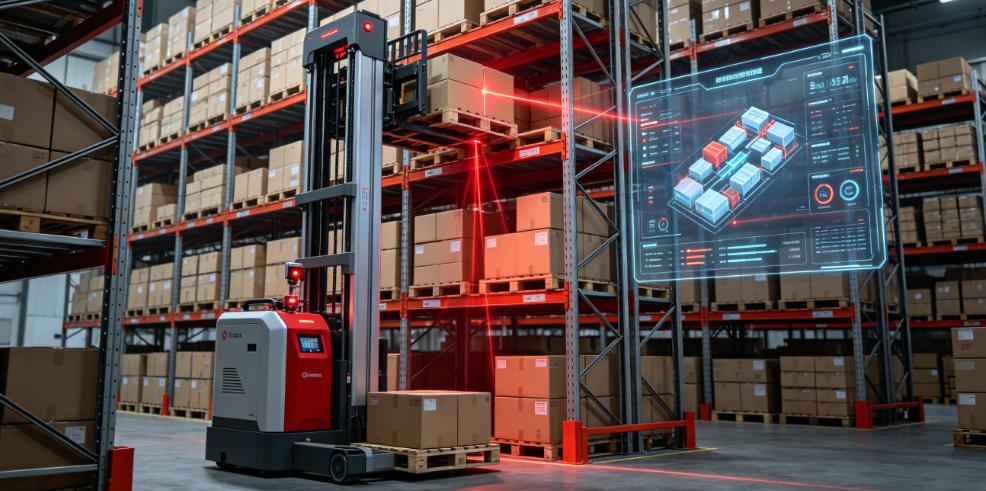
In automated guided vehicles (AGV) and autonomous mobile robots (AMR), the distance laser sensor plays a central role in environmental perception.
Key functions include:
- Real-time path planning and dynamic obstacle avoidance
- SLAM (Simultaneous Localization and Mapping)
- Obstacle detection in dynamic environments
- Warehouse structure recognition
High-precision laser distance sensors enable centimeter-level navigation accuracy, improving both safety and operational efficiency in smart logistics systems.
3. Smart Warehousing and Logistics Systems
In smart warehouses, laser sensors are widely used for automation and inventory management, such as:
- Pallet height detection and stacking recognition
- Automatic sorting line calibration
- Volume measurement and space optimization
- Automated storage and retrieval systems (AS/RS)
With distance laser sensors, warehouses can achieve fully automated operation, reducing labor costs and improving efficiency.
4. Construction and Precision Measurement Industry
In construction and surveying, laser distance sensors are increasingly replacing traditional measuring tools.
Applications include:
- Building structure measurement
- Indoor 3D scanning
- Bridge deformation monitoring
- BIM (Building Information Modeling) data collection
Laser sensors are ideal for large-scale structures due to their long-range and high-precision measurement capabilities.

5. Smart Transportation and Infrastructure Systems
In smart city and transportation systems, laser sensors are used for:
- Vehicle speed detection and enforcement systems
- Distance monitoring and collision prevention
- Smart parking systems
- Tunnel and road condition monitoring
In high-speed environments, distance laser sensors provide fast response and reliable data output, ensuring safety and intelligent traffic management.
6. Extended Applications: AI and Autonomous Systems
Beyond traditional industries, laser distance sensors are widely used in:
- Drone obstacle avoidance and terrain mapping
- Smart agriculture equipment
- Service robotics environment sensing
- AI vision + laser fusion systems
With AI integration, laser sensors are evolving from simple measurement tools into core spatial perception systems.
Key Advantages of Laser Distance Sensors
Compared with other sensor technologies, laser distance sensors offer:
- High-precision distance measurement
- Long-range stable detection
- Insensitivity to lighting conditions
- High-speed dynamic response
- Easy integration into industrial systems
These advantages make laser sensors a key technology in Industry 4.0 and smart automation.
Market Trends: Growing Demand for Laser Sensors
With the advancement of smart manufacturing and robotics, global demand for laser sensors and laser distance sensors continues to grow rapidly.
Key trends include:
- Industrial automation driving large-scale adoption
- AGV/AMR expansion boosting demand for distance laser sensors
- Smart warehouse systems accelerating deployment
- AI + machine vision integration increasing application value
In the future, laser sensors will expand beyond industrial use into smart cities, autonomous driving, and smart homes.
How to Choose a Laser Distance Sensor?
When selecting a laser distance sensor, consider the following factors:
1. Measurement Accuracy
High-precision sensors are essential for automation and robotics.
2. Measuring Range
Different applications require short or long-range distance laser sensors.
3. Response Speed
High-speed production lines require fast-response laser sensors.
4. Environmental Adaptability
Sensors must perform reliably in dust, lighting changes, and industrial environments.
5. Interface and Integration
Support for industrial protocols (IO-Link, Modbus, etc.) improves system compatibility.
Future Development Trends of Laser Sensors
Future laser sensors will evolve in the following directions:
- Higher precision and longer range
- Miniaturization and low power consumption
- AI-powered recognition and measurement
- Multi-sensor fusion (vision + laser)
- Expansion into robotics and autonomous systems
Especially in AMR, autonomous driving, and smart factories, laser distance sensors will become core perception components.
XT-S240 Mini 106°×80°, Outdoor 10m, Indoor 12m Solid-State Flash Lidar

Conclusion
As industrial intelligence and automation continue to evolve, laser sensors (laser distance sensors) have become a foundational technology for modern sensing systems.
Whether in manufacturing, robotics navigation, or smart logistics, distance laser sensors provide high value in accuracy, efficiency, and automation. In the future, laser sensors will continue driving the evolution of intelligent systems toward higher precision and smarter operations.




Please upload banner from store admin blog pages