How to Measure Distance with a Laser Sensor: Step-by-Step Guide
How Can I Accurately Measure Distance Using a Laser Sensor?
With the development of laser measurement technology, measuring distance with a laser has become a crucial technique in construction, robotics, automation, and scientific research. Compared to traditional measurement methods, laser distance measurement offers non-contact, high-precision, and fast-response capabilities, making it increasingly popular in construction sites, automated control systems, and smart devices. This article provides a detailed guide on how to use a laser distance sensor to measure distance, covering the basic principles, operational steps, and tips for improving measurement accuracy.
What Is Laser Distance Measurement?
Laser distance measurement (measure distance with laser) is a high-tech method that uses a laser length measurement sensor to accurately determine the distance between the sensor and a target object. Unlike traditional tape measures, ultrasonic, or infrared devices, laser distance measurement does not require physical contact with the object, which improves safety and significantly enhances measurement efficiency.
Laser beams are highly focused and directional, capable of traveling long distances in a straight line while maintaining a small spot size and high accuracy. This allows laser sensors to reliably measure distances ranging from a few centimeters to hundreds of meters, depending on laser power, sensor sensitivity, and environmental conditions such as ambient light, air refractive index, and weather.
Additionally, the core advantage of laser distance measurement lies in the speed of light. By calculating the time or phase difference between the emitted and reflected light, laser sensors can achieve millisecond-level response times and millimeter-level accuracy, making them ideal for fast-feedback applications such as robot navigation, UAV altitude control, industrial production line monitoring, and precision construction measurements.
In short, laser distance measurement is a non-contact, fast, high-precision, and versatile technology that meets the demands of modern engineering, research, and smart devices, making it one of the most advanced solutions in distance measurement today.

Basic Principles of Laser Distance Measurement
The core principle of laser distance measurement (measuring distance with a laser) is using the propagation properties of light to determine the distance between the sensor and the target. Whether in industrial measurement, UAV control, or robot obstacle avoidance, laser distance measurement relies on precise optical and electronic measurement techniques to achieve high-accuracy, fast-response distance calculation. The main methods include:
1. Time-of-Flight (ToF)
Time-of-Flight is one of the most straightforward and widely used laser measurement methods. The sensor emits a very short pulse of laser light, which travels to the target and reflects back to the sensor. The sensor’s electronics record the time difference between emission and reception and calculate the distance based on the speed of light.
Formula:
Distance = Speed of Light × Time / 2
- Divided by 2: The laser travels to the target and back, so the actual distance is half the total travel time.
- Characteristics: Extremely fast measurement, capable of millisecond-level real-time measurement, with millimeter-level precision. Ideal for dynamic scenarios.
-
Applications:
- Obstacle detection and avoidance in mobile robots and automated guided vehicles (AGVs)
- UAV altitude control and terrain following
- Material detection and positioning on industrial production lines
- Measuring distances of fast-moving objects
Time-of-Flight is excellent for long-distance and high-precision measurements because it directly calculates distance using light speed, making it a core technology in modern laser distance devices.
2. Phase-Shift Measurement
Phase-shift measurement is another common laser distance method, mainly used for high-precision measurements at short to medium ranges. The sensor continuously emits modulated laser light while receiving reflected light from the target. By comparing the phase difference between the emitted and received light, the sensor can calculate the precise distance to the target.
-
Characteristics:
- High accuracy, up to micrometer-level
- Fast response, suitable for continuous monitoring
- Strong interference resistance, stable even in complex lighting conditions
-
Applications:
- Precision experimental measurements, such as length, thickness, or small displacement detection
- Industrial automation, including assembly line material positioning and dimension inspection
- Robot navigation and positioning, especially in complex indoor environments
- Close-range obstacle detection and proximity warning
Compared with ToF, phase-shift measurement excels in short-to-medium range and high-precision scenarios, especially for continuous real-time monitoring and detecting tiny changes.
Both methods rely on the propagation properties of light (time or phase) for precise calculation. Compared to ultrasonic or infrared distance measurement, laser distance measurement provides superior accuracy, speed, and interference resistance. By selecting the appropriate method, developers and engineers can achieve high-precision, fast-response measurements in measuring distance with a laser, measure distance with laser, laser length measurement sensor applications, supporting robot navigation, industrial measurement, and smart device functionality.
How to Measure Distance: Step-by-Step
To achieve precise measuring distance with laser results, follow a scientific operational procedure. Correct operation improves measurement accuracy and stability in laboratories, construction sites, robots, or UAV projects.
1. Prepare and Position
- Place the laser distance meter or laser length measurement sensor on a stable workbench, tripod, or measuring stand to ensure the starting point is steady.
- Avoid environmental vibrations or air currents, which can affect high-precision measurements.
- For long-distance measurements, use a fixed support to maintain the relative position of the sensor and target.
Tip: In bright environments or outdoors, using a shading cover or reflective target can improve laser beam stability and measurement precision.
2. Align the Target
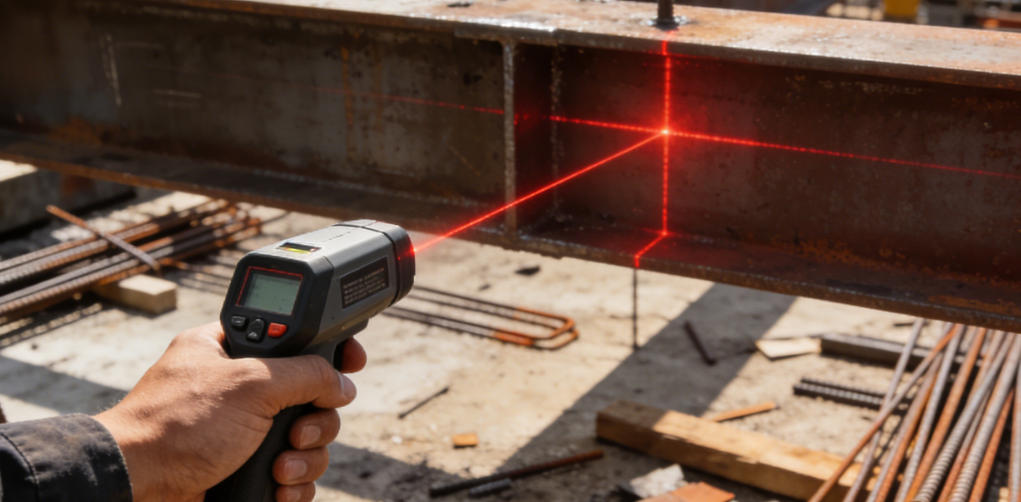
- Turn on the device and aim the laser beam precisely at the target surface. Ensure the beam hits the center area, as lasers travel in a straight line.
- For reflective or transparent surfaces, apply matte stickers or reflective tape to ensure stable reflection.
- For long-distance measurements, avoid beam deviation or obstacles blocking the path.
Safety Note: Never look directly into the laser beam. Wear protective goggles if using high-power lasers.
3. Emit the Laser and Wait for Reflection
- Press the measurement button to send the laser toward the target.
- The laser reflects back to the sensor, which records the time (ToF) or phase change (phase-shift) of the returning light.
- Modern devices complete a measurement within milliseconds and can continuously sample for real-time monitoring.
Tip: Minimize environmental interference like dust, smoke, or direct sunlight for long-distance measurements to improve reflection stability.
4. Read the Measurement Result
- The meter calculates the distance automatically and displays it on a screen or sends it to a control system (e.g., Arduino or PLC).
- Units can be meters, centimeters, or feet; high-precision devices may display millimeters.
- Continuous measurement mode outputs real-time distance changes, ideal for robot obstacle avoidance, UAV navigation, or production line monitoring.
- Single measurement mode suits low-power or intermittent applications, such as construction, warehouse inventory, or lab experiments.
Optimization Tips:
- Use a tripod or fixed support to reduce hand-held errors in long-distance or continuous measurements.
- Avoid direct sunlight; adjust the measurement angle or use a shading device to stabilize returned signals.
- For reflective, glossy, or transparent objects, matte tape enhances reflection and improves reliability.
Following these steps ensures precise, efficient measuring distance with laser, allowing the sensor to perform optimally in robot navigation, industrial measurement, construction, and UAV applications. Leveraging the laser length measurement sensor ensures millimeter-level, non-contact accuracy.
Key Considerations and Tips
- Keep the line of sight clear: Ensure the laser path is unobstructed to avoid interference.
- Select an appropriate target surface: Smooth or transparent surfaces may reduce reflection; use matte stickers if needed.
- Long-distance measurement: Considering how far do lasers travel, high-performance devices can cover hundreds of meters, though environmental conditions affect actual range.
- Stable support: For long-range measurements, use a tripod or fixture to reduce hand-held error.

Major Applications of Laser Distance Measurement
Laser distance measurement (measuring distance with laser) provides non-contact, high-precision, and fast-response distance data, serving various industries:
1. Construction and Engineering
Widely used on construction sites, laser measurement quickly and accurately determines room dimensions, floor heights, column spacing, and site distances. Unlike tape measures, laser sensors reach complex or hard-to-access areas, such as high structures, narrow passages, or large spans.
-
Examples:
- Building façade height measurement
- Interior layout and space planning
- Construction monitoring and progress measurement
- Benefits: Non-contact reduces high-altitude risks while improving efficiency and accuracy.
2. Robotics and Automation
Robots rely on precise distance data for navigation, obstacle avoidance, and path planning. Laser sensors provide real-time environmental feedback, enabling safe and efficient movement.
-
Examples:
- AGV path planning in warehouses or factories
- Educational robot obstacle avoidance
- Smart vacuum cleaner navigation
- Benefits: Rapid feedback and continuous measurement ensure reliable dynamic obstacle avoidance, outperforming ultrasonic or infrared sensors.
3. Industrial Production and Quality Control
Laser measurement is used for automated positioning, inspection, and measurement, offering high-precision support in production lines.
-
Examples:
- Part positioning on automated assembly lines
- Height monitoring in packaging and logistics
- Dimensional inspection in industrial quality control
- Benefits: Non-contact reduces human error, improves efficiency, and maintains repeatable measurement accuracy.
4. Remote Measurement and Surveying
Combined with LiDAR, laser distance sensors enable large-scale terrain mapping and building scanning. Laser point cloud data creates high-precision 3D maps for surveying, urban planning, and environmental monitoring.
-
Examples:
- UAV terrain scanning and building mapping
- City planning and road construction data collection
- Natural terrain and forest coverage measurement
- Benefits: Remote, fast, and accurate, especially suitable for large or hazardous areas.
Across construction, robot navigation, industrial automation, and remote surveying, laser distance measurement (measuring distance with laser, measure distance with laser, laser length measurement sensor) offers high precision, fast response, and non-contact measurement, becoming an essential tool for modern measurement and control systems. Choosing the right sensor and measurement method significantly enhances efficiency, ensures reliable data, and provides precise distance information for complex projects.
Summary: Advantages of Laser Distance Measurement
Using measure distance with laser technology offers clear benefits:
- High precision: More accurate than tape measures or ultrasonic sensors
- Non-contact: No need to touch the object
- Fast response: Almost instant readings
- Wide application range: Suitable for short to long distances
Laser distance measurement has become a key component of modern measurement technology, providing fast, efficient, and accurate distance solutions for both industrial and everyday applications.
Vzense NYX Series ToF Sensor -NYX650-NYX660

After-sales Service: Our professional technical support team specializes in TOF camera technology and is always ready to assist you. If you encounter any issues during the usage of your product after purchase or have any questions about TOF technology, feel free to contact us at any time. We are committed to providing high-quality after-sales service to ensure a smooth and worry-free user experience, allowing you to feel confident and satisfied both with your purchase and during product use.




Please upload banner from store admin blog pages
Please select collection from store admin blog pages