RGB‑D Cameras: Applications, AI, Robotics & 3D Vision Trends
What Is an RGB‑D Camera and How Does It Power AI, Robotics, and 3D Vision?
With the rapid development of intelligent vision technology, rgb cameras and rgb‑d / rgbd (color-depth fusion cameras) have become core drivers for advancing computer vision, robotics, and immersive experiences. Unlike traditional rgb cameras, which only provide two-dimensional image information, RGB‑D cameras simultaneously capture color images and depth information, giving devices more comprehensive and intelligent visual perception capabilities.
What Is an RGB‑D Camera? Understanding the Technical Core
RGB‑D cameras (rgbd cameras) are intelligent devices that integrate traditional rgb cameras (color image sensors) with depth sensors. They not only capture 2D color images but also acquire three-dimensional spatial information of the scene. Unlike ordinary rgb cameras, which can only record the color and texture of objects, RGB‑D cameras provide depth data for each pixel, allowing computers to 'see' the real-world position and shape of objects in space.
The data output typically includes:
- Rich RGB color images: High-resolution color images provide true-to-life colors and details, suitable for visual recognition, scene analysis, and video monitoring.
- Accurate depth data (Depth): Using infrared, structured light, or time-of-flight (ToF) technology, the camera measures distances between objects and the camera, enabling 3D modeling, object measurement, and distance estimation.
- Point cloud and 3D reconstruction data: Combining RGB information generates high-precision point clouds that can be used for 3D scene reconstruction, object detection, pose estimation, gesture recognition, and robotic navigation.
- Motion and spatial perception: RGB‑D cameras can track object movements in real time, supporting SLAM (simultaneous localization and mapping), AR/VR real-time interaction, and smart security applications.
By combining color and depth information, RGB‑D cameras overcome the limitations of traditional rgb cameras in complex lighting, occlusion, and spatial understanding. They provide critical data support for AI, autonomous driving, robotic navigation, industrial automation, smart homes, virtual reality, and augmented reality. In particular, RGB‑D technology allows robots to understand 3D structures like humans, significantly enhancing autonomous decision-making and interactive experiences.

Why Is RGB‑D / RGBD Technology Rapidly Becoming Popular?
Compared to ordinary rgb cameras, RGB‑D cameras (rgbd cameras) offer significant advantages, driving their adoption in AI, robotics, AR, and smart security applications:
✅ Real-Time 3D Perception
RGB‑D cameras capture 2D color images while simultaneously outputting depth information and 3D coordinates, enabling precise spatial perception.
- For robots, RGB‑D cameras allow real-time obstacle recognition, distance measurement, and path planning for autonomous navigation and collision avoidance.
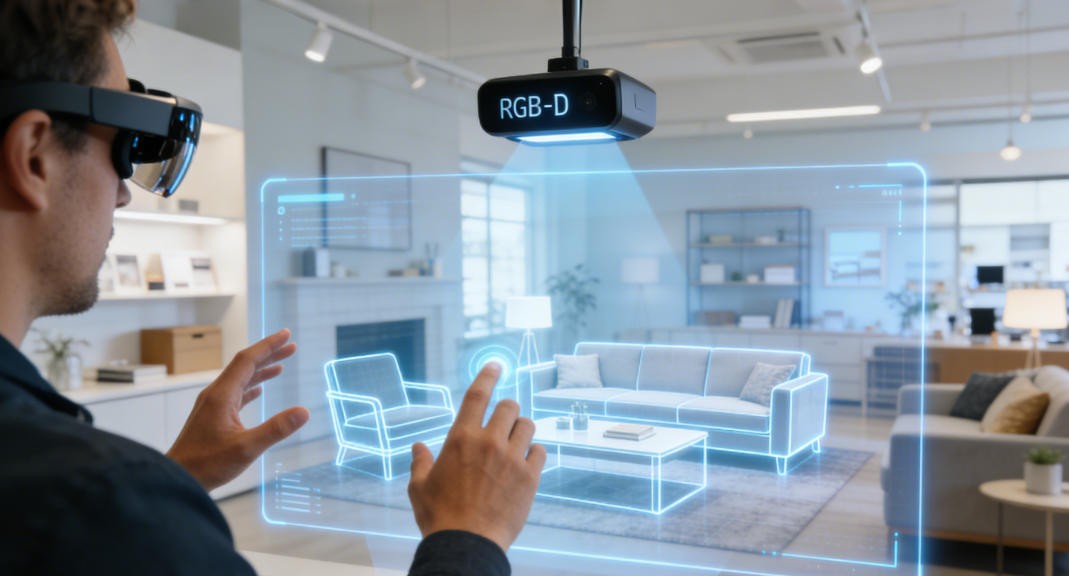
- In AR/VR applications, they provide accurate spatial depth information, seamlessly integrating virtual objects into the real world for immersive and interactive experiences.
- Combined with machine learning algorithms, RGB‑D data can be used for 3D motion capture, gesture recognition, and pose estimation, significantly enhancing device perception capabilities.
✅ Improved Recognition Accuracy
Traditional rgb cameras rely solely on color and texture for recognition, which can fail under varying lighting, occlusion, or complex backgrounds. RGB‑D cameras combine depth and color data, allowing systems to:
- Accurately separate foreground from background, improving detection and classification stability.
- Recognize the 3D shape of partially occluded objects, enhancing tracking and recognition accuracy.
- Provide reliable data for automated production, unmanned retail, and smart security, improving efficiency and safety.
✅ More Diverse Applications
RGB‑D cameras go far beyond traditional rgb cameras, offering diverse applications across industries:
- Smart robotics: Environment perception, path planning, grasping, and manipulation all rely on RGB‑D data for higher-precision automation.
- AR/VR: Depth information enhances scene interaction and immersion, supporting gaming, education, and training applications.
- Smart security and surveillance: Detect intruders, analyze behaviors, and trigger alerts for improved safety management.
- Industrial automation and warehouse management: Accurate object recognition, measurement, and handling improve operational efficiency.
- Medical and education: RGB‑D technology provides more intuitive and precise data for surgical assistance, rehabilitation, and interactive learning.
As a result, rgb‑d cameras / rgbd cameras have become a key tool for visual innovation, with applications expanding rapidly across industrial, scientific, educational, and entertainment sectors.
Popular Application Areas of RGB‑D Cameras
As rgbd camera (3D depth camera) technology matures, these devices are being adopted across industries, enabling applications that traditional rgb cameras cannot achieve.
Computer Vision and AI
By capturing both RGB color images and depth data, rgb‑d cameras greatly enhance algorithmic perception:
- Depth information reduces interference from occlusions or complex backgrounds in object detection, image segmentation, and scene understanding.
- RGB + depth data provide richer features for machine learning and deep learning algorithms, helping build stable 3D scene models.
- Typical applications include smart surveillance, unmanned retail shelf recognition, industrial quality inspection, and automated visual inspection.
Robotic Navigation and Intelligent Control
RGB‑D cameras are indispensable for modern intelligent robots:
- Provide precise 3D environmental mapping for autonomous path planning and dynamic obstacle avoidance.
- Enable robotic arms or service robots to grasp and manipulate objects with high precision, improving industrial and logistics efficiency.
- Support warehouse management, delivery robots, and cleaning robots, allowing full spatial awareness and real-time decision-making.

Augmented Reality (AR) / Virtual Reality (VR)
Embedded rgb‑d devices enhance AR/VR experiences:
- Depth data accurately measures user-to-object distances, allowing virtual objects to naturally integrate into the real world.
- Supports gesture recognition, motion capture, and spatial interaction, enhancing immersion in education, gaming, and training.
- Provides precise spatial references for indoor navigation, virtual try-ons, and furniture placement applications.
Medical and Education
RGB‑D cameras also play an important role in healthcare and education:
- In surgical assistance, 3D reconstruction and depth measurement allow doctors to observe structures more clearly, improving precision.
- In rehabilitation and motion assessment, RGB‑D devices track patient movements in real time, offering data feedback and analysis.
- In education, RGB‑D cameras enable interactive classrooms, virtual labs, and immersive learning, helping students understand complex spatial concepts.
Other Innovative Applications
Beyond the above areas, rgb‑d cameras / rgbd cameras are also widely used in:
- Smart homes: Gesture control, environment sensing, and security monitoring.
- Creative industries and entertainment: VR experiences, stage performance capture, 3D modeling, and digital content production.
- Indoor 3D scanning: Home design, interior layout optimization, and architectural surveying.
Because RGB‑D technology integrates color and depth, it excels in scenarios where traditional rgb cameras fall short, making it a critical tool in industrial, research, educational, and consumer markets.
RGB‑D Technology and Future Trends
With the rapid development of AI, machine learning, big data, and edge computing, the role of rgbd cameras (RGB‑D cameras) will become increasingly significant. High-performance rgb cameras combined with advanced depth-fusion algorithms allow devices to capture 3D spatial information with higher precision, providing perception capabilities close to human vision.
Technological Development Trends
- Higher Resolution and Accuracy: Future RGB‑D cameras will adopt higher-resolution color sensors and more precise depth sensors, achieving micron-level depth measurement and improving industrial inspection, robotic grasping, and autonomous driving reliability.
- Low Power and Miniaturization: Optimized chips and sensor designs will make RGB‑D cameras smaller and more energy-efficient, suitable for drones, portable devices, and smart home systems.
- Deep Algorithm Integration: Combining deep learning and computer vision, RGB‑D data can be directly applied to object recognition, scene reconstruction, motion tracking, and real-time decision-making, making intelligent devices more autonomous and efficient.
- Cloud and Edge Collaboration: RGB‑D data will integrate seamlessly with cloud and edge computing platforms for large-scale data analysis, remote monitoring, and real-time interaction, driving the development of smart cities and intelligent factories.
Market and Application Prospects
- Autonomous Driving and Smart Transportation: RGB‑D cameras provide accurate 3D information around vehicles, supporting environment perception, collision avoidance, and path planning for safer transportation.
- Industrial Automation and Smart Manufacturing: 3D detection, point cloud analysis, and object recognition improve production efficiency, reduce errors, and enable flexible manufacturing.
- Smart Homes and Consumer Electronics: Gesture recognition and spatial sensing provide interactive control, security monitoring, and environmental optimization.
- Healthcare, Education, and Entertainment: Surgical assistance, rehabilitation, virtual labs, immersive gaming, and virtual demonstrations benefit from RGB‑D technology, offering more intuitive and efficient experiences.
In the future, rgb‑d cameras / rgbd cameras will not only be essential tools for scientific research and industrial R&D but will also see widespread adoption in the consumer market. As technology matures and costs decrease, RGB‑D cameras will become core infrastructure in intelligent robots, autonomous vehicles, AR/VR, smart factories, and smart cities, ushering visual intelligence into a whole new era.
Slamtec RPLIDAR A2 A3 S1 S2 S3 Lidar Front-End Ports Ethernet Adapter

After-sales Support:
Our professional technical team specializing in 3D camera ranging is ready to assist you at any time. Whether you encounter any issues with your TOF camera after purchase or need clarification on TOF technology, feel free to contact us anytime. We are committed to providing high-quality technical after-sales service and user experience, ensuring your peace of mind in both shopping and using our products.



Please upload banner from store admin blog pages