RGBD Depth Camera: Complete 3D Vision Solution for Robotics & AR/VR
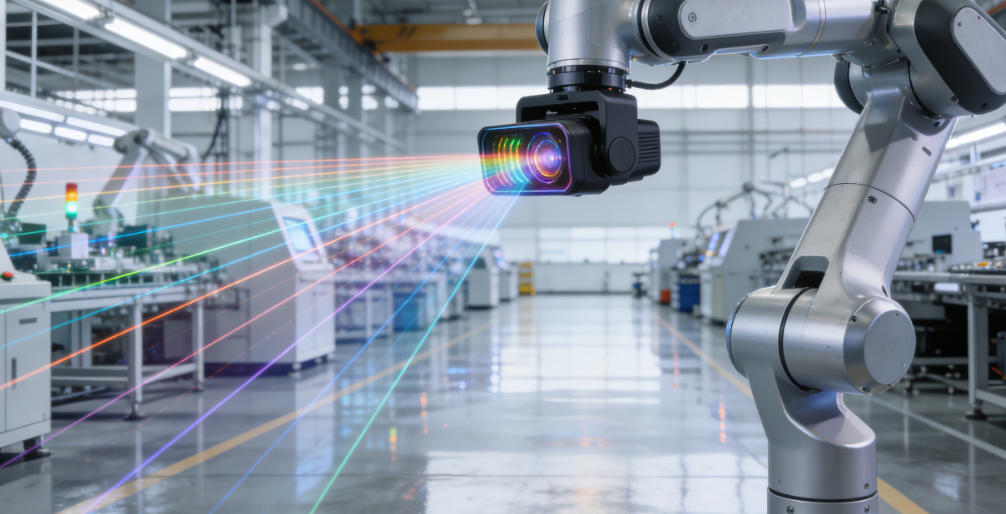
How Does a Depth Camera for Robotics Improve 3D Vision and Intelligent Automation?
With the rapid growth of AI vision technology and 3D perception requirements, RGBD depth cameras have become core sensing devices in fields such as robotics, autonomous driving, AR/VR, intelligent security, and industrial inspection. RGBD means simultaneously capturing RGB color images and depth information, fusing these data streams to give machines human-like 3D spatial perception, enabling more accurate object recognition and spatial reconstruction.
What is an RGBD Depth Camera?
An RGBD depth camera (RGB-D Camera) is a high-precision visual sensor that combines color imaging (RGB) with depth sensing (Depth). Unlike traditional cameras that only capture 2D color images, RGBD cameras capture both the scene’s color, texture, and spatial distance information, generating complete 3D scene data.
RGBD depth cameras typically use advanced depth sensing technologies, including ToF (Time-of-Flight), structured light, or stereo vision. These methods precisely measure the distance from each pixel to the object, creating high-resolution depth maps that are synchronized with RGB images, providing richer and more accurate data for computer vision and artificial intelligence applications.
By fusing RGB + Depth data, RGBD cameras enable complex 3D perception tasks, including:
- 3D modeling and scene reconstruction: Quickly generate high-precision point clouds and mesh models, widely used in VR, AR, architectural surveying, and digital twins.
- SLAM (Simultaneous Localization and Mapping): Provide key spatial and pose information for mobile robots and autonomous vehicles, enabling real-time localization and mapping.
- Object detection and recognition: Depth information allows systems to determine shape, volume, position, and orientation more accurately than RGB-only cameras.
- Pose estimation and human-computer interaction: Depth data enables precise skeletal tracking and pose analysis for gesture recognition, motion capture, and interactive devices.
- Industrial inspection and automation: RGBD cameras provide accurate 3D data for tasks like size measurement and quality control, helping machines handle complex operations.
In short, an RGBD depth camera is more than just a camera; it is the core 3D perception module for intelligent systems. By capturing both RGB color data and depth information, it greatly enhances the system’s understanding of the environment, allowing robots, drones, industrial equipment, and interactive systems to “see” the 3D world and perform tasks with precision.
With the development of deep learning and computer vision algorithms, the value of RGBD data continues to grow, making it indispensable in AI, robotic vision, smart surveillance, 3D reconstruction, AR/VR, and other cutting-edge technology fields.

DOMI RGBD Camera – High-Performance 3D Depth Perception Module
As a professional manufacturer specializing in ToF (Time-of-Flight) depth sensing technology, DOMI offers RGBD camera modules that combine high-precision color imaging with high-resolution depth measurement—an ideal choice for building intelligent vision systems. DOMI RGBD cameras are widely used in embedded vision systems, robotic vision, 3D scene reconstruction, volume measurement, industrial automation, drone navigation, and AR/VR applications. By fusing RGB and Depth data, DOMI RGBD cameras provide complete 3D spatial perception solutions for various applications.
Core Advantages
Synchronized RGB + Depth Data Output
DOMI RGBD camera modules support high-resolution RGB images and precise depth maps (Depth Map) simultaneously. This real-time RGBD data fusion allows systems to perform tasks such as 3D modeling, object recognition, pose estimation, spatial reconstruction, and scene understanding with seamless alignment and enhanced computational accuracy, significantly reducing visual errors and ensuring reliable robot navigation, automated inspection, and VR/AR interaction.
Enhanced Machine Vision Accuracy
Unlike traditional RGB cameras that only capture 2D images, DOMI RGBD cameras enhance systems’ understanding of spatial information through depth sensing. They can precisely measure an object’s distance, size, shape, and pose, delivering exceptional accuracy in complex environments.
- In autonomous driving and mobile robots, RGBD cameras can detect obstacles in real time, measure safe distances, and assist in path planning.
- In industrial inspection and quality control, they accurately measure part volumes, detect surface defects, and enable efficient automated inspection workflows.
- In 3D reconstruction and AR/VR, they generate high-precision point clouds and 3D models, providing comprehensive spatial data for virtual environments.
Adaptable to Complex Lighting Conditions
DOMI RGBD cameras employ advanced ToF depth sensing technology and optimized optics, enabling stable performance in bright light, backlight, low light, or nighttime conditions. Whether in indoor industrial workshops, outdoor autonomous navigation, or real-time AR/VR 3D modeling, they deliver high-precision depth maps and HD color images, ensuring system stability and robustness. The modules support multiple interfaces, including USB, MIPI, and Ethernet, allowing easy integration into embedded or industrial control systems.
Additional Advantages
- Lightweight design: Easy to embed in drones, robots, or portable devices.
- SDK and development tools: Rich software interfaces for customization and secondary development.
- Multi-scenario compatibility: Applicable to industrial automation, smart monitoring, AI robotic vision, 3D reconstruction, and VR/AR.
- High reliability and longevity: Suitable for continuous operation and long-term stable performance.
With these advantages, DOMI RGBD cameras are not just cameras—they are the core module for 3D visual perception, spatial understanding, and autonomous decision-making in modern intelligent systems.
Core Technology and Working Principles of RGBD Depth Cameras
RGBD cameras achieve complete 3D spatial perception by combining color imaging sensors with depth measurement sensors, enabling vision systems to capture both color information and spatial depth data. This integration is critical for applications in robot navigation, autonomous driving, industrial inspection, AR/VR, and 3D reconstruction.
RGB Color Image Capture
RGBD cameras feature high-performance RGB cameras that capture full color information via red, green, and blue channels.
- High-resolution images: Capture textures, edges, and surface details for object recognition, image segmentation, and surface inspection.
- Enhanced image processing: Features like low-light enhancement, HDR, and auto white balance enable stable capture in dim indoor or bright outdoor environments.
- Application examples: In smart retail, RGB images help identify product colors and labels; in industrial automation, they assist in detecting surface defects and classifying workpieces.
Depth Sensing
Depth is captured using technologies such as:
-
ToF (Time-of-Flight)
- Emits infrared pulses and measures the return time to calculate distances.
- High precision and real-time, suitable for robot navigation and drone obstacle avoidance.
-
Structured Light
- Projects optical patterns and calculates depth from pattern deformation.
- Excellent for industrial inspection, 3D modeling, AR/VR.
-
Stereo Vision
- Uses two cameras to calculate depth from disparities.
- Suitable for outdoor or dynamic scenes, with lower cost.
Depth information not only provides distance to objects but also helps the system understand shape, size, position, and spatial relationships, enhancing performance in obstacle avoidance, path planning, measurement, and 3D reconstruction.
RGB + Depth Data Fusion
RGB and depth images are synchronized and aligned, forming a complete RGBD data stream. This enables:
- Point cloud generation: Mapping color and depth data to 3D space.
- 3D scene modeling: High-precision reconstruction for architectural surveying, digital twins, and VR/AR.
- Intelligent object tracking: Robots can detect object boundaries, volume, and pose for navigation and manipulation.
- AI algorithm support: RGBD data provides rich features for object detection, pose estimation, and action recognition.
By fusing RGB + Depth, RGBD cameras allow machines to 'see' the 3D world, enabling intelligent perception, spatial understanding, and autonomous decision-making.

Popular Applications of RGBD Depth Cameras
With the maturity and decreasing cost of RGBD technology, these cameras have become essential in many cutting-edge applications. Their ability to capture color and depth simultaneously enables precise 3D perception, spatial reconstruction, and intelligent decision-making.
Robot Navigation and Autonomous Mobility
In mobile robots, autonomous vehicles, and delivery robots, RGBD cameras can capture surrounding 3D environments in real time:
- Generate 3D environmental maps
- Detect obstacles, measure distances and dimensions
- Dynamically plan optimal paths for autonomous navigation and avoidance
- Support SLAM algorithms for precise indoor and outdoor localization
This makes RGBD cameras core sensors for warehouse robots, service robots, and autonomous driving assistants.
Industrial Automation and Precision Inspection
In manufacturing, electronic assembly, part inspection, and dimensional measurement, RGBD cameras provide high-precision 3D spatial data:
- Volume measurement and 3D modeling of workpieces
- Detect surface defects, warping, or assembly deviations
- Enable automated vision-guided operations
- Improve inspection efficiency while reducing manual labor
Combined with AI, RGBD cameras allow fast, precise, and intelligent automated inspection, greatly increasing production efficiency.
Human-Computer Interaction and Pose Recognition
In smart homes, gaming, fitness monitoring, and healthcare, RGBD cameras capture human poses, gestures, and motion trajectories:
- Gesture recognition and control for AR/VR or virtual interfaces
- Pose estimation and motion capture for gaming, exercise analysis, or rehabilitation
- Behavior analysis: monitoring crowd behavior, fall detection, or workplace motion
Fusing color and depth data significantly improves accuracy in human detection and interaction, allowing real-time understanding of actions and intentions.
AR/VR and 3D Scene Reconstruction
In augmented reality (AR) and virtual reality (VR), RGBD cameras are critical for realistic interactive experiences and high-precision 3D modeling:
- Real-time spatial modeling: Quickly generate indoor/outdoor 3D scenes for seamless integration of virtual and real objects
- Virtual object positioning and interaction: Depth information enables collision detection and accurate placement
- Digital twins and scene reconstruction: High-precision 3D scanning for architecture, cultural heritage, and creative industries
- Immersive gaming: Combined with motion capture, depth data enables natural interaction and real-time response in virtual environments
By simultaneously capturing color, texture, and depth, RGBD cameras provide full 3D data streams for AR/VR systems, making them essential for immersive applications.
Why Choose DOMI RGBD Solutions?
As a leading ToF and RGBD vision module provider, DOMI offers:
✅ Multiple interface options (USB, MIPI, Ethernet)
✅ High-precision depth sensing and stable color imaging
✅ Customizable solutions with SDK support
✅ Suitable for various 3D vision system development
Whether for industrial automation, AI robotic vision, or AR/VR interactive projects, DOMI RGBD depth cameras can be flexibly integrated and developed.
Conclusion: RGBD Depth Cameras Are the Future of Visual Recognition
With the advancement of intelligent perception, RGBD depth cameras have transitioned from research labs to commercial products. Compared to traditional 2D cameras, they provide more accurate and comprehensive visual information, making them essential for 3D perception, human-computer interaction, autonomous navigation, and spatial reconstruction.
If you are designing the next generation of intelligent vision products, choosing a high-performance RGBD camera module is a key step to success.
XT-S240Pro 3D ToF Lidar| Compact, Solid State, 240 Lines, 20m Working Distance

After-sales Service: Our professional technical support team specializes in TOF camera technology and is always ready to assist you. If you encounter any issues during the usage of your product after purchase or have any questions about TOF technology, feel free to contact us at any time. We are committed to providing high-quality after-sales service to ensure a smooth and worry-free user experience, allowing you to feel confident and satisfied both with your purchase and during product use.



Please upload banner from store admin blog pages