What Is a ToF Sensor? How dToF Works and Why Robots Use It
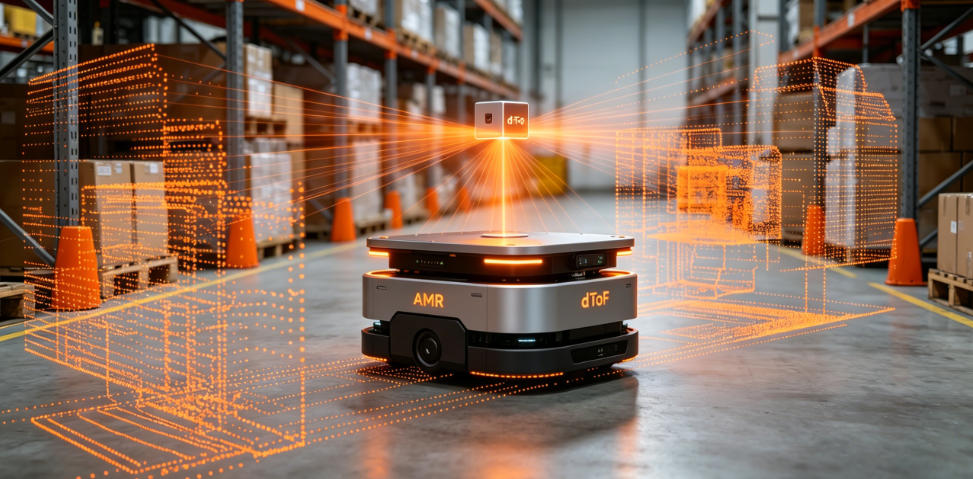
What Is a ToF Sensing and Why Is dToF Becoming Essential for Modern Robots?
With the rapid growth of robotics, drones, autonomous vehicles, industrial automation, and Physical AI, the Time-of-Flight (ToF) sensor has become one of the most important technologies in the field of 3D vision.
From Autonomous Mobile Robots (AMRs) and AGV navigation systems to industrial safety monitoring, drone altitude measurement, smart access control, and people-counting systems, more industries are adopting ToF depth sensors to achieve accurate spatial awareness.
In this article, we will answer several key questions:
- What is a ToF sensor?
- How does ToF technology work?
- What is the difference between dToF and iToF?
- Why are more robotic systems adopting dToF sensors?
Let's explore the fundamentals of ToF technology, its core components, major architectures, and future trends.
What Is a ToF Sensor?
A ToF (Time-of-Flight) sensor measures distance by calculating the time it takes for emitted light to travel to an object and return to the sensor.
The fundamental distance calculation is:
D = (c × t) / 2
Where:
- D = Distance
- c = Speed of light (approximately 3 × 10⁸ m/s)
- t = Round-trip flight time of light
Since light travels extremely fast, ToF systems require timing accuracy in the nanosecond or even picosecond range.
Unlike traditional RGB cameras that capture color information, a ToF sensor captures depth information by measuring distance at every pixel.
As a result, ToF technology is commonly referred to as:
- Depth Sensor
- 3D Vision Sensor
- Laser Distance Sensor
- ToF Camera
- 3D Depth Camera
Its primary purpose is not to capture images but to understand the spatial structure of the environment.

Core Components of a ToF Sensor
A typical ToF system consists of four major components:
1. VCSEL Laser Emitter
A VCSEL (Vertical-Cavity Surface-Emitting Laser) emits infrared laser light toward the target.
Common wavelengths include:
- 850 nm
- 940 nm
Compared with LEDs, VCSELs offer:
- Higher optical efficiency
- Lower power consumption
- Better sunlight immunity
- Faster modulation speeds
- More concentrated beam profiles
For these reasons, VCSELs have become the preferred light source for modern ToF sensors.
2. Receiver
The receiver architecture depends on the ToF technology being used.
dToF Sensors
Typically use:
- SPAD Arrays (Single-Photon Avalanche Diodes)
SPADs are capable of detecting individual photons with extremely high sensitivity.
iToF Sensors
Typically use:
- CMOS Image Sensors
These provide higher resolution and lower manufacturing costs.
3. TDC (Time-to-Digital Converter)
The Time-to-Digital Converter (TDC) functions as an ultra-high-speed stopwatch.
Its responsibilities include:
- Recording photon arrival times
- Measuring flight time
- Calculating distance values
The accuracy of the TDC directly affects ranging precision.
4. Optical Filters
Optical filters suppress ambient light interference.
In outdoor environments with sunlight levels exceeding 100,000 lux, filters help:
- Reduce infrared noise
- Improve signal-to-noise ratio (SNR)
- Increase measurement stability
dToF vs iToF: What's the Difference?
The ToF market is primarily divided into two categories:
- Direct Time-of-Flight (dToF)
- Indirect Time-of-Flight (iToF)
What Is dToF (Direct Time-of-Flight)?
Direct Time-of-Flight measures the actual travel time of emitted laser pulses.
The process is straightforward:
- Emit a laser pulse
- The pulse reflects off the target
- The sensor records the return time
- Distance is calculated directly
Because dToF measures actual flight time, it provides highly accurate ranging performance.
Advantages of dToF Sensors
Long Measurement Range
Typical ranging distances include:
- 10 m
- 20 m
- 50 m
- 100 m+
Excellent Sunlight Immunity
dToF systems perform reliably under:
- Bright outdoor environments
- Direct sunlight
- 100,000+ lux conditions
Strong Multi-Path Interference Resistance
Suitable for:
- Industrial automation
- Warehouse robotics
- Autonomous Mobile Robots (AMRs)
- Automated Guided Vehicles (AGVs)
- Drones
- Autonomous driving systems
Typical dToF Applications
- LiDAR systems
- Autonomous vehicles
- Robot obstacle avoidance
- Drone altitude measurement
- Intelligent transportation systems
- Industrial safety monitoring
What Is iToF (Indirect Time-of-Flight)?
Indirect Time-of-Flight measures the phase shift between emitted and reflected light signals rather than directly measuring travel time.
Advantages include:
- Higher image resolution
- Lower cost
- Easier miniaturization
- Mature CMOS manufacturing process
Common resolutions include:
- 320 × 240
- 640 × 480
- VGA
- 1 MP and above

dToF vs iToF Comparison
| Feature | dToF | iToF |
|---|---|---|
| Measurement Method | Direct Time Measurement | Phase Shift Measurement |
| Receiver Type | SPAD | CMOS |
| Range | 0.02 m – 100 m+ | 0.1 m – 10 m |
| Sunlight Resistance | Excellent | Moderate |
| Multi-Path Interference | Low | Higher |
| Resolution | Medium | High |
| Cost | Higher | Lower |
| Typical Applications | Robotics, Drones, LiDAR | AR/VR, Face Recognition |
For outdoor robotic applications, dToF is increasingly becoming the preferred choice.
Why Are Robots Adopting dToF Sensors?
As Physical AI and Embodied AI continue to evolve, robots need more than just vision—they need spatial understanding.
Traditional technologies face several limitations.
Stereo Vision
Stereo vision relies heavily on texture information.
Performance often degrades when encountering:
- White walls
- Smooth floors
- Dark objects
Low-light conditions can further reduce accuracy.
Structured Light
Structured light projects infrared patterns to estimate depth.
However:
- Outdoor sunlight can overwhelm the projected pattern
- Effective range is typically limited to a few meters
Advantages of dToF
Reliable in Complete Darkness
Since dToF is an active sensing technology, it does not rely on ambient lighting.
Stable Performance Outdoors
dToF maintains accuracy even under intense sunlight, making it ideal for:
- Outdoor delivery robots
- Mobile service robots
- Agricultural robots
- Drones
Improved Glass Detection
Traditional vision systems often struggle with:
- Glass doors
- Transparent walls
- Reflective surfaces
Advanced dToF sensors can analyze photon return histograms and reflection patterns, improving transparent object detection and enhancing operational safety.
Applications of dToF in AMRs, AGVs, and Drones
Autonomous Mobile Robots (AMRs)
Common applications include:
- Warehouse automation
- Smart manufacturing
- Healthcare logistics
Key functions:
- SLAM mapping
- Obstacle detection
- Dynamic obstacle avoidance
- Path planning
Popular search keywords:
- AMR navigation sensor
- Robot obstacle avoidance sensor
- 3D depth perception
Automated Guided Vehicles (AGVs)
dToF sensors provide:
- Precise distance measurement
- Collision prevention
- Safety zone monitoring
They are often integrated with Virtual Safety Fence systems to enhance workplace safety.
Unmanned Aerial Vehicles (UAVs)
Typical use cases include:
- Altitude holding
- Terrain following
- Obstacle avoidance
- Precision landing
Compared with ultrasonic sensors, dToF offers:
- Longer measurement range
- Higher accuracy
- Better environmental adaptability
dToF Is Becoming a Core Perception Technology for Physical AI
NVIDIA's Physical AI vision emphasizes four essential capabilities:
- Perception
- Reasoning
- Planning
- Action
Among them, perception serves as the foundation of intelligent decision-making.
Powered by technologies such as:
- SPAD detectors
- VCSEL laser emitters
- High-precision TDC circuits
- Edge AI processors
dToF is rapidly becoming a critical component of next-generation machine vision systems.
Future trends include:
- AI-powered ToF Cameras
- Edge AI + dToF integration
- Intelligent SPAD sensors
- Multi-sensor 3D perception fusion
- High-resolution dToF modules
As a result, more industrial robots, service robots, drones, and autonomous vehicles are incorporating dToF technology into their perception stacks.
IHawk 100E 3D Structured Light Camera With VGA Resolution And 0.3-8 Meters Range

Conclusion
ToF sensors have evolved far beyond consumer electronics and are now playing a critical role in robotics, industrial automation, intelligent transportation, and the emerging era of Physical AI.
If your application requires:
- High-precision distance measurement
- Reliable outdoor performance
- Robot obstacle avoidance
- AGV navigation
- AMR autonomous navigation
- Drone altitude sensing
- 3D depth perception
then dToF (Direct Time-of-Flight) is one of the most promising depth sensing technologies to watch in the coming years.
As SPAD detectors, VCSEL lasers, and edge AI processors continue to advance, dToF is expected to become a standard component of next-generation machine vision systems, spatial perception platforms, and intelligent autonomous machines.




Please upload banner from store admin blog pages