
ToF Technology for Reliable Markerless Navigation in Mobile Robots
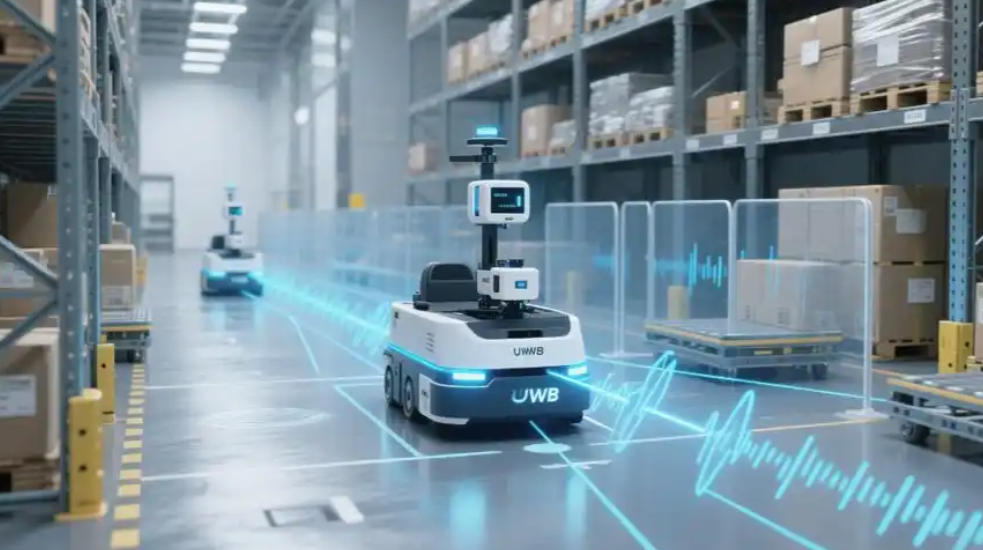
How Does ToF Technology Enable Reliable Markerless Navigation for Robots?
A 3D Perception Foundation for Autonomous, Mapless, and High-Robustness Navigation
With the rapid advancement of robotics, autonomous driving, AMR/AGV systems, and smart logistics, traditional navigation methods based on QR codes, magnetic tapes, reflective markers, or fixed infrastructure are increasingly becoming a bottleneck for scalability and flexibility.
As a result, markerless navigation—also known as mapless navigation or infrastructure-free navigation—is emerging as the dominant approach for next-generation mobile robots. Among the enabling technologies, TOF (Time-of-Flight) depth sensing plays a critical role by providing real-time, absolute, and reliable 3D spatial perception, even in complex and dynamic environments.
This article systematically explains how ToF depth cameras enable robust markerless navigation, covering technical principles, core advantages, algorithm integration, real-world applications, and future development trends.
What Is Markerless Navigation?
Markerless navigation refers to a robot’s ability to autonomously navigate without relying on any artificial external references, such as:
-
QR codes or fiducial markers
-
Reflective landmarks
-
Magnetic strips or guide wires
-
Pre-installed beacons or fixed reference points
Instead, robots rely entirely on onboard sensors and algorithms to perceive the environment, build maps, localize themselves, and plan paths in real time.
At its core, markerless navigation is driven by:
👉 Real-time perception
👉 Real-time localization and mapping (SLAM)
👉 Dynamic decision-making and environmental adaptation
This approach enables flexible deployment, rapid scaling, and continuous operation in changing environments.

Why ToF Technology Is Critical for Markerless Navigation
In applications such as AGV/AMR navigation, warehouse automation, autonomous delivery, and mobile robotics, markerless navigation demands a perception system that is:
-
Independent of environmental markers
-
Robust to lighting and texture changes
-
Capable of real-time 3D spatial understanding
ToF (Time-of-Flight) depth sensing technology meets these requirements and has become one of the most reliable perception solutions for markerless navigation systems.
Introduction to ToF (Time-of-Flight) Depth Sensing Technology
ToF depth sensing is an active 3D perception technology. Its working principle is straightforward:
The sensor emits modulated near-infrared (NIR) light into the environment and precisely measures the time or phase delay of the reflected light returning to the sensor. Using the speed of light, it calculates the absolute distance to each point in the scene.
Unlike 2D cameras or passive vision systems, ToF depth cameras directly output real-scale depth maps and dense 3D point clouds, enabling robots to understand spatial structure without relying on texture, color, or artificial landmarks.
High-search keywords naturally covered:
ToF depth camera, 3D depth sensing, real-time point cloud, active depth sensor, robot perception
Core Advantages of ToF Depth Cameras for Markerless Navigation
Compared with stereo vision, structured light, or ultrasonic sensing, ToF sensors offer several decisive advantages for autonomous navigation.
1. Real-Time, High-Precision Depth Perception
ToF cameras deliver pixel-level depth data at high frame rates (30–60 fps or higher), supporting real-time 3D environment modeling and high-speed navigation.
2. Strong Robustness to Lighting Conditions
Because ToF uses active illumination and phase-based measurement, it operates reliably under:
-
Low light or nighttime conditions
-
Strong ambient light
-
High-contrast or reflective environments
This makes ToF suitable for indoor–outdoor hybrid navigation scenarios.
3. Low Latency and Deterministic Output
Depth calculation is largely hardware-accelerated, avoiding complex stereo matching or feature extraction pipelines. This results in low end-to-end latency, which is critical for real-time obstacle avoidance and control loops.
4. Stability in Dynamic and Low-Texture Environments
ToF does not depend on static visual features or textures. It performs consistently in:
-
Crowded environments
-
Moving obstacles
-
White walls, metal shelves, or reflective floors

How ToF Enables Reliable Markerless Navigation
In a markerless navigation system, robots must continuously perform:
-
3D environment perception
-
Mapping and localization (SLAM)
-
Obstacle detection and avoidance
-
Path planning and motion control
ToF depth sensing provides the foundational spatial data for all these tasks.
Real-Scale Spatial Awareness
ToF outputs absolute distance measurements, enabling robots to accurately assess object size, distance, and safe clearance—without artificial markers.
Improved SLAM Accuracy and Stability
When integrated into visual SLAM, RGB-D SLAM, or multi-sensor fusion SLAM, ToF depth data:
-
Reduces scale ambiguity
-
Improves robustness in low-feature scenes
-
Enhances localization accuracy over time
SEO keywords included:
ToF SLAM, markerless SLAM, robot localization without markers, RGB-D SLAM
Autonomous Decision-Making in Complex Spaces
In environments such as narrow corridors, reflective warehouses, or texture-poor indoor spaces, ToF provides consistent depth input for navigation and motion planning.
Key Applications of ToF-Based Markerless Navigation
ToF depth sensing is widely deployed across multiple robotic domains:
-
Autonomous Mobile Robots (AMRs)
-
AGVs in smart logistics
-
Service and delivery robots
-
Inspection and patrol robots
-
Low-speed autonomous driving systems
Typical use cases include:
-
Flexible warehouse automation without infrastructure changes
-
Autonomous navigation in public spaces
-
Dynamic obstacle avoidance in crowded environments
ToF + Markerless Navigation: Core Technology Integration
1. High-Precision Markerless Localization
ToF depth cameras provide centimeter-level depth accuracy, enabling robots to localize in unknown or changing environments when combined with:
-
Visual SLAM
-
ToF-based SLAM
-
LiDAR + ToF fusion SLAM
This enables true mapless or low-map navigation, reducing deployment cost and maintenance complexity.
2. Real-Time Obstacle Avoidance in Dynamic Environments
Unlike 2D vision systems, ToF directly measures distance, enabling:
-
Reliable detection of static and dynamic obstacles
-
Accurate distance and volume estimation
-
Safe navigation at higher speeds
This is especially valuable for warehouse robots, delivery robots, and service robots operating near humans.
3. From 2D Avoidance to True 3D Path Planning
Traditional 2D LiDAR-based navigation operates on a planar assumption, which limits perception of height, slope, and overhanging objects.
ToF enables full 3D spatial understanding, allowing robots to:
-
Evaluate obstacle height and passability
-
Detect overhanging obstacles and ground irregularities
-
Understand slopes, ramps, and steps
-
Build dense 3D point cloud maps
This supports 3D SLAM, voxel mapping, and semantic navigation, significantly improving navigation success rates.

Advantages of ToF in Complex Real-World Environments
Industrial and Warehouse Environments
-
Multi-level shelving
-
Forklift activity
-
Uneven floors and overhead structures
ToF helps robots distinguish safe traversal zones from hazards.
Public Spaces
-
Crowds and dynamic obstacles
-
Carts, wheelchairs, temporary installations
-
Mixed ramps and steps
3D perception improves safety and human–robot coexistence.
Outdoor and Agricultural Robotics
-
Irregular terrain
-
Varying vegetation height
-
Unstructured environments
ToF enables accurate terrain understanding and stable navigation.
Multi-Sensor Fusion: ToF + LiDAR + IMU
In advanced systems, ToF is typically fused with:
-
LiDAR for long-range perception
-
IMU for motion and attitude estimation
-
RGB cameras for semantic understanding
This fusion approach:
-
Improves robustness under extreme conditions
-
Reduces single-sensor failure risk
-
Enhances overall navigation reliability
Future Trends: ToF Driving Markerless Navigation Adoption
As ToF sensors continue to improve in resolution, cost, and power efficiency, their adoption will accelerate:
-
Expansion from indoor to outdoor navigation
-
Support for higher-speed robots
-
Multi-robot collaborative navigation
-
Deep integration with AI-based perception and decision-making
ToF + SLAM + AI is becoming the standard architecture for next-generation autonomous navigation systems.
Conclusion: ToF as a Core Technology for Markerless Navigation
ToF depth sensing provides real, real-time, and reliable 3D perception, solving many of the limitations of traditional navigation technologies.
With ToF, robots achieve:
-
Markerless autonomous localization
-
High-precision obstacle avoidance
-
True 3D spatial understanding
-
Stable and scalable mapless navigation
As robotics, smart logistics, autonomous driving, and smart cities continue to evolve, ToF-enabled markerless navigation will remain a foundational technology for safe, flexible, and intelligent autonomous systems.
SLAMTEC RPLIDAR S2L 30m TOF LiDAR Sensor for Navigation & Avoidance

After-sales Support:
Our professional technical team specializing in 3D camera ranging is ready to assist you at any time. Whether you encounter any issues with your TOF camera after purchase or need clarification on TOF technology, feel free to contact us anytime. We are committed to providing high-quality technical after-sales service and user experience, ensuring your peace of mind in both shopping and using our products.





Please upload banner from store admin blog pages