Laser Distance Sensor vs TOF Camera: Accuracy & Applications
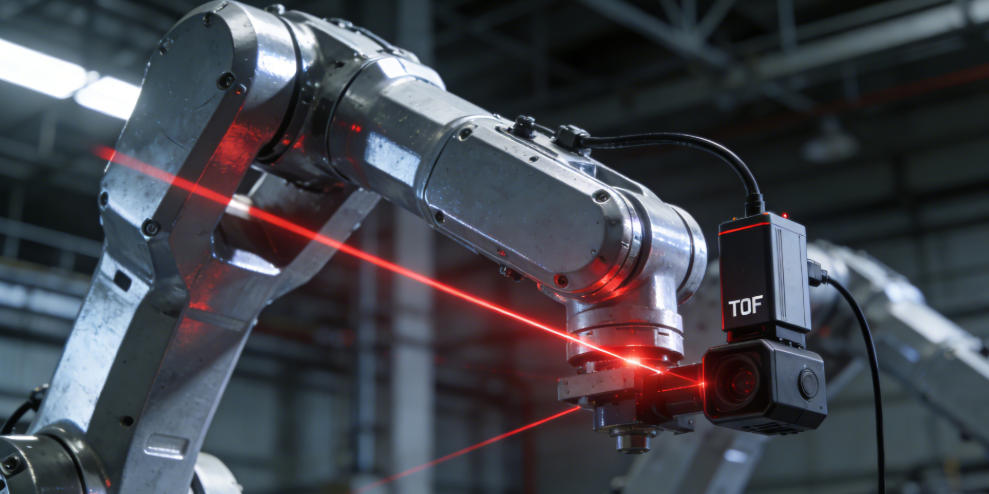
In modern industrial automation, robot navigation, and 3D imaging systems, laser distance sensors and TOF cameras have become core technologies. Understanding their principles, accuracy, and application scenarios is essential for engineers, researchers, and enthusiasts alike.
Principles and Applications of Laser Distance Sensors
A laser sensor is a high-tech device that uses optical principles for precise measurement. It emits high-frequency laser beams and calculates the distance between the sensor and an object by measuring the time it takes for the laser to reflect back or the change in angle. As a non-contact measurement method, laser distance sensors can quickly acquire target distances while avoiding potential damage or friction errors associated with traditional contact measurement.
This technology offers fast response, high precision, and adaptability to complex environments. It is widely used in laser height measurement, laser length measurement, triangulation sensors, as well as industrial production line inspection, quality control, automated assembly, and robot positioning.
Whether for short-range or long-range measurements, laser distance sensors provide stable and reliable data. For example, in Arduino laser distance projects, laser distance modules, and laser proximity sensors, these devices are easy to deploy and maintain high accuracy under various operating conditions. Developers and engineers can integrate these sensors with platforms like Arduino, ESP32, or Raspberry Pi for secondary development, enabling automated measurements, real-time monitoring, and data collection.
In modern industrial and intelligent systems, the importance of laser distance measurement is particularly pronounced. In applications such as AGV (Automated Guided Vehicle) navigation, LiDAR-equipped robots, smart logistics systems, and automated warehouse management, laser distance sensors provide precise spatial positioning and real-time obstacle detection. By optimizing target surface reflectivity, adjusting laser emission angles, and minimizing ambient light interference, modern laser distance systems can achieve high-precision measurements (accuracy up to 0.01 mm), meeting the stringent requirements of industrial automation, robotic navigation, and smart manufacturing.
Additionally, laser distance sensors feature high repeatability, wide measurement range, and strong anti-interference capabilities, making them suitable for objects of various materials and shapes. Applications in short-range laser measurement, long-range laser measurement, and triangulation-based sensing not only improve measurement efficiency but also reduce human error. When combined with TOF or RGB-D cameras in robotics, AGVs, drones, or VR/MR environments, they enable more precise 3D spatial perception and real-time depth measurement, providing reliable data for automated control and intelligent navigation.
In summary, laser distance sensors, with their non-contact operation, high accuracy, fast response, and environmental adaptability, have become indispensable in modern industry, intelligent robotics, 3D imaging, and automation systems. Proper system integration and data processing allow them to meet current measurement needs while providing robust support for future smart manufacturing and intelligent logistics.

What Does a TOF Camera Do?
A TOF (Time-of-Flight) camera is a sensor that measures the distance to objects by calculating the time it takes for light to travel from the camera to the object and back. By emitting infrared light and capturing the reflected signal, the camera can compute the distance and generate a complete 3D depth map. Unlike standard cameras that only capture 2D images, TOF cameras enable devices to “perceive” depth and spatial relationships, providing a more realistic understanding of the environment.
TOF cameras are widely used in face recognition, portrait photography (background blur and precise cutouts), gesture recognition, AR/VR interactions, autonomous driving, and robot obstacle avoidance. They offer fast measurement, high precision, and excellent performance in low-light conditions, making them a key technology for 3D perception in intelligent devices. In short, the core function of a TOF camera is to give devices the ability to understand distance and space.
Depth Perception with TOF and RGB-D Cameras
A TOF camera (Time-of-Flight Camera) measures the time it takes for light pulses to travel to an object and return, calculating distances with high precision. It can quickly generate a full-scene depth map, supporting real-time 3D measurements. TOF technology does not rely on surface texture, maintaining high accuracy in low-light conditions, complex environments, or when detecting fast-moving objects. TOF cameras are widely applied in industrial robots, AGV navigation, drone distance measurement, and 3D imaging systems, providing reliable data for depth measurement, obstacle avoidance, path planning, 3D modeling, and intelligent vision systems.
Modern TOF cameras are often combined with laser distance sensors, RGB-D cameras, and laser proximity sensors to further enhance measurement stability and accuracy.
RGB-D cameras combine color (RGB) images with depth (D) information, generating colored point clouds, depth maps, and 3D scene models. They are suited for indoor robot manipulation, AR/VR/MR applications, virtual simulation, 3D modeling, and smart home systems. Compared to TOF cameras, RGB-D cameras provide more detailed color-depth fusion and finer texture in well-lit, textured environments but may have some errors or delays in low-light or highly dynamic scenes.
In practice, TOF and RGB-D cameras are often used together to form high-precision, multi-functional depth perception systems. For example, in AGV navigation, drone obstacle avoidance, industrial robot manipulation, VR/AR/MR interactions, smart manufacturing, and 3D mapping, the TOF camera provides fast, stable depth data, while the RGB-D camera offers fine-grained color-depth information. Together, they enable rapid, high-precision depth measurements with strong environmental adaptability.
This combination can also be applied to high-dynamic scene detection, 4D LiDAR-assisted modeling, interactive smart walls, and VR/MR virtual environment construction, allowing systems to maintain high precision and reliability in high-speed motion, low light, or complex backgrounds. With proper algorithms and data fusion, TOF and RGB-D cameras provide optimized 3D perception for intelligent robot navigation, automated inspection, industrial mapping, and virtual reality applications.
Comparison: Laser Distance Sensor vs. TOF Camera
| Technology | Accuracy | Advantages | Typical Applications |
|---|---|---|---|
| Laser Distance Sensor | High (up to 0.01 mm) | Non-contact, fast response, stable measurement | Industrial production lines, laser height measurement, laser length measurement, Arduino laser distance projects |
| TOF Camera | High/Medium | Fast full-scene depth mapping, suitable for dynamic scenes | Robot obstacle avoidance, AGV navigation, 3D mapping, VR/AR/MR interactions, drone distance measurement |
Laser distance sensors are ideal for point measurements and high-precision positioning, such as detecting object dimensions on production lines or measuring height and length. Their non-contact, high-precision nature minimizes errors. They are also suitable for Arduino laser distance projects, laser proximity sensors, and laser distance modules, providing stable distance data for robotics and automation systems.
TOF cameras are better for area-based or large-scale depth perception, rapidly generating full-scene depth maps. They excel in dynamic environments, such as AGV navigation, robot obstacle avoidance, drone distance measurement, and VR/AR/MR interactions, maintaining measurement stability and precision in high-speed or complex scenarios.
Combining laser distance sensors with TOF cameras provides high-precision point measurement along with rapid scene-wide depth acquisition, greatly improving measurement stability, system reliability, and industrial productivity. This integrated solution is becoming a trend in intelligent manufacturing, 3D imaging, robotic vision navigation, and VR/MR depth interactions.

Methods to Improve Measurement Accuracy
To fully utilize the capabilities of laser distance sensors and TOF cameras in industrial automation and high-precision measurement, the following optimization strategies are recommended:
- Adjust the laser beam angle relative to the object surface to maximize reflected light reception and improve accuracy.
- Minimize environmental interference, such as strong light, dust, or high humidity, which can affect TOF cameras and laser sensors; consider using shading or air filtering devices.
- Apply filtering and data processing algorithms, such as averaging, multi-frame fusion, or Kalman filtering, to enhance repeatability and precision of raw sensor data.
- Regularly calibrate sensors and cameras to maintain high-precision output over long-term operation.
- Select high-quality sensors and modules, such as high-precision short-range laser sensors, high-resolution TOF cameras, or high-performance RGB-D cameras, to maximize overall measurement performance.
Using these methods, industrial systems, robotic navigation, and 3D imaging projects can achieve high-precision, fast-response, and reliable measurements, providing solid data support for smart manufacturing, drone distance measurement, AGV navigation, and VR/AR/MR interactions.
Conclusion
Laser distance sensors and TOF cameras play vital roles in modern intelligent manufacturing and robotic applications. Mastering their principles and usage can effectively enhance measurement accuracy, system stability, and operational efficiency.
Robosense 32-line 3D LiDAR sensor RS-Helios-5515 unmanned ranging navigation obstacle avoidance V2R RS-Helios-1615 Laser radar

After-sales Support:
Our professional technical team specializing in 3D camera ranging is ready to assist you at any time. Whether you encounter any issues with your TOF camera after purchase or need clarification on TOF technology, feel free to contact us anytime. We are committed to providing high-quality technical after-sales service and user experience, ensuring your peace of mind in both shopping and using our products.




Please upload banner from store admin blog pages