
Vision-Guided Robotics Explained Systems & Industrial Applications
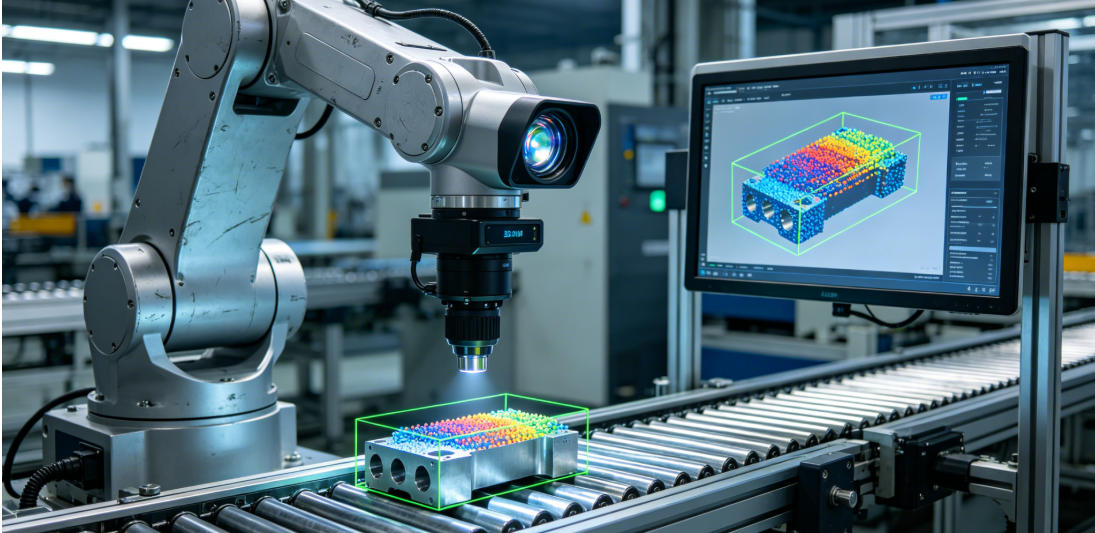
How Does Vision-Guided Robotics Work in Modern Industrial Automation Systems?
Introduction: What Is Vision-Guided Robotics?
In modern industrial automation, smart manufacturing, and warehouse logistics, vision-guided robotics (VGR) has become a core enabling technology. It allows robots to 'see,' interpret their environment, and make intelligent decisions in real time.
Unlike traditional industrial robots that rely on fixed programming and rigid positioning, vision-guided robots use AI vision systems, cameras, depth sensors, and machine learning algorithms to adapt dynamically to changing environments.
This makes VGR systems essential for applications such as:
- Smart factories and Industry 4.0 production lines
- Autonomous warehouse picking systems
- Robot guidance for assembly and inspection
- Logistics sorting and pallet handling
- Collaborative robotics (cobots)
This article explains vision-guided robotics systems, core technologies, and real-world applications in detail.
What Is Vision-Guided Robotics (VGR)?
Vision-guided robotics (VGR) refers to robotic systems that use visual input—typically from RGB cameras, RGB-D cameras, or LiDAR sensors—to guide motion, positioning, and task execution.
These systems combine:
- Computer vision algorithms
- Machine learning / AI models
- Depth sensing technologies (ToF, stereo vision, LiDAR)
- Real-time control systems
- Robot motion planning software
This enables robots to perform complex tasks such as:
- Object detection and recognition
- 3D positioning and localization
- Path planning and obstacle avoidance
- Quality inspection and measurement
- Pick-and-place operations

Core Components of Vision-Guided Robot Systems
1. Vision Sensors
Vision sensors are the 'eyes' of the robot. Common types include:
- RGB cameras for color and texture recognition
- RGB-D cameras for depth + color fusion
- LiDAR sensors for precise 3D mapping
- ToF cameras for real-time depth measurement
These sensors enable 3D perception in robotics systems and improve accuracy in dynamic environments.
2. AI and Computer Vision Algorithms
AI plays a critical role in interpreting visual data. Key functions include:
- Object recognition and classification
- Pose estimation (6D object positioning)
- Scene understanding and segmentation
- Feature extraction and tracking
Popular models support modern industrial AI vision systems used in robotics automation.
3. Robot Control System
The robot control system converts visual input into motion commands. It includes:
- Motion planning algorithms
- Kinematic control
- Real-time feedback loops
- Collision avoidance systems
This ensures precise execution in robotic automation systems for manufacturing.
4. Communication and Edge Computing
Modern VGR systems rely on:
- Edge AI processors for low latency
- Industrial communication protocols
- Cloud-based monitoring platforms
- Real-time data synchronization
This supports scalable smart factory robotics infrastructure.
How Vision-Guided Robotics Works
A typical workflow includes:
- Image capture using cameras or depth sensors
- Data processing via AI vision algorithms
- Object detection and localization in 2D/3D space
- Path planning and decision-making
- Robot execution of movement or task
- Feedback loop for continuous optimization
This allows robots to operate in unstructured and dynamic environments, unlike traditional automation systems.
Types of Vision-Guided Robotics Systems
1. 2D Vision-Guided Robotics
- Uses RGB cameras
- Suitable for surface inspection and barcode reading
- Common in packaging and sorting lines
2. 3D Vision-Guided Robotics
- Uses depth cameras or LiDAR
- Provides spatial awareness and object positioning
- Ideal for pick-and-place and bin picking
3. AI-Powered Autonomous Robotics
- Combines deep learning + sensor fusion
- Enables full autonomy in logistics and manufacturing
- Used in AMRs and intelligent warehouse robots

Key Applications of Vision-Guided Robotics
1. Smart Manufacturing
Vision-guided robots are widely used in:
- Assembly line automation
- Precision welding and soldering
- Surface inspection and defect detection
- Component alignment
This improves manufacturing efficiency and quality control automation.
2. Warehouse Automation and Logistics
In logistics, VGR systems enable:
- Automated picking and sorting
- Pallet recognition and handling
- Inventory scanning
- AMR navigation support
3. Quality Inspection Systems
Vision robots are used for:
- Defect detection in products
- Dimensional measurement
- Surface texture analysis
- Packaging verification
This is a key part of industrial machine vision inspection systems.
4. Autonomous Mobile Robots (AMRs)
AMRs rely heavily on vision guidance for:
- SLAM navigation
- Obstacle detection
- Path optimization
- Human-robot collaboration
5. Agriculture and Outdoor Robotics
Applications include:
- Crop monitoring
- Fruit picking robots
- Autonomous spraying systems
- Field mapping using vision + LiDAR
Benefits of Vision-Guided Robotics
- Higher automation flexibility
- Reduced reliance on fixed infrastructure
- Improved precision and repeatability
- Real-time adaptability to changing environments
- Lower labor costs and increased productivity
These advantages make VGR technology a key driver of Industry 4.0 transformation.
Challenges in Vision-Guided Robotics
Despite rapid development, challenges remain:
1. Lighting Sensitivity
RGB-based systems may struggle in low-light or reflective environments.
2. High Computational Requirements
AI vision processing requires strong GPU or edge computing hardware.
3. Complex Calibration
Multi-sensor fusion systems require precise calibration.
4. Dynamic Environment Complexity
Fast-changing industrial scenes can reduce recognition stability.
Future Trends in Vision-Guided Robotics
The future of VGR systems is driven by:
- AI-driven 3D perception systems
- Multi-sensor fusion
- Edge AI robotics computing
- Real-time semantic mapping
- Human-aware collaborative robotics
- Digital twin integration for robotics simulation
These technologies will accelerate the adoption of fully autonomous intelligent robotics systems.
DJI Livox Mid-70 LiDAR 5CM Minimal Detection Range Original In Stock for Self-driving Robots

Conclusion
Vision-guided robotics (VGR) is transforming modern automation by enabling robots to perceive, understand, and interact with their environment intelligently.
By combining AI vision systems, depth sensing technologies, and advanced robotics control, VGR systems are powering the next generation of:
- Smart factories
- Autonomous warehouses
- Industrial inspection systems
- Intelligent logistics platforms
As industries move toward full automation, vision-guided robotics will remain a core technology in AI-driven industrial transformation and smart manufacturing ecosystems.


Please upload banner from store admin blog pages
Please select collection from store admin blog pages